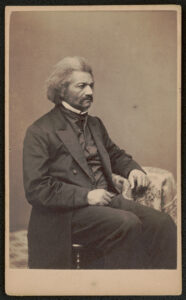
Frederick Douglass, the formerly enslaved man celebrated as one of America’s most powerful abolitionist voices, delivered a historic commencement address at Western Reserve College on July 12, 1854. Invited by the graduating students of the Philozetian and Phi Delta literary societies, Douglass passionately delivered his two-hour speech, “The Claims of the Negro: Ethnologically Considered,” to a gathering of 3,000. Douglass challenged the rising tide of scientific racism and promoted the shared humanity and equality of all people. At a time when few Black Americans were granted such a platform, the moment embodied the spirit of abolition that defined the Western Reserve region. In an era of deep national division, the students’ bold invitation and Douglass’s powerful message affirmed education’s enduring role in advancing truth and justice.
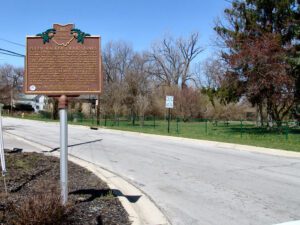
In 1972, Urbancrest’s Ellen Walker Craig-Jones became the first African-American woman to be elected mayor, by popular vote, of a United States municipality. During her term as mayor (1972-1975), Craig-Jones oversaw the modernization of Urbancrest’s various programs and the village rebuilt three main streets, installed streetlights and street signs, and received approval to start a $3 million housing project. Craig-Jones had many years of experience in service to her community, serving twelve years on the Urbancrest Village Council. She was the recipient of dozens of awards and honors, including Who’s Who Among Black Americans.
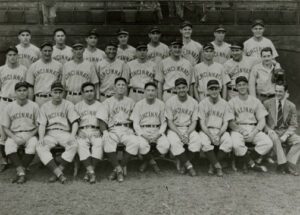
The 1869 Cincinnati Red Stockings made history not only as the most dominant baseball club of its time, but also as the first band of professional ballplayers. Cincinnati’s decision to pay players proved to be a success, and other cities soon began establishing their own professional clubs throughout America. In 1876, the Reds joined the newly formed National League. Baseball soon became one of Cincinnati’s most popular entertainment venues, aided in part by the team’s World Series titles in 1919 and 1940. Cincinnati’s “Big Red Machine,” featuring players such as Johnny Bench, Joe Morgan, and Pete Rose, dominated baseball in the 1970s, picking up additional titles in 1975 and 1976. A surprise wire-to-wire title again in 1990 strengthened the Reds’ legacy and helped ensure future generations of Reds fans.
801 E. Pete Rose Way, Bicentennial Commons at Sawyer Point
Cincinnati
, OH
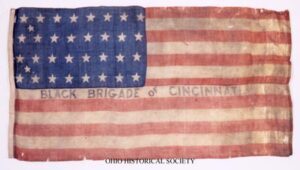
Following the success of Confederate forces in eastern Kentucky and General John Hunt Morgan’s raids there in 1862, Cincinnatians believed that Southern invasion was imminent. Anxious officials ordered Cincinnati citizens to form home guards, but black men willing to volunteer were rebuffed when they attempted to join a defense force. Instead, police serving as provost guards rounded up many and marched them by bayonet to build fortifications in Kentucky. Reacting to the shameful treatment of the blacks eager to support the Union, the commander of the Department of Ohio dispatched Major General Lewis Wallace to command the civilians and to liberate black men forced into service. (continued on other side)
Garrett Augustus Morgan was an African American businessman and prolific inventor of devices that made people’s lives safer and more convenient. Born on March 4, 1877 in Claysville, the Black segregated section of Paris, Kentucky, Morgan migrated north first to Cincinnati and then Cleveland in 1895. He lived and worked in this house at 5204 Harlem Avenue. In 1906, Morgan started the G.A. Morgan Hair Refining Company to market the hair straightener he had invented. The following year he opened a sewing machine repair shop. In 1908, he and his wife Mary opened Morgan’s Cut Rate Ladies Clothing Store. (continued on other side)
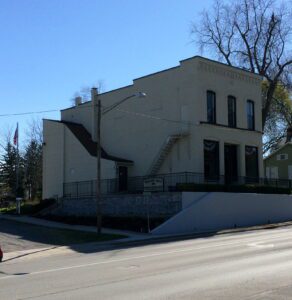
Henry Hanford Wakeman (1840-1879) of New York came to Waterville and became a successful businessman. He conceived the idea of a local Masonic Lodge, which became Wakeman Lodge No. 522 Free and Accepted Masons in 1879, and bequeathed $1,000 toward the construction of a meeting place. In 1880, a cornerstone was laid and this building was dedicated on October 21, 1881. For over 100 years, the Masons held their meetings upstairs while the lower floor was often rented out to a succession of businesses or used for public gatherings. Rising maintenance expenses and lower membership numbers caused the Masons to put Wakeman Hall up for sale in 1995. The Waterville Historical Society purchased the building in 1997 and spent several years rehabilitating it to serve as a local history archive and the Historical Society’s meeting place.
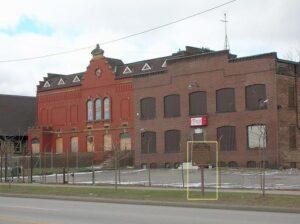
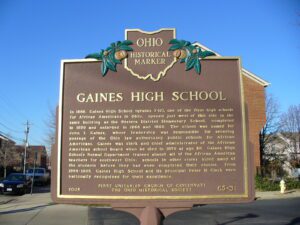
In 1866, Gaines High School (grades 7-12), one of the first high schools for African Americans in Ohio, opened just west of this site in the same building as the Western District Elementary School, completed in 1859 and enlarged in 1866 and 1868. The school was named for John I. Gaines, whose leadership was responsible for securing passage of the Ohio law authorizing public schools for African Americans. Gaines was clerk and chief administrator of the African American school board when he died in 1859 at age 38. Gaines High School’s Normal Department trained almost all of the African American teachers for southwest Ohio; schools in other states hired many of the students before they had even completed their studies. From 1866-1886, Gaines High School and its principal Peter H. Clark were nationally recognized for their excellence.
Saint Lucas Evangelical Lutheran Church, 745 Walbridge Ave
Toledo
, OH
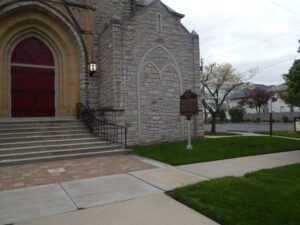
In 1886, thirty-six members from Toledo’s downtown Lutheran church, St. Paul’s, met to form a German-speaking Lutheran congregation for immigrants from Pommern, Mecklenburg and Hanover. Initially worshipping at St. Stephen’s at the corner of Harrison and Oliver Street, the congregation built a frame church on this site in 1887. That same year St. Lucas pioneered an early form of health insurance, The Mutual Sick Benefit Society, that later became a larger fraternal organization called The Mutual Sick Benefit Society for Ohio and Other States. In 1999, after joining a program called Reconciling in Christ, St. Lucas became the first Lutheran congregation in northern Ohio to publicaly welcome the LGBT communities. Named after Saint Luke, the patron saint of physicians, the church’s history is one of healing.