In 1918, Charles Young made a desperate attempt to convince the U.S. Army that he was fit for duty. The Army’s highest-ranking Black officer, he had been medically retired and not given a command during World War I. To demonstrate his fitness, he rode 497 miles from his home in Wilberforce, Ohio, to Washington, D.C. Leaving on June 6 he made the journey in 17 days, 16 on horseback and 1 resting. Averaging 31 miles each day, he rode 45 minutes and walked 15 minutes every hour. Upon his arrival, Young met with Secretary of War Newton Baker. Pressured by the Black press and the White House, Baker hedged. He recalled Young to active duty a year later and assigned him to Camp Grant, Illinois, just five days before the end of the war.
Major Daniel McCook of Carrollton and his 9 sons and their cousins, the 5 sons of Dr. John McCook of Steubenville, won popular acclaim for their outstanding service in the United States Army and Navy. “Tribe of Dan” Maj. Daniel: mortally wounded at Buffington Island. Maj. Latimer: a surgeon. Brig. Gen. George: early regimental commander. Midshipman John: died at sea. Brig Gen. Robert: murdered by guerrillas. Maj. Gen. Alexander: commander of the 20th Corps. Brig. Gen. Daniel Jr. mortally wounded at Kenesaw Mt. Maj. Gen. Edwin: served under Grant and Sherman. Pvt. Charles: killed at Bull Run. Col. John: seriously wounded in Virginia.
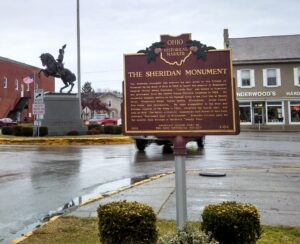
The Sheridan monument was erected by and given to the Village of Somerset by the State of Ohio in 1905 to honor the memory of Somerset’s General Phillip Henry Sheridan. “Little Phil” was raised in Somerset and graduated from the United States Military Academy in 1852. He rendered valuable service to the Federal Army in the Civil War at Stone’s River, Missionary Ridge, Yellow Tavern, Winchester, Cedar Creek, Five Forks, and Appomattox. He later commanded in the West and became General of the Army in 1883, received his fourth star, and died in 1888. The heroic sculpture, created by Carl Heber of New York, portrays “Sheridan’s Ride” to Winchester. Somerset citizens paid for the granite base through a children’s “penny fund.”
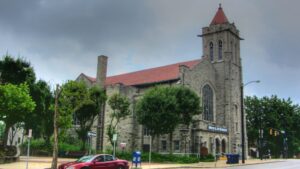
Oldest Religious Congregation in north-central Ohio. First Methodist Sermon preached at the “spring” in 1809 by Rev. James Copus. Services then conducted in blockhouse, 1811; in first court house, 1813; at church home of Dr. William B. James, 1814; first church building located N.W. corner Park Avenue East and Adams, 1820; present site in 1870. All land donated by General James Hedges, a distinguished member.
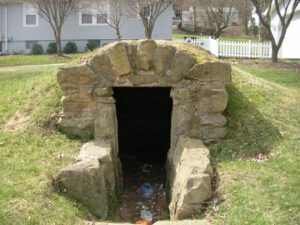
Prisoners convicted of rioting, larceny and adultery in Morgan County between 1833 and 1839 were confined to a dungeon near the Court House in McConnelsville. This stone vault, 11 feet high, 5 feet wide and 12 feet long, was discovered in 1964 and is believed to have been used as the county dungeon. The Morgan County Pomona Grange #81 in co-operation with the County Commissioners and the County Agricultural Society reconstructed the structure on this site in 1965 as a community service project.
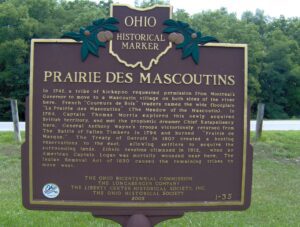
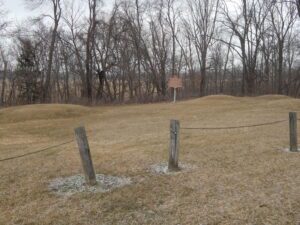
In 1742, a tribe of Kickapoo requested permission from Montreal’s Governor to move to a Mascoutin village on both sides of the river here. French “Coureurs de Bois” traders named the wide floodplain “La Prairie des Mascoutins” (The Meadow of the Mascoutin). In 1764, Captain Thomas Morris explored this newly acquired British territory, and met the prophetic dreamer Chief Katapelleecy here. General Anthony Wayne’s troops victoriously returned from The Battle of Fallen Timbers in 1794 and burned “Prairie de Masque.” The Treaty of Detroit in 1807 created a hunting reservation to the east, allowing settlers to acquire the surrounding lands. Ethnic tensions climaxed in 1812, when an American Captain Logan was mortally wounded near here. The Indian Removal Act of 1830 caused the remaining tribes to move west.
The Nettle Lake Mound Group consists of 4 low mounds overlooking a stream that runs into Nettle Lake. The mounds vary in height from 1 to 3 feet and in diameter from 18 to 30 feet. The mounds are composed primarily of reddish-brown sand (secondary mound) covering a layer of darker sand and loam (primary mound). These mounds have been partially excavated in the past by pot hunters in search of relics. Although the records of these excavations are vague and incomplete, pottery fragments, burials, and flint artifacts found in the mounds indicate that they were constructed by the Hopewell Indians.
Here, on April 10, 1779 during the Revolutionary War, David Zeisberger founded one of the five Delaware Christian missions to occupy the Tuscarawas Valley between May 3, 1772 and September 8, 1781. Living at the Lichtenau mission near the Delaware capital of Goschachgunk (presently Coshocton, Ohio), Zeisberger feared that the Delaware nation was about to break their neutrality and join the British led Indians. Accordingly, he decided to disperse his Christian congregation and move his converts thirty-five miles up river to a place of safety in this large alluvial plain adjacent to the Tuscarawas River.