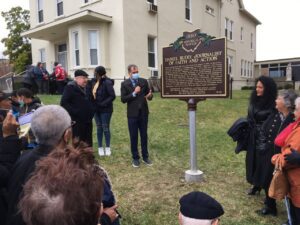
Daniel Arthur Rudd was born into slavery on August 7, 1854, in Bardstown, Kentucky. He became a newspaperman, lecturer, publicist, and tireless advocate for the Roman Catholic Church. After the Civil War Rudd moved to Springfield. Baptized and raised in Catholicism, he joined St. Raphael Parish, where the philosophy of racial equality offered by the church solidified his vision of justice. By 1885 he had established his own weekly newspaper, The Ohio State Tribune. He rebranded it The American Catholic Tribune (ACT) after moving to Cincinnati. Rudd claimed ACT was the only Catholic newspaper owned by an African American. At the height of its popularity in 1892, the publication had a circulation of 10,000. In 1893 Rudd was asked to chair the Afro-American Press Association, representing more than 200 black-owned newspapers.
3201-3537 Burlington-Macedonia Road, Lawrence County Road 120
South Point
, OH
Macedonia Cemetery (circa 1840) belongs to Macedonia Church, Ohio’s first Black Church. Those buried include settlers of the Macedonia Free Black Settlement, built by free people who assisted freedom seekers along the Underground Railroad. Also interred are soldiers of the Civil War’s United States Colored Troops (USCT), most of whom served in the 5th Regiment, Ohio’s first Black Regiment (1863). The Polley family also rest here. Emancipated slaves, the family continued their freedom struggle when their children were kidnapped from Ohio and unlawfully sold into slavery. Macedonia’s extant burial grounds include this sacred site and another 1/2 mile north.
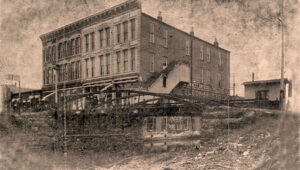
Emmitt-Greenbaum Building, 200 North Market Street, was built around 1878 by businessman and politician James Emmitt (1806-1893) to replace his 1837 wooden warehouse. The brick three-story Italianate building featured five vertical cast iron belts of simulated stone, a projecting cornice, reeded pilasters, and a “fortress-like fourteen bay front.” A covered wooden stairway on the building’s south side originally projected over the canal. Charles Louis Greenbaum (1871-1935) purchased the building in 1912 and opened his department store advertising it as “The Store with The Goods!” Over 140 years, the Emmitt-Greenbaum building was occupied by Jas. Emmitt Dry Goods, Hoffman’s, Greenbaum’s, Armbruster and Armbruster, Waverly Drugs, and the Bee Hive Tavern. A structural collapse after decades of deterioration condemned the building and the southwestern half was razed in 2021.
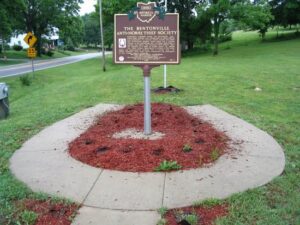
Originally a vigilante group, the Bentonville Anti-Horse Thief Society was formed here in March 1853 by area landowners to recover stolen horses and mules and to prosecute thieves. Horse theft was a serious offense in the antebellum era. Trustees nominated a captain and riders, who received a $10 reward upon the capture of a thief or stolen horse. As horses lost their former importance in society in the early 1900s, the organization evolved into a social club. Its annual banquet, held each April, celebrates the continuity of this Adams County tradition.
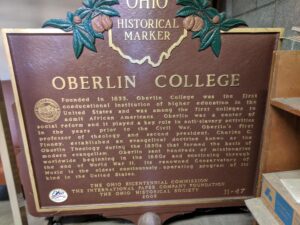
Founded in 1833, Oberlin College was the first coeducational institution of higher education in the United States and was among the first colleges to admit African Americans. Oberlin was a center of social reform and it played a key role in anti-slavery activities in the years prior to the Civil War. Oberlin’s first professor of theology and second president, Charles G. Finney, established an evangelical doctrine known as the Oberlin Theology during the 1850s that formed the basis of modern evangelism. Oberlin sent hundreds of missionaries worldwide beginning in the 1880s and continuing through the end of World War II. Its renowned Conservatory of Music is the oldest continuously operating program of its kind in the United States.
Constructed of sandstone quarried from nearby Putnam Hill, the Stone Academy dates to 1809. The Springfield School House Company erected the building, it is believed, to lure the statehouse from Chillicothe. However, when Zanesville was chosen as the capital the following year, the building was used for public functions and for its “intended” purpose as a school. The Ohio Anti-slavery Society held its state conventions here in 1835 and 1839, with prominent abolitionist leader Theodore Weld, among others, in attendance. The Stone Academy became a private residence after 1839. In the 1870s, it was the childhood home of Elizabeth Robins, the famed late-nineteenth and early-twentieth century actress, playwright, author, and activist. The Stone Academy was donated to the Pioneer and Historical Society of Muskingum County in 1981.
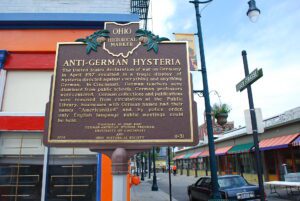
The United States’ declaration of war on Germany in April 1917 resulted in a tragic display of hysteria directed against everything and anything German. In Cincinnati, German teachers were dismissed from public schools, German professors were censored, German collections and publications were removed from circulation at the Public Library, businesses with German names had their names “Americanized” and, by police order, only English language public meetings could be held. (Continued on other side)
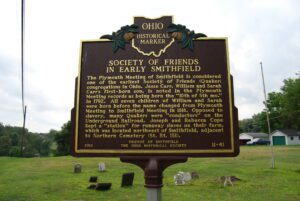
The Plymouth Meeting of Smithfield is considered one of the earliest Society of Friends (Quaker) congregations in Ohio. Jesse Carr, William and Sarah Carr’s first born son, is noted in the Plymouth Meeting records as being born the “10th of 5th mo.” in 1792. All seven children of William and Sarah were born before the name changed from Plymouth Meeting to Smithfield Meeting in 1818. Opposed to slavery, many Quakers were “conductors” on the Underground Railroad. Joseph and Rebecca Cope kept a “station” for runaway slaves on their farm, which was located northwest of Smithfield, adjacent to Northern Cemetery (St. Rt. 151).