

, OH
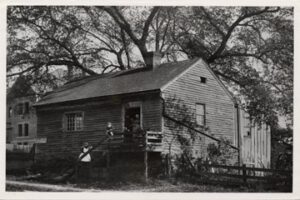
Following the establishment of the public land system in 1785, the Continental Congress appointed a committee, chaired by James Monroe, to establish government in the new territory north and west of the Ohio River. Drafted prior to the Constitution of the United States, the Ordinance of 1787 provided the mechanism by which prospective states would enter the Union on an equal basis with existing states. It also prohibited slavery in the new territory and pledged good faith in dealing with Native American tribes. According to this plan, the Northwest Territory became the states of Ohio, Indiana, Illinois, Michigan, Wisconsin, and part of Minnesota in due course.
, OH
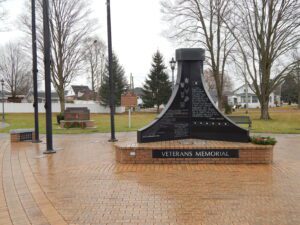
Local views on the Vietnam War mirrored national attitudes of pride and confusion. Piqua citizens participated in the “Letters for Life” campaign in 1970 for prisoners of war. Piqua Daily Call assistant news editor James W. DeWeese traveled to Paris in a frustrated attempt to deliver the letters to the Hanoi Peace delegation. The state activated the local Ohio National Guard unit in 1970 to help suppress anti-Vietnam student rioting in Columbus. The military conflict came home in 1966 when William Pitsenbarger became the first of eleven men from Piqua to die in Vietnam. In 1967, Piqua High School graduate Air Force Major William J. Baugh was shot down over North Vietnam and taken prisoner. He remained a P.O.W. until 1973.
, OH
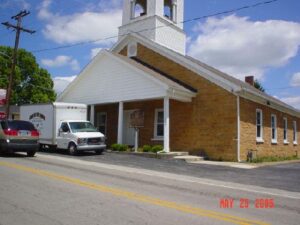
The First Presbyterian Church of West Union, built in 1810, is known as the “Church of the Governors.” Although the date is uncertain, the congregation was organized circa 1800 on Thomas Kirker’s land on Eagle Creek, about three miles from West Union. Kirker, Ohio’s second governor, was influential in organizing the congregation and raising funds for the construction of the building. Stonemason, Thomas Metcalfe, Kentucky governor from 1828-1832, was awarded the contract to build the walls for $250.00; the total construction cost was $500.00. The first three regular ministers – William Williamson, Dyer Burgess, and John P. Van Dyke – all held strong anti-slavery sentiment that was felt throughout the congregation. During the Civil War, soldiers of the 70th Ohio Volunteer Infantry, a regiment of recruits from Adams County and eastern Brown County, were said to have been temporarily quartered in the church before leaving West Union in 1861.
, OH
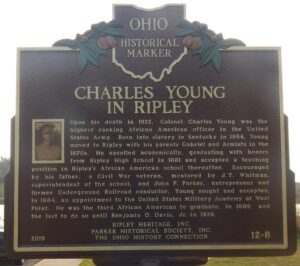
Charles Young in Ripley. Upon his death in 1922, Colonel Charles Young was the highest ranking African American officer in the United States Army. Born into slavery in Kentucky in 1864, Young moved to Ripley with his parents Gabriel and Arminta in the 1870s. He excelled academically, graduating with honors from Ripley High School in 1881 and accepted a teaching position in Ripley’s African American school thereafter. Encouraged by his father, a Civil War veteran, mentored by J. T. Whitman, superintendent of the school, and John P. Parker, entrepreneur and former Underground Railroad conductor, Young sought and accepted, in 1884, an appointment to the United States Military Academy at West Point. He was the third African American to graduate, in 1889, and the last to do so until Benjamin O. Davis, Jr. in 1936.
, OH
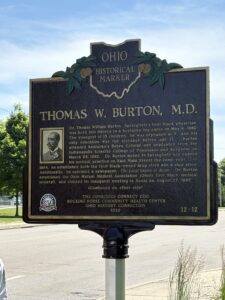
Dr. Thomas William Burton, Springfield’s first Black physician, was born into slavery in a Kentucky log cabin on May 4, 1860. The youngest of 15 children, he was orphaned at 9, and his only education was the alphabet before age 21. Burton attended Kentucky’s Berea College and graduated from the Indianapolis Eclectic College of Physicians and Surgeons on March 24, 1892. Dr. Burton moved to Springfield and opened his medical practice on East Main Street the same year. In 1894, he established both the first Black-owned drug store and a shoe store. Additionally, he operated a newspaper, The Loyal Legion of Honor. Dr. Burton established the Ohio Mutual Medical Association (Ohio’s first Black medical society), and chaired its inaugural meeting in Xenia on August 27, 1897. (Continued on other side)
, OH
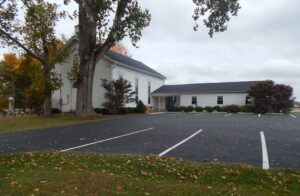
The comingling of faiths in an area settled predominantly by Quakers helps explain the origins of Jonah’s Run Baptist Church. Ministered to by a Baptist preacher, the children and neighbors of Daniel Collett (1752-1835), an Episcopalian and private in the Revolutionary War, and his wife Mary Haines Collett (1753-1826), a Quaker from Virginia, became Baptists and started the church in 1838. Levi Lukens (1767-1860), a Quaker from Pennsylvania by way of Virginia, purchased the land where the church stands in 1812 and sold it in 1839 to a founder of the congregation. Like local Quaker meetinghouses, the church had separate entrances for men and women and a partition between the two that divided the sanctuary. The congregation’s sons and daughters lived their faith. Howard McCune (1852-1923) was the Clinton Baptist Association’s moderator and president of the Ohio Baptist Convention’s state board. Anne Cossum (1894-1977) was a missionary in China from 1920-1927.
, OH
In 1834, ministers gathered at Providence Church in Berlin Crossroads and organized the Providence Anti-Slavery Baptist Association; believed to be both the first African American Baptist Association in Ohio and among the earliest in the country. The Association’s name boldly reflected its stance: opposition to slavery and a commitment to freedom. Several affiliated churches and their members were known Underground Railroad safe houses and conductors. Providence Association grew to include member churches across Ohio—including Athens, Bidwell, Beaver, Blackfork, Burlington, Gallipolis, Glouster, Ironton, Middleport, Nelsonville, Rutland—as well as congregations in West Virginia, Kentucky, and Michigan.
, OH
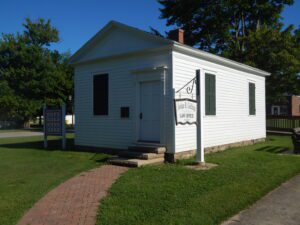
This building served as the law office to Joshua Reed Giddings, a Whig congressman who advocated for the abolition of slavery and an end to the domestic slave trade. Born in 1795, much of Giddings’ young life was occupied by working on his father’s farm. After serving in the War of 1812, he began to study law, gaining admittance to the bar in 1821. A successful lawyer, Giddings was elected to the Ohio House of Representatives in 1826. In 1837, he was elected as a Whig to the U.S. House of Representatives, where he quickly established himself as a staunch opponent of slavery. In 1854, he joined the Republican Party, contributing greatly to the platform during the party’s conventions of 1856 and 1860. As reward for his dedication, President Abraham Lincoln appointed him as consul- general to Canada, where he served until his death in 1864.