

, OH
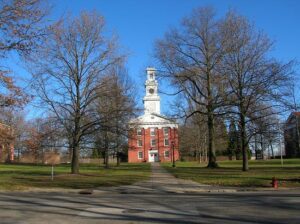
With the help of town founder, David Hudson, Western Reserve College and its Academy were founded in 1826. Often called “The Yale of the West,” the college saw success initially as all of its professors and college presidents were Yale College graduates. Nationally, Western Reserve College became involved with the Underground Railroad and anti-slavery movement 28 years before the Civil War began. Moreover, Western Reserve College established the Loomis observatory, named for Elias Loomis, a Yale tutor and WRC professor, which is now the second oldest observatory in the United States. The Western Reserve College moved to Cleveland in 1882 and eventually became Case Western Reserve University while the Academy remained in Hudson. Today, the Western Reserve Academy is one of the nation’s oldest and most respected independent college preparatory schools.
, OH
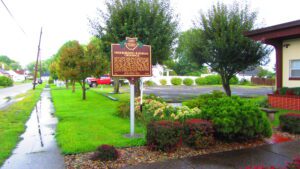
Underground Railroad crossings, agents, and conductors were common along the Ohio River between Washington County, Ohio and Wood County, Virginia. At Constitution, six miles upriver from Belpre, Judge Ephraim Cutler listened for hoot owl calls that signaled when a boatload of runaway slaves was crossing from Virginia to the Ohio shore. “Aunt Jenny,” a slave woman in Virginia, used a horn signal to alert abolitionist John Stone in Belpre when fugitive slaves were crossing. At Little Hocking, eight miles downriver from Belpre, slaves crossing from Virginia looked for a lantern signal to guide them to the Horace Curtis Station on the Ohio River shore. Runaway slaves were also assisted by Thomas Vickers at Twin Bridges, James Lawton at Barlow, and others as they traveled northward by various routes through Morgan County to Putnam in Muskingum County where the Underground Railroad merged with the Muskingum River Corridor.
, OH
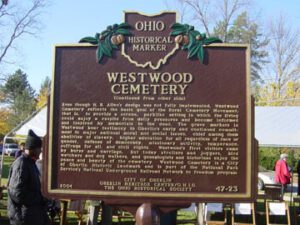
Shortly after Oberlin Colony was established in 1833, a two-acre burying ground was set aside south of Plum Creek in the area bounded by Main, Morgan, and Professor streets. By 1861, however, with the town and Oberlin College growing and the Civil War escalating, the need for a larger cemetery became clear. After an extensive search, 27.5 acres of land belonging to Henry Safford were acquired one mile west of the center of Oberlin. H.B. Allen was hired to create a design in the style of the Rural Cemetery Movement, and in July 1864 Westwood Cemetery was formally dedicated. Burials in Westwood had actually begun in August 1863, and over the next few years hundreds of remains were reinterred from Oberlin’s “Old Cemetery” and from burying grounds in surrounding communities. In the mid-1860s the cemetery was enlarged to its present 47 acres, and in 2004 burials and memorials were estimated to number almost ten thousand. (Continued on other side)
, OH
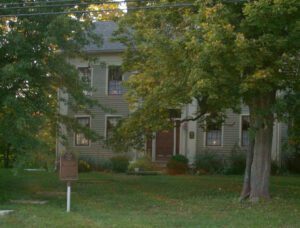
Built in 1819, this classic Greek Revival style colonial is attributed to the works of master builder and architect Jonathon Goldsmith. Goldsmith is known for his simple, yet elegant craftsmanship and architectural designs, especially the unique front doorways that are signatures of his creations. The house reveals original detailed woodwork and a functional floor plan. It was constructed for Uri Seeley, one of the earliest settlers of Lake County. Seeley and his family were dedicated to the anti-slavery movement and used this residence as a stop for travelers on the Underground Railroad. The property was listed on the National Register of Historic Places in 1973.
, OH
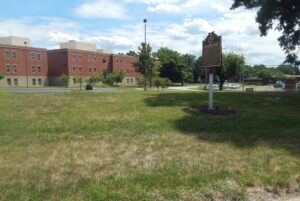
After the outbreak of the Civil War in the spring of 1861, the U.S. War Department commissioned Ohio Senator B.F. Wade of Jefferson and local Congressman John Hutchins of Warren to supervise the Union Army’s recruiting service in Northeastern Ohio. Recruitment rolls were to be filled in summer so training could be conducted during the fall. The Oak Grove Fairgrounds in Warren, home of the Trumbull County Agricultural Society, was one of the sites selected for the training. This camp was named Camp Hutchins in Congressman Hutchins’ honor. John Hutchins, an attorney by profession, had served as Trumbull County Clerk of Courts and had been assocaited with future Ohio governors David Tod (1862-1864) and Jacob Cox (1866-1868), in their law firms. An ardent anti-slavery man and Underground Railroad agent, Hutchins served in the U.S. Congress from 1859 to 1863.
, OH
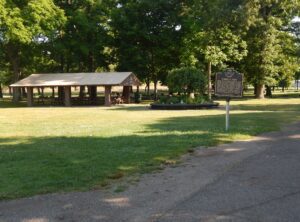
Nimisilla Park was established in 1894. Prior to its founding, the site was the location of the county fair from 1859 to 1893. Throughout its history, Nimisilla Park hosted horse races, live music, soldier reunions, and a zoo, among other events. Prominent political figures, such as Rutherford B. Hayes, James A. Garfield, William McKinley, and Eugene V. Debs, made speeches at the park. In 1918, Debs delivered a famous anti-war speech for which he was arrested and jailed. As of 2016, the park continues to serve as a gathering place for the community.
, OH
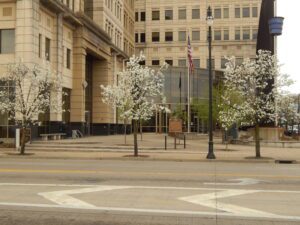
Abraham Lincoln spoke from the rear of a Cincinnati, Hamilton & Dayton Railroad passenger train on Saturday, September 17, 1859, to about 1000 people at South Fourth and Ludlow streets (about 785 feet south of here). Lincoln, elected president of the United States a year later, made five Ohio speeches, considered an extension of his 1858 debates with Stephen A. Douglas while they competed for a U.S. Senate seat from Illinois. After Douglas defeated Lincoln, he toured Ohio supporting 1859 Democratic candidates. The Republican response was to ask Lincoln to do the same for his party. He spoke twice in Columbus on September 16, and in Dayton, Hamilton, and Cincinnati the next day. Later, Republicans swept the 1859 elections, selecting William Dennison Jr., an 1835 Miami University graduate, as governor and winning majorities in the legislature. When Lincoln became president, he appointed Dennison postmaster general in 1864. [Continued on other side]
, OH
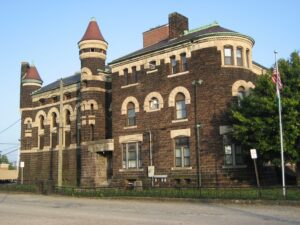
Designed by J. W. Yost, a renowned Ohio architect, the jail first opened for use in 1889. The Richardsonian Romanesque structure cost $120,000 to build. It was constructed of pink sandstone known as “brownstone,” which was quarried near Millersburg, Ohio. The front three levels were built to house the families of the sheriff and the jail matron. Sheriff Andrew Crilly was the first to occupy the sheriff’s quarters when the jail opened. The rear portion of the building was used for the incarceration of male and female prisoners on separate floors. The 32 cells, each a minimum of 8′ x 8′ in size, had an official total capacity of 68 prisoners. However, well over that number were housed here at times. The jail building was last used for incarcerations in 1987. (Continued on/from other side)