

, OH
In 1962, Asian Indian students of Case Western Reserve University started India Association of Cleveland (IAC). In 1967, IAC started a newspaper “LOTUS,” regarded as the first such Asian Indian community newspapers in the United States. In 1978, IAC started a community center to be owned and managed by a new organization: India Community Center (ICC), the first such facility established by Asian Indians in Ohio. In 1980, IAC and ICC merged and formed the Federation of India Community Associations (FICA). Other associations representing the various states and interests in India became Federation members.
, OH
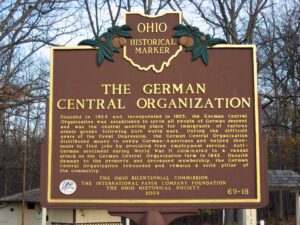
Founded in 1924 and incorporated in 1925, the German Central Organization was established to serve all people of German descent and was the central meeting place for immigrants of various ethnic groups following both world wars. During the difficult years of the Great Depression, the German Central Organization distributed money to needy German-Americans and helped thousands to find jobs by providing free employment service. Anti-German sentiment during World War II culminated in a vandal attack on the German Central Organization farm in 1942. Despite damage to the property and decreased membership, the German Central Organization rebounded and remains a solid pillar of the community.
, OH
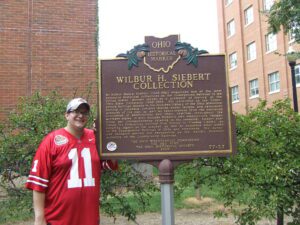
Dr. Wilbur Henry Siebert (1866-1961) organized one of the most extensive historical collections on the Underground Railroad in the United States. Siebert served as a professor of history at the Ohio State University, 1893-1935. His collection on the Underground Railroad, housed in the Archives/Library of the Ohio Historical Society in Columbus, contains diaries, books, letters, and newspaper accounts of the day, as well as reminiscences from the dwindling population of abolitionists and their families throughout the northern states. It also includes Siebert’s own manuscripts, images, notes, and correspondence relating to his research. Siebert published The Underground Railroad from Slavery to Freedom (1898), an enduring classic on the subject, as well as numerous other books on the Underground Railroad in Ohio and elsewhere. His extensive research earned him recognition as the world’s foremost authority on the Underground Railroad.
, OH
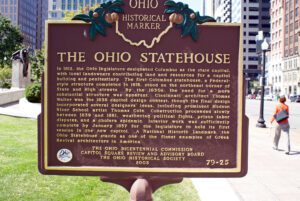
In 1812, the Ohio legislature designated Columbus as the state capital, with local landowners contributing land and resources for a capitol building and penitentiary. The first Columbus statehouse, a Federal-style structure completed in 1816, stood on the northeast corner of State and High streets. By the 1830s, the need for a more substantial structure was apparent. Cincinnati architect Thomas Walter won the 1838 capitol design contest, though the final design incorporated several designers’ ideas, including prominent Hudson River School artist Thomas Cole. Construction proceeded slowly between 1839 and 1861, weathering political fights, prison labor disputes, and a cholera epidemic. Interior work was sufficiently complete by January 1857 for the legislature to hold its first session in the new capitol. A National Historic Landmark, the Ohio Statehouse stands as one of the finest examples of Greek Revival architecture in America.
, OH
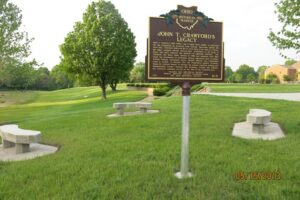
John T. Crawford (1813-1880), was a white Union soldier. In gratitude for the kindnesses he received from African-Americans during the Civil War, Crawford willed his 18 1/2-acre farm to be used as a “home, for aged, indigent worthy colored men, preference to be given to those who have suffered the miseries of American Slavery.” The Crawford Old Men’s Home opened in 1888 and operated until 1964 under the trusteeship of prominent African-Americans such as lawyer William Parham, newspaper editor Wendell Dabney, and Ambassador Jesse D. Locker. It merged with the Progressive Benefit Society’s Home for Colored Women to become the Lincoln Crawford Nursing and Rehabilitation Center. Pleasant Hill Academy, College Hill Library, and Crawford Commons are all on the site of the Crawford farm.
, OH
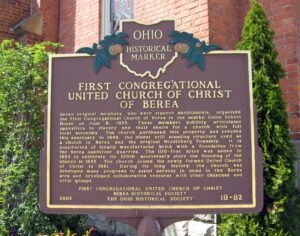
Seven original members, who were staunch abolitionists, organized the First Congregational Church of Berea in the nearby Union School House on June 9, 1855. These members publicly articulated opposition to slavery and their desire for a church with full local autonomy. The church purchased this property and erected this sanctuary in 1869, the oldest still standing structure used as a church in Berea and the original Middleburg Township. It is constructed of locally manufactured brick with a foundation from the Berea sandstone quarries. The 100-foot spire was added in 1954 to celebrate its 100th anniversary since the founding of the church in 1855. The church joined the newly formed United Church of Christ in 1961. During its long history, the church has developed many programs to assist persons in need in the Berea area and developed collaborative ventures with other churches and civic groups.
, OH
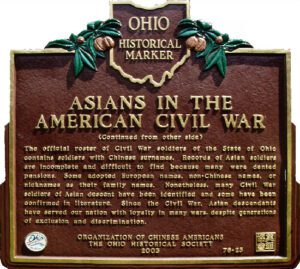
Despite exclusionary laws preventing U.S. citizenship, Asians served in the Union and Confederate armies and navies during the American Civil War (1861-1865). Many of these soldiers were denied citizenship following their services due to the anti-Asian sentiment, which culminated in the Naturalization Act of 1870 and the Chinese Exclusion Act of 1882. The exclusionary laws continued until 1943, and all restrictions on national origin or race were abolished in 1965. In April 2003, House Joint Resolution 45 was introduced to Congress to posthumously proclaim Civil War soldiers of Asian descent to be honorary citizens of the United States as recognition of their honorable services. (continued on other side)
, OH
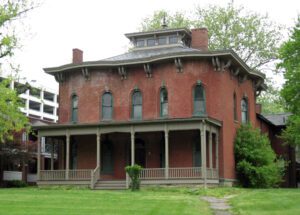
The Cozad-Bates House is one of the oldest remaining structures in Cleveland’s University Circle. The original section, built circa 1853, is the only pre-Civil War residential structure left in the neighborhood. Built by Samuel and Jane Cozad’s son, Andrew Cozad, the first section used locally made brick to form a simple two-story, one-room-deep, vernacular English-I house. The family owned a large portion of the land which is now occupied by University Circle. Justus Cozad, Andrew’s son, returning from the west where he worked as a railroad superintendent and civil engineer, built the later section on Mayfield Road for his larger family in 1872. It is a rare surviving example of Italianate-influenced residential architecture, including a hipped roof, curved bay windows, paired eave brackets, and prominent belvedere. The house was listed on the National Register of Historic Places in 1974 and designated as a Cleveland Landmark in 2006.