

, OH
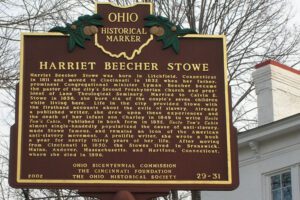
Harriet Beecher Stowe was born in Litchfield Connecticut in 1811 and moved to Cincinnati in 1832 when her father, prominent Congregational minister Lyman Beecher became the pastor of the city’s Second Presbyterian Church and president of Lane Theological Seminary. Married to Calvin E. Stowe in 1836, she bore six of the couple’s seven children while living here. Life in the city provided Stowe with the firsthand accounts about the evils of slavery. Already a published writer, she drew upon these experiences and the death of her infant son Charley in 1849 to write Uncle Tom’s Cabin. Published in book form in 1852, Uncle Tom’s Cabin almost single-handedly popularized the cause of anti-slavery, made Stowe famous, and remains an icon of the American anti-slavery movement. A prolific writer, she wrote a book a year for nearly thirty years of her life. After moving from Cincinnati in 1850, the Stowes lived in Brunswick, Maine, Andover, Massachusetts, and Hartford, Connecticut, where she died in 1896.
, OH
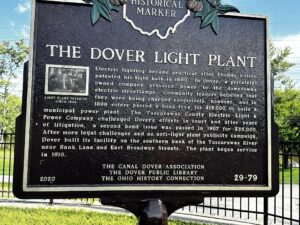
Electric lighting became practical after Thomas Edison patented his light bulb in 1880. In Dover, a privately-owned company provided power to the downtown’s electric streetlamps. Community leaders believed that they were being charged excessively, however, and in 1898 voters passed a bond levy for $15,000 to build a municipal power plant. The Tuscarawas County Electric Light & Power Company challenged Dover’s efforts in court and after years of litigation, a second bond issue was passed in 1907 for $35,000. After more legal challenges and an anti-light plant publicity campaign, Dover built its facility on the southern bank of the Tuscarawas River near Bank Lane and East Broadway Streets. The plant began service in 1910 and, with the Northern Ohio Traction & Light Company, supplied electricity to Dover.
, OH
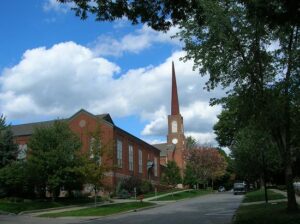
On this site, the first meetinghouse owned by the Hudson Congregational Church was dedicated March 1, 1820, twenty-one years after David Hudson first came to the Hudson area. Its members met here until they completed their sanctuary on Aurora Street in 1865. In August 1835, church members unanimously adopted a resolution declaring that slavery is”a direct violation of the law of Almighty God.” At a November 1837 prayer meeting, church member and anti-slavery leader John Brown made his first public vow to destroy slavery.
, OH
Born in Jefferson, Ohio, Theodore E. Burton graduated from Oberlin College and became a prominent Cleveland attorney. He was elected to Congress in 1888 and served from 1889-91, 1895-1909, and 1921-28. He was elected U.S. Senator in 1908 and 1928 and was a leading contender for the U.S. Presidency in 1916. Due to his work in saving Niagara Falls from development and his opposition to wasteful waterways projects, President Theodore Roosevelt appointed Burton chairman of the Inland Waterways Commission in 1907 and the National Waterways Commission in 1909. Burton is credited with pushing legislation through Congress that authorized the construction of the Panama Canal and negotiating agreements to ensure its neutrality. He lobbied to fight wasteful spending and influence of big business and sponsored the Sherman Anti-Trust Act of 1890. As president of the American Peace Society, Burton hosted the First World Conference on International Justice in Cleveland in 1928, attended by 13,000, including world leaders.
, OH
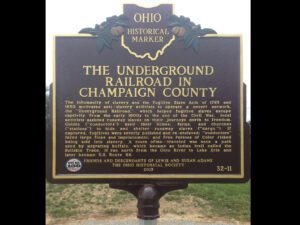
The inhumanity of slavery and the Fugitive Slave Acts of 1793 and 1850 motivated anti-slavery activists to operate a covert network, the “Underground Railroad,” which helped fugitive slaves escape captivity. From the early 1800s to the end of the Civil War, local activists assisted runaway slaves on their journeys north to freedom. Guides (“conductors”) used their homes, farms, and churches (“stations”) to hide and shelter runaway slaves (“cargo.”) If captured, fugitives were severely punished and re-enslaved; “conductors” faced large fines and imprisonment, and Free Persons of Color risked being sold into slavery. A route often-traveled was once a path used by migrating buffalo, which became an Indian trail called the Bullskin Trace. It ran north from the Ohio River to Lake Erie and later became U.S. Route 68.
, OH
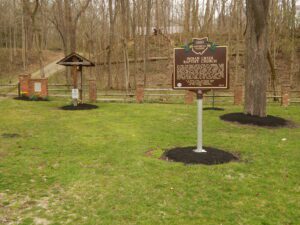
The Indian Creek Regular Baptist Church was established in 1810 as an arm of the Little Cedar Creek Church of Brookville, Indiana. The congregation purchased three acres of land for a burial ground and church and built a log structure here in 1811. Members voted in 1812 that they would receive no person who believed in the principles of slavery. By 1829, membership had reached 150 and the present brick meeting house was built. In the 1840s, membership declined due to conflict over mission activity The congregation dissolved in 1879 and the land was deeded to the Indian Creek Cemetery Association in 1880. The county park system received the property in 1960 through and with the cooperation of the Butler County Historical Society and the Cemetery Association.
, OH
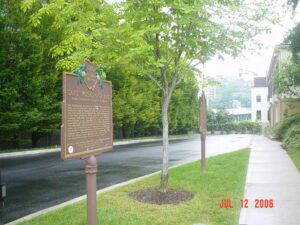
The first African American artist to achieve international acclaim, painter Robert S. Duncanson (1821-1872) was born in New York and settled in Cincinnati in 1840. He pursued his artistic career during a time of tremendous racial prejudice and was acknowledged as the “best landscape painter in the West.” Arts patron Nicholas Longworth commissioned murals from Duncanson around 1850 for his home Belmont, now the Taft Museum of Art; these paintings are regarded as one of the finest pre-Civil War domestic decoration schemes in the United States. Sponsored by anti-slavery groups, he traveled widely during the 1860s in Europe. Duncanson rose above oppression to create expressions of African American cultural identity, leading the way for other people of color to pursue careers in the arts.
, OH
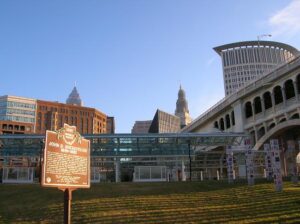
Born at Richford, New York, John D. Rockefeller moved to the Cleveland area with his family at age 14. He began his business career as a bookkeeper in 1855. From modest beginnings he became one of the richest men of his era by developing the world’s largest oil corporation, the Standard Oil Company, which was founded here in the Flats of Cleveland. Rockefeller moved to New York City in 1884 but maintained two homes in Cleveland, returning often with his wife Laura (1839-1915). Although he was a controversial businessman, Rockefeller donated millions of dollars to Cleveland charities and institutions, and land for Rockefeller and Forest Hills parks. John and Laura Rockefeller are interred in Lake View Cemetery.