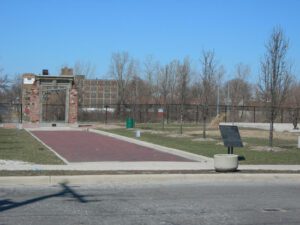
In 1934, workers at the Electric Auto-Lite Company and other automotive-related manufacturers secretly organized the Automobile Workers Federal Union Local 18384, American Federation of Labor (AFL), which became the United Auto Workers (UAW) Local 12. Anti-unionism, broken pledges by management, and abuse of workers had festered locally for generations. Workers bitterly resented the fact that management took advantage of the Depression’s high unemployment to decrease wages. In February, workers struck at Auto-Lite, Bingham Stamping, Logan Gear, and Spicer Manufacturing Company. When management refused to negotiate in good faith, the workers, including a large number of women, struck the Auto-Lite in mid-April. Auto-Lite management secured a court order limiting the number of strikers to twenty-five. The strike appeared to be lost until the Lucas County Unemployed League organized fierce resistance to the court injunction as the crowd around the plant grew to ten thousand. (continued on other side)
In 1951, several pioneer drag racers opened on of the Midwest’s first drag strips known by local racing enthusiasts as the “Fulton Airport Champioins Raceway.” For the next eight years half-brothers Art and Walt Arfons, Otis “Otie” Smith and “Akron Arlen” Vanke raced here. Both Arfons, who were long-time bitter rivals, at one point held the world land speed record. Otie, the first president of the Cam Jammers car club in Akron, won the National Hot Rod Association’s 1959 championship. Vanke won many national champtionships as a Stock, Super Stock and Pro Stock racer.
Born in Richmond, Virginia, Powhatan Beaty moved to Cincinnati in 1849, where he spent the majority of his life. Beaty enlisted as a private in the Union Army in June 1863, and two days later was promoted to first sergeant, Company G, 5th United States Colored Troops (USCT). All the officers of Company G were killed or wounded during an attack on Confederate forces at New Market Heights, Virginia, in September 1864. Beaty took command of his company, and for his valor received the Congressional Medal of Honor. Beaty was one of two African-Americans buried in Ohio to receive the Medal of Honor for service in the Civil War. He died on December 6, 1916, leaving two sons, attorney and state representative A. Lee Beaty and John W. Beaty. He is buried in Union Baptist Cemetery along with nearly 150 USCT veterans.
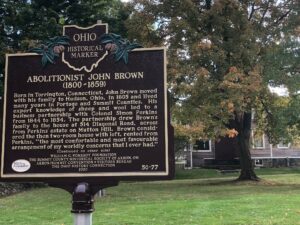
Born in Torrington, Connecticut, John Brown moved with his family to Hudson, Ohio, in 1805 and lived many years in Portage and Summit Counties. His expert knowledge of sheep and wool led to a business partnership with Colonel Simon Perkins from 1844 to 1854. The partnership drew Brown’s family to the house at 514 Diagonal Road, across from Perkins’ estate on Mutton Hill. Brown considered the then two-room house with loft, rented from Perkins, “the most comfortable and most favourable arrangement of my worldly concerns that I ever had.” (Continued on other side)
On December 30, 1847, six educators met at the Summit County Courthouse to organize the first convention of the Ohio State Teachers’ Association, now known as the Ohio Education Association (OEA). The organizers Josiah Hurty (Richland County), Thomas W. Harvey (Geauga County), M.D. Leggett (Summit County), Lorin Andrews (Ashland County), William Bowen (Stark County), and Marcellus F. Cowdery (Lake County) hoped “to elevate the profession of teaching” and “to promote the interests of schools in Ohio.” In 1853, the General Assembly enacted the new association’s entire slate of proposals into law, thus ensuring free, universal, public education in Ohio. For 176 years, the Ohio Education Association has advocated for fair terms and conditions of employment for Ohio educators and for the betterment and improvement of public education for all students.
John Malvin (1795-1880) was an operative on the Underground Railroad and an ardent member of anti-slavery and abolitionist causes. Born in Dumfries, Virginia of a free mother and enslaved father, Malvin was apprenticed at an early age to learn carpentry and taught himself to read and write. In 1827, he moved to Cincinnati where he became an ordained preacher and an activist in the cause of freedom. In 1831, with his wife Harriet, he moved to Cleveland where he became a charter member of the First Baptist Church, a sawmill operator, and captain and owner of the canal boat Auburn. (continued on other side)
801 E. Pete Rose Way, Bicentennial Commons at Sawyer Point
Cincinnati
, OH
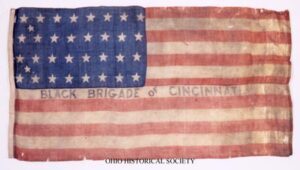
Following the success of Confederate forces in eastern Kentucky and General John Hunt Morgan’s raids there in 1862, Cincinnatians believed that Southern invasion was imminent. Anxious officials ordered Cincinnati citizens to form home guards, but black men willing to volunteer were rebuffed when they attempted to join a defense force. Instead, police serving as provost guards rounded up many and marched them by bayonet to build fortifications in Kentucky. Reacting to the shameful treatment of the blacks eager to support the Union, the commander of the Department of Ohio dispatched Major General Lewis Wallace to command the civilians and to liberate black men forced into service. (continued on other side)
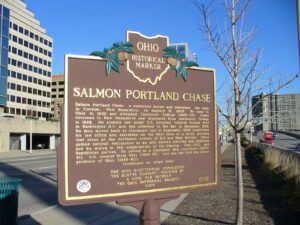
Salmon Portland Chase, a renowned lawyer and statesman, was born in Cornish, New Hampshire, on January 13, 1808. He came to Ohio in 1820 and attended Cincinnati College (1822-23). Chase returned to New Hampshire and graduated from Dartmouth College in 1826. He studied law under U.S. Attorney General William Wirt in Washington D.C. and was admitted to the bar in December 1829. He then moved back to Cincinnati and in September 1830 established his law office and residence on the first floor of a brick building that stood at the northeast corner of 3rd and Main Streets. Chase gained national recognition as an anti-slavery attorney and politician and by aiding in the organization of the Liberty, Free-Soil, and Republican parties. He served as a Cincinnati city councilman (1840-41), U.S. senator from Ohio (1849-55), and was the first Republican governor of Ohio (1856-60). (continued on other side)