

, OH
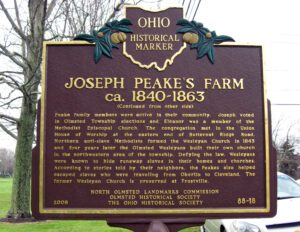
Joseph Peake was born in Pennsylvania in 1792 and came to Ohio in 1809 with his parents and brother. They were the first African Americans to settle permanently in the Cleveland area. He was the son of George Peake, a runaway slave from Maryland, who fought on the British side at the Battle of Quebec in 1759 during the French and Indian War. A man with some means and talent, George Peake invented a stone hand mill for grinding corn, a labor-saving device that endeared the Peakes to their neighbors in western Cuyahoga County. Joseph Peake and his wife Eleanor, an African American from Delaware, bought land in the 1840s on the Mastick Plank Road and built a home near this marker. [Continued on other side]
, OH
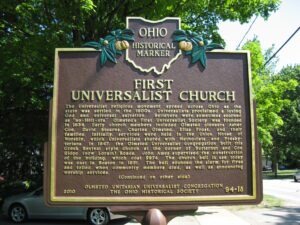
The Universalist religious movement spread across Ohio as the state was settled in the 1800s. Universalists proclaimed a loving God and universal salvation. Believers were sometimes scorned as “no-Hell-ers.” Olmsted’s First Universalist Society was founded in 1834. Early church members included Olmsted pioneers Asher Coe, David Stearns, Charles Olmsted, Elias Frost, and their families. Initially, services were held in the Union House of Worship, which Universalists shared with Methodists and Presbyterians. In 1847, the Olmsted Universalist congregation built this Greek Revival style church at the corner of Butternut and Coe Ridge (now Lorain) Roads. John Ames supervised the construction of the building, which cost $974. The church bell in use today was cast in Boston in 1851. The bell sounded the alarm for fires and tolled when community members died, as well as announcing worship services.
, OH
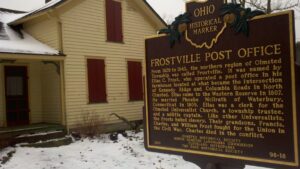
The North Olmsted Historical Society was founded in 1953 and became incorporated as a non-profit association in 1961. A year later, Frostville Museum opened in the Prechtel House. The society took on the challenge of preserving the history of the entire original township and became the Olmsted Historical Society in 1969. The Frostville Museum has grown from one house to a small village. Volunteers are dedicated to preserving the past and the present for the future. In August 2010, First Lady Michelle Obama designated the society as a Preserve America Steward. Frostville is an affiliate of the Cleveland Metroparks.
, OH
Miranda Boulden Parker lived at 2644 Marsh Avenue from 1907 to 1915. She moved into the four-family rental home with her daughters Bianca and Portia, who both worked as teachers. Miranda Parker was the widow of John P. Parker, Ripley’s Underground Railroad hero, born into slavery who famously helped more than 400 fugitives escape to freedom. In March 1914, after several vacant apartments in their Marsh Avenue home were repeatedly vandalized, daughter Bianca assumed the role as building caretaker. When she appealed to the police for help against vandals breaking windowpanes, shutters, and transoms, the police made no effort to arrest the offenders. Instead, the Health Department issued a 24-hour eviction notice. Bianca Parker sued Norwood’s Health Officer and Chief of Police unsuccessfully. The Parker family left Norwood for the more welcoming and integrated Madisonville neighborhood.
Miranda Boulden Parker lived in a home on this site from 1907(1) to 1915(2). She was the widow of Underground Railroad hero John P. Parker, who had been born into slavery. They lived in Ripley, Ohio, where John P. Parker helped more than 400 fugitives escape to freedom.(3) After his death in 1900, Miranda and their daughters Bianca and Portia, both teachers, came to Norwood. Here they rented an apartment in a four-family dwelling where Bianca became the caretaker.(4) From 1913-‘14, vandals broke over 63 windowpanes, shutters, and transoms. Bianca appealed to the police for help. Instead, the police notified the Health Department, who gave the Parkers a 24-hour eviction notice. The Parkers moved out of Norwood after unsuccessfully suing the city. (123 words)
City of Norwood, Ohio
Norwood Historical Society
The Ohio History Connection
This park was established by the City of Norwood in 1923(5) for the purpose of preventing Black Americans from owning homes here.(6) From 1907(7) to 1922(8), a four-family house on this site was rented by Black families.(9) George and Sarah Hirst lived in one of those units. On July 5, 1922, the Hirsts purchased a vacant lot next door(10) to the four-family dwelling and hired a Black contractor to build them a home.(11) White neighbors, fearing that a “Negro colony” might be developing, petitioned(12) Norwood City Council to take action.(13)(14) The Council used the right of eminent domain to seize the vacant lot from George and Sarah Hirst.(15) The Council also seized several other adjacent lots and demolished the four-family dwelling, creating Marsh Park.(16) (125 words)
City of Norwood, Ohio
Norwood Historical Society
The Ohio History Connection
, OH
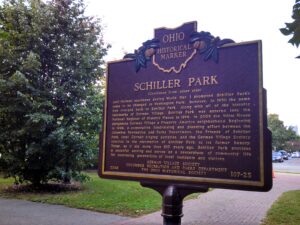
Long a gathering place for residents of Columbus, this area, which became known as Schiller Park, hosted German songfests, Fourth of July festivities, the 1864 and 1865 Ohio State Fairs, and the 1871 peace celebration commemorating the end of the Franco-Prussian War. In 1867, the City of Columbus purchased 23 acres of this area, then known as Stewart’s Grove, for $15,000 and named it City Park. On July 4, 1891, before a crowd of 50,000, the German-American community dedicated the 25-foot tall, 2,640 pound statue of German poet Friedrich von Schiller that had been cast in Munich, Germany and given as a gift to the City of Columbus. In 1905, the Park’s name was changed to Schiller Park. (Continued on other side)
, OH
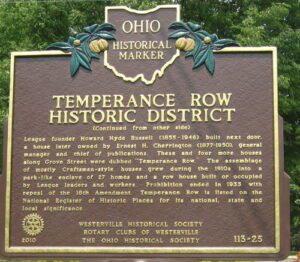
Here lived the reformers of the Anti-Saloon League of America who led the movement that turned the United States “dry” in 1920 with the 18th Amendment prohibiting the manufacture, sale or transportation of intoxicating liquor. Moving its headquarters to Westerville in 1909, the League built a publishing house that buried the liquor industry in a 10-year avalanche of books, pamphlets and periodicals that helped win Prohibition and made Westerville the “Dry Capital of the World.” Rev. Purley A. Baker (1858-1924), the League’s general superintendent, bought 11 acres and erected his rustic home at Park and Grove streets in 1910. (Continued other side)
, OH
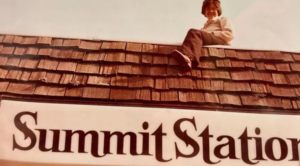
2210 Summit Street once housed one of Ohio’s longest-running lesbian bars. In 1970, a lesbian bartender at Jack’s A Go Go recognized that while Columbus had bars for gay men, it needed one geared toward lesbian clientele. Patrons knew the bar as “Jack’s,” Logan’s Off Broadway, and Summit Station. Staff welcomed women from small towns, women working in trades, women of color, butch/femme lesbians, and transgender people. Regulars recall that stepping through the door felt like finally entering a place of true belonging. Women could dance, “get together,” break up, sing karaoke, party with friends, and celebrate birthdays and holidays. Summit Station remained a safe public space, despite ongoing police harassment of its gender non-conforming regulars. A sign posted outside declared: “Ladies Night, Every Night. Men $5.” (Continued on other side)
, OH
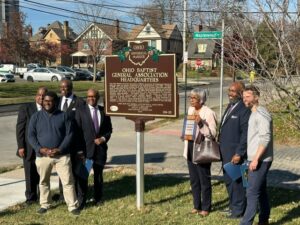
The Ohio Baptist General Association (OBGA) acquired 48 Parkwood Avenue in 1954 and used the former residence as its headquarters until 1996. Formed in 1896, the Association includes more than forty African American churches, many formed prior to the Civil War. Baptist general associations nationwide became an important voice during the 1960s Civil Rights Movement as they addressed the wrongs of racial violence and discrimination in business, housing, and education. The OGBA fought for the ideals of justice and freedom with its strongly-held Baptist beliefs. “America with her wealth as a great nation,“ OGBA President Wilber A. Page declared in 1957, “is well able to face integration and give a democracy to all her citizens.” The former Association Headquarters was listed in the National Register of Historic Places on December 3, 2020.