

, OH
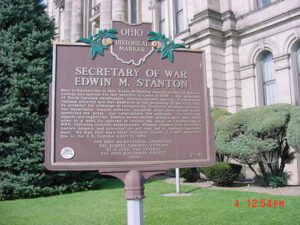
Born in Steubenville in 1814, Edwin McMasters Stanton studied at Kenyon College and opened his law practice in Cadiz in 1836. The grandson of North Carolina slaveholders, Stanton opposed slavery. A successful railroad attorney and War Democrat at the beginning of the Civil War, he accepted the challenge of reorganizing President Abraham Lincoln’s War Department. Stanton enforced unpopular draft laws, fought draft, restricted the press, and nationalized the railroads. An effective planner and logistician, Stanton moved 20,000 soldiers more than 1,200 miles in a week by railroad to relieve the siege of Chattanooga in 1863. Following Lincoln’s assassination, Stanton clashed with President Andrew Johnson and provoked the act that led to Johnson’s impeachment. He died four days after President Ulysses S. Grant appointed him to the U.S. Supreme Court in 1869.
, OH
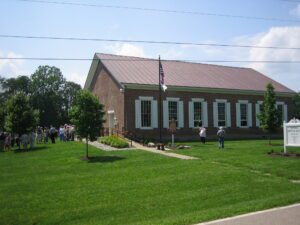
The Hopewell Associate Reformed Church and Cemetery, now known as Historic Hopewell, was founded in 1808 in a log building that was replaced in 1826 with the present building. It was built by the area’s first settlers, mainly Scotch-Irish who left Kentucky and South Carolina because of their opposition to slavery. The church encouraged worship by African Americans and played an important role in the Underground Railroad. It became the parent church for four “Daughter” Presbyterian congregations: Fairhaven in 1835, Oxford in 1837, College Corner in 1849, and Morning Sun in 1876. Reverend Alexander Porter, the first pastor, was committed to education and constructed a school near the Hopewell Spring that still produces clear water. “Old Hopewell” was completely refurbished in 1880, but by 1915 the membership declined and regular services discontinued. Today Hopewell holds Sunday services in the summer and is maintained by a generous and devoted group of volunteers.
, OH
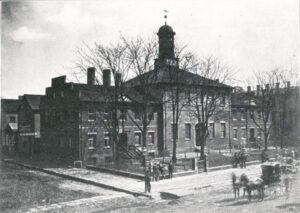
In 1809 the citizens of Zanesville erected a building on this site which served as the capitol of Ohio from October 1, 1810, until May 1, 1812. The 9th and 10th sessions of the Ohio General Assembly met here before returning to Chillicothe in May 1812. The building was then used as the Muskingum County Courthouse until the present courthouse was built in 1874. The 1809 date stone from the old building was incorporated into the new building and may be seen over the front steps.
, OH
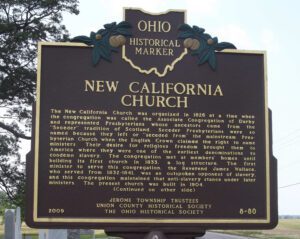
The New California Church was organized in 1826 at a time when the congregation was called the Associate Congregation of Darby and represented Presbyterians whose ancestors came from the “Seceder” tradition of Scotland. Seceder Presbyterians were so named because they left or “seceded from” the mainstream Presbyterian Church when the English Crown claimed the right to name ministers. Their desire for religious freedom brought them to America where they were one of the earliest denominations to condemn slavery. The congregation met at members’ homes until building its first church in 1833, a log structure. The first minister to serve this congregation, the Reverend James Wallace, who served from 1832-1841, was an outspoken opponent of slavery, and this congregation maintained that anti-slavery stance under later ministers. The present church was built in 1904. (continued on other side)
, OH
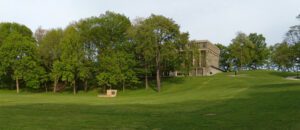
In 1968, Richard Nixon won the presidency partly based on a campaign promise to end the Vietnam War. Though the war seemed to be winding down, on April 30, 1970, Nixon announced the invasion of Cambodia, triggering protests across college campuses. On Friday, May 1, an anti-war rally was held on the Commons at Kent State University. Protestors called for another rally to be held on Monday, May 4. Disturbances in downtown Kent that night caused city officials to ask Governor James Rhodes to send the Ohio National Guard to maintain order. Troops put on alert Saturday afternoon were called to campus Saturday evening after an ROTC building was set on fire. Sunday morning in a press conference that was also broadcast to the troops on campus, Rhodes vowed to “eradicate the problem” of protests at Kent State. (Continued on other side)
, OH
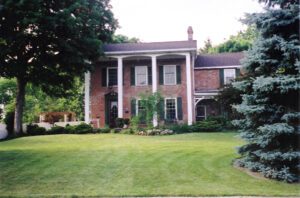
Jonathan Wright (1782-1855) and his wife Mary Bateman Wright (1787-1866) moved with their five children from Menallen, Adams County, Pennsylvania, in 1814 and built this Federal style house. Using skills acquired from his father, Joel Wright, a surveyor who platted the city of Columbus, Jonathan platted the village of “Springborough,” named for the many springs in the vicinity. The Wright family established and operated a woolen factory, two flour mills, a general store, and a 320-acre farm in the Springboro area. The Wrights were active members of the Society of Friends (Quakers) and strongly opposed slavery. The house was a station on the Underground Railroad, offering assistance to runaway slaves during their flight to freedom. Many members of the Wright family, including Jonathan, Mary, and four of their children, are buried in the Friends Cemetery on nearby Factory Road.
, OH
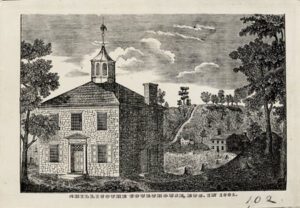
The first Northwest Territory assembly formally met in Cincinnati in September 1799 to initiate self-government. The legislators were deeply divided politically. The Republicans (antifederalists or “Jeffersonians”), led by Thomas Worthington and Edward Tiffin of Chillicothe, opposed the appointed government headed by the Federalist governor, Arthur St. Clair. They saw it as arbitrary and autocratic and recognized that change could occur only with statehood. To deter the movement, the St. Clair faction in 1801 divided the territory and removed the capital from Chillicothe to Cincinnati. Their actions triggered a violent confrontation led by the antifederalist Michael Baldwin who incited the local rabble-rousers, known as “the Bloodhounds,” to riot in the streets of Chillicothe. Both political unrest and advancing settlement accelerated the Chillicothe faction’s campaign for Ohio statehood.
, OH
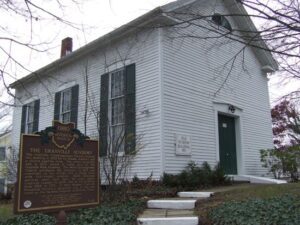
The Granville Congregational Church erected this building in 1833 for its Female Academy and a church meeting room. The school prospered and, in 1837, moved to make way for the Granville Male Academy. The Welsh Congregational Church purchased the structure in 1863 and converted its two stories into a single room with full-height windows. Welsh language services were held here for sixty years. Granville Grange #2230 met in the building from 1923 to 1973. It then became Granville Historical Society’s property and, in 1981, was listed on the National Register of Historic Places.