After witnessing the slave trade in Wheeling, Virginia, Quaker abolitionist Benjamin Lundy (1789-1839) resolved to battle the institution, first organizing the Union Humane Society in St. Clairsville in 1815. In 1821, Lundy moved to Mount Pleasant and began publishing the Genius of Universal Emancipation, a newspaper devoted wholly to anti-slavery issues. The newspaper would later be published in Tennessee, Baltimore, Washington D.C., and Philadelphia. Lundy traveled widely to promote circulation, lecturing on the moral evils of slavery and its associated negative economic and social effects. The Lundy home served as an Underground Railroad stop.
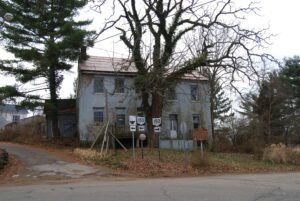
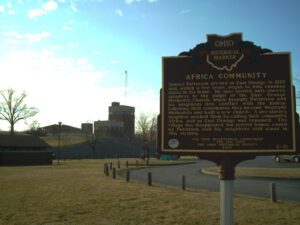
Samuel Patterson arrived in East Orange in 1824 and, within a few years, began to hide runaway slaves in his home. He also invited anti-slavery speakers to the pulpit of the East Orange Methodist Church, which brought Patterson and his neighbors into conflict with the bishop. Following their consciences, they became Wesleyan Methodists and built a new church. A pro-slavery neighbor mocked them by calling their community Africa, and so East Orange was renamed. The village has disappeared, but several homes owned by Patterson and his neighbors still stand in this vicinity.
Betsey Mix Cowles dedicated her life to fighting slavery and improving the status of women. Her desire for a formal education led her to Oberlin College, where she completed two years of study in 1840. An advocate of immediate abolition, Cowles lectured on the moral depravity of slavery, opened her home, at this site, to fugitive slaves. Opposed to expansion of slavery into the West, Cowles protested the Mexican War. Cowles served as president of Ohio’s first women’s rights convention (in Salem) in 1850, and the following year wrote a treatise on equal pay for working urban women. She served as the first dean of women at Grand River Institute, and later became one of the first women public school superintendents in Ohio.
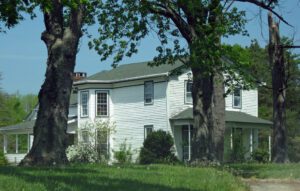
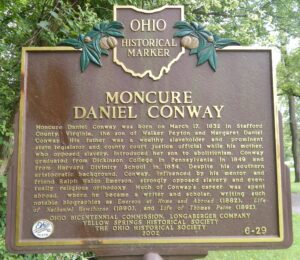
Moncure Daniel Conway was born on March 17, 1832 in Stafford County, Virginia, the son of Walker Peyton and Margaret Daniel Conway. His father was a wealthy slaveholder and prominent state legislator and county court justice official while his mother, who opposed slavery, introduced her son to abolitionism. Conway graduated from Dickinson College in Pennsylvania in 1849 and from Harvard Divinity School in 1854. Despite his southern aristocratic background, Conway, influenced by his mentor and friend Ralph Waldo Emerson, strongly opposed slavery and eventually religious orthodoxy. Much of Conway’s career was spent abroad, where he became a writer and scholar, writing such notable biographies as Emerson at Home and Abroad (1882), Life of Nathaniel Hawthorne (1890), and Life of Thomas Paine (1892).
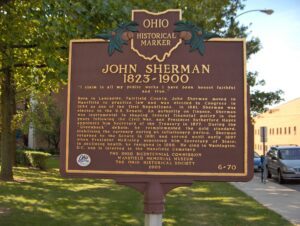
Born in Lancaster, Fairfield County, John Sherman moved to Mansfield to practice law and was elected to Congress in 1854 as one of the first Republicans. In 1861, Sherman was elected to the U.S. Senate. An authority on finance, Sherman was instrumental in shaping federal financial policy in the years following the Civil War, and President Rutherford Hayes appointed him Secretary of the Treasury in 1877. During the “Greenback” debate, he re-implemented the gold standard, stabilizing the currency during an inflationary period. Sherman returned to the Senate in 1881 and served until early 1897 when President McKinley appointed him Secretary of State; in declining health, he resigned in 1898. He died in Washington, D.C. and is interred in the Mansfield Cemetery.
Congregations of the Religious Society of Friends (Quakers), called “meetings”, worshiped in plain meeting houses. On this site stood the last Richland Friends Meeting House, built in 1872. Ninety-four Friends established the meeting in 1826 and it endured for 147 years. The cemetery is where many generations of members of this meeting are buried. The faith, based on pacifism and simplicity, blossomed in the region during the first half of the 19th century. (Continued on other side)
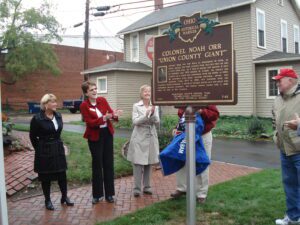
Cyprian Lee (1792-1854) settled in the Union County wilderness in 1820 and purchased the 118 West Sixth Street lot in 1828 for $6. County treasurer, coroner, shoemaker, and anti-slavery activist, Lee lived here in a log cabin until 1832 when this Greek Revival two-story brick house was completed. Other notable citizens to have resided in this oldest brick house in Marysville were showman Noah Orr (1836-1882), also known as the “Union County Giant,” and Josiah Jacob Morelock (1833-1899), a member of the Marysville City Council and the first Fire Department in Marysville. The Morelock family tannery business and stables were located behind this house.
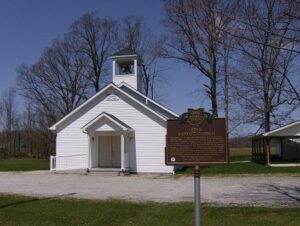
Thirteen African American families migrated to Pebble Township in Pike County in the early 1820s from Virginia. Some of the families were former slaves while others were freeborn people of color. Their farm knowledge and skill helped to make them prosperous, angering some of their white neighbors who began a campaign of harassment. Ten of the original African American settlers eventually moved away, but despite the difficulties with the white population, other African Americans continued to arrive to the settlement. They founded a church, later known as the Eden Baptist Church, built a meeting hall, and organized a school. Several of the families were also involved in the activity of the Underground Railroad. The PP Settlement thrived until the 1950s when, for economic reasons, residents moved to other communities.