Archibald Worthington (1818-1895) was a freed slave from Virginia, a Civil War veteran, and prominent landowner in Highland Township. Census records indicate he was manumitted prior to 1850, and by 1860 owned land in northwest Ohio. Worthington also farmed, boarded freed slaves, and owned apple orchards and livestock. April 1866 township records show that he supported the local school for Black families. He and his wife Elizabeth raised three children: Henry, Mathilda, and James. Henry enlisted in the Massachusetts 54th Volunteer infantry, one of the first Black regiments formed in the Civil War. He died January 8, 1865, in a prison camp and is buried in North Carolina’s Salisbury National Cemetery. Mathilda and James both met partners and married, had children, and left the area. Archibald Worthington died in 1895 and is buried in Wilmington’s Sugar Grove Cemetery.
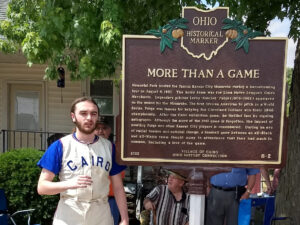
Memorial Park hosted the famous Kansas City Monarchs during a barnstorming tour on August 4, 1961. The home team was the Lima Metro League’s Cairo Merchants. Legendary pitcher Leroy “Satchel” Paige (1906-1982) appeared on the mound for the Monarchs. The first African American to pitch a World Series, Paige was famous for helping the Cleveland Indians win their 1948 championship. After the Cairo exhibition game, he thrilled fans by signing autographs. Although the score of the 1961 game is forgotten, the impact of meeting Paige and other Kansas City players is remembered. During an era of racial tension and national change, a baseball game between an all-Black and all-White team taught many in attendance that they had much in common, including a love of the game.
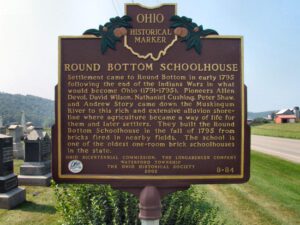
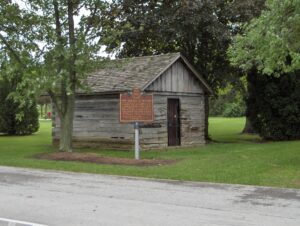
Settlement came to Round Bottom in early 1795 following the end of the Indians Wars in what would become Ohio (1791-1795). Pioneers Allen Devol, David Wilson, Nathaniel Cushing, Peter Shaw, and Andrew Story came down the Muskingum River to this rich and extensive alluvion shoreline where agriculture became a way of life for them and later settlers. They built the Round Bottom Schoolhouse in the fall of 1795 from bricks fired in nearby fields. The school is one of the oldest one-room brick schoolhouses in the state.
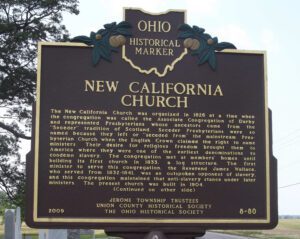
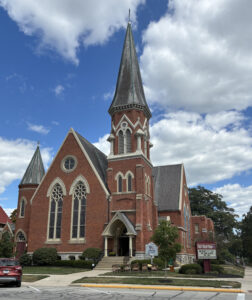
The New California Church was organized in 1826 at a time when the congregation was called the Associate Congregation of Darby and represented Presbyterians whose ancestors came from the “Seceder” tradition of Scotland. Seceder Presbyterians were so named because they left or “seceded from” the mainstream Presbyterian Church when the English Crown claimed the right to name ministers. Their desire for religious freedom brought them to America where they were one of the earliest denominations to condemn slavery. The congregation met at members’ homes until building its first church in 1833, a log structure. The first minister to serve this congregation, the Reverend James Wallace, who served from 1832-1841, was an outspoken opponent of slavery, and this congregation maintained that anti-slavery stance under later ministers. The present church was built in 1904. (continued on other side)
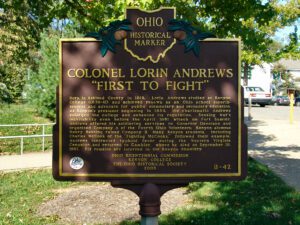
Born in Ashland County in 1819, Lorin Andrews studied at Kenyon College (1838-41) and achieved renown as an Ohio school superintendent and advocate for public elementary and secondary education. As Kenyon’s president beginning in 1854, the charismatic Andrews enlarged the college and enhanced its reputation. Sensing war’s inevitability even before the April 1861 attack on Fort Sumter, Andrews offered his soldiering services to Governor Dennison and organized Company A of the Fourth Ohio Volunteers; Kenyon alumnus Henry Banning raised Company B. Many Kenyon students, including Charles McCook of the “Fighting McCooks,” followed their example. Andrews contracted typhoid fever during the Western Virginia Campaign and returned to Gambier, where he died on September 18, 1861. His remains are interred in the Kenyon cemetery.
Sidney’s First Presbyterian Church formally organized on September 4, 1825, under the guidance of Reverend Joseph Stevenson, who traveled from Bellefontaine for that purpose. The original eight-member congregation worshipped outdoors or in the Shelby County Courthouse until able to finance their own building in 1834. First Presbyterian’s small frame chapel was constructed on the half-acre parcel that became their permanent home. Two centuries later, the congregation continues to worship at the corner of Miami Avenue and North Street on Lot 109, set aside for religious use in Charles Starrett’s 1819-1820 agreements platting Sidney’s original 70-acre tract. (Continued on other side)
The village was laid out on August 18, 1847, by Benjamin Todd, and consisted of 18 lots in Section 26 of Pleasant Township. Originally named Pleasantville, it was incorporated in 1858 and the name was changed in honor of Maj. Gen. Alexander Macomb, famous for defending Plattsburgh, N.Y., during the War of 1812 and later Commander of the U.S. Army. William Chapman was the first mayor.
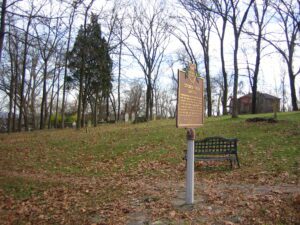
Originally belonging to the William Henry Harrison family, this cemetery was known as “The Pasture Graveyard” until the Civil War era. It became the final resting place of many members of the Harrison and Symmes families as well as other early settlers to the North Bend area. It was in use until 1884 when Maple Grove Cemetery opened as the official township cemetery.