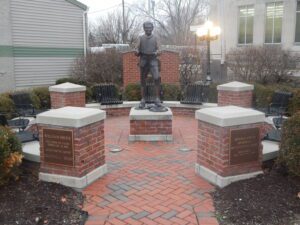
William Bruce founded and platted the city of Eaton in 1806. Born in Virginia in 1762, Bruce relocated to Ohio in 1793. In 1806, he purchased nearly two thousand acres of land from the government for the founding of Eaton. Bruce, a Revolutionary War veteran, named the town for General William Eaton, a veteran of the Tripolitan War, a war fought between the United States and the Barbary States from 1800-1805. Some of Eaton’s principal streets also took their names from other Tripolitan War veterans, including Somers, Decatur, and Israel. Bruce established the first sawmill and gristmill in Eaton and often distributed corn meal to the needy and deserving. He also made liberal donations of land for the benefit of the town, and sold many lots inexpensively or on partial payment to induce settlers to locate in the town. William Bruce died in 1830 and is interred in the Mound Hill Cemetery in Eaton.
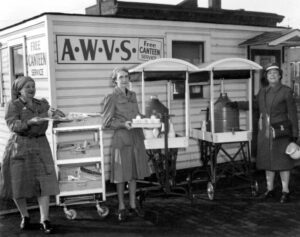
The Lima Chapter of the American Women’s Voluntary Services Organization established a community-based, free canteen during World War II for troops traveling on the Pennsylvania Railroad and adjacent Baltimore & Ohio-Nickel Plate Railroads. Meeting as many as forty trains a day, the ladies served 2.5 million troops between 1942-1945. Food, coffee, and other items were donated to the canteen from a twelve county area. The “AWVS” disbanded in 1945, but succeeding volunteers continued to provide service throughout the Korean Conflict and Viet Nam War. Lima’s “Servicemen’s Free Canteen” was the longest, continuously operated service canteen in the United States. An estimated four million soldiers, sailors, and marines were served between 1942-1970.
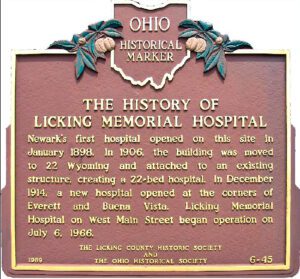
Newark’s first hospital opened on this site in January 1898. In 1906, the building was moved to 22 Wyoming and attached to an existing structure, creating a 22-bed hospital. In December 1914, a new hospital opened at the corners of Everett and Buena Vista. Licking Memorial Hospital on West Main Street began operation on July 6, 1966.
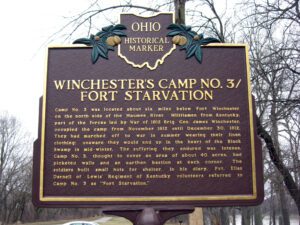
Camp No. 3 was located about six miles below Fort Winchester on the north side of the Maumee River. Militiamen from Kentucky, part of the forces led by War of 1812 Brig. Gen. James Winchester, occupied the camp from November 1812 until December 30, 1812. They had marched off to war in summer wearing their linen clothing; unaware they would end up in the heart of the Black Swamp in mid-winter. The suffering they endured was intense. Camp No. 3, thought to cover an area of about 40 acres, had picketed walls and an earthen bastion at each corner. The soldiers built small huts for shelter. In his diary, Pvt. Elias Darnell of Lewis’ Regiment of Kentucky volunteers referred to Camp No. 3 as “Fort Starvation.”
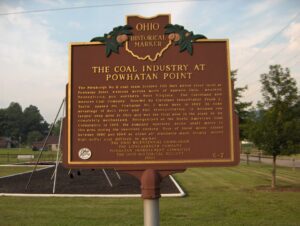
The Pittsburgh No. 8 coal seam, located 100 feet below river level at Powhatan Point, extends across much of eastern Ohio, western Pennsylvania, and northern West Virginia. The Cleveland and Western Coal Company, founded by Cleveland industrialist Frank E. Taplin, opened the Powhatan No. 1 mine here in 1922 to take advantage of both river and rail transportation. It became the largest deep mine in Ohio and was the first mine in the state to be completely mechanized. Reorganized as the North American Coal Corporation in 1925, the company operated seven shaft mines in this area during the twentieth century. Four of these mines closed between 1980 and 1984 as clean air standards made locally mined high-sulfur coal difficult to market.
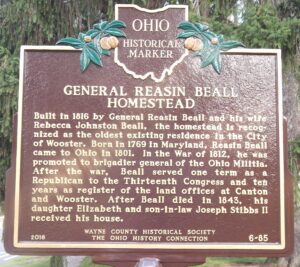
Built in 1816 by General Reasin Beall and his wife Rebecca Johnston Beall, the homestead is recognized as the oldest existing residence in the City of Wooster. Born in 1769 in Maryland, Reasin Beall came to Ohio in 1801. In the War of 1812, he was promoted to brigadier general of the Ohio militia. After the war, Beall served one term as a Republican to the Thirteenth Congress and ten years as a register of the land offices at Canton and Wooster. After Beall died in 1843, his daughter Elizabeth and son-in-law Joseph Stibbs II received his house.
In the early 1770s, Chief White Eyes (Koquechagachton) of the Delaware tribe founded White Eyes Town approximately two miles southeast of this marker on a plain near present day West Lafayette. A friend of the Moravian leader David Zeisberger, White Eyes was an ardent supporter of Moravian missionary efforts and kept the Delawares neutral during the American Revolutionary War. White Eyes’s dream was to bring his people under the influence of Christianity. He also hoped to establish a fourteenth state for the Indian nations, which would join the other thirteen. White Eyes died at the height of his career in November 1778 near Pittsburgh. The cause of his death remains open to question.
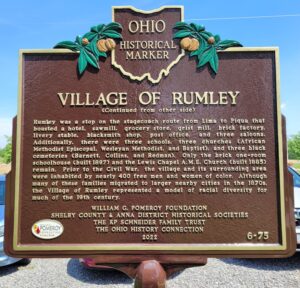
The Temple of Rumley Church is of one of two remaining buildings in what once was Rumley, a thriving African American community in Shelby County. On May 19, 1837, the village was surveyed for Amos Evans, who built his hewed log dwelling and store. Brothers Joel and George Goings (aka. Goens), freed black men from Monongalia County, Virginia, purchased 80 acres of land that same year. They settled with their families near Rumley in Van Buren Township along with other free men and women of color, including former slaves. Joel Goings erected the first brick house in 1841, using bricks from his own brickyard. By 1846, the Rumley community stretched over 7,000 acres and included the Collins, Redman, Williams, Davis, Lett, and Brown families. (Continued on other side)