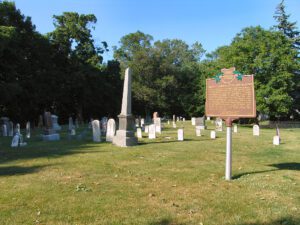
Israel Harrington (1779-1841) established a tavern at Lower Sandusky (now Fremont) shortly after the War of 1812. As a judge and land speculator, Harrington influenced the organization of much of northwestern Ohio. In 1824 he traded the tavern for land a short distance from this site, where an Indian trail crossed the Portage River. Elmore grew from this settlement. Harrington and his father (also Israel Harrington, a veteran of the American Revolution) are interred here, along with many of the pioneers who transformed this section of the Black Swamp into productive farmland.
After completing Fort Winchester, Brigadier General James Winchester ordered his troops to cross to the north side of the Maumee River. The troops occupied the new site, Camp #2, from November 3-10, 1812. An earthen fortification was built for protection. Militia soldier Elias Darnell recorded on November 4th that “The weather is very rainy, which makes our situation extremely unpleasant…. Four of this army have gone to the silent tomb to-day never more to visit their friends in Kentucky; the fever is very prevalent in camp; nearly every day there is one or more buried.” Winchester referred to a burial place for the encampment in his General Orders for November 5th. Camp #2 proved to be too wet and marshy, Winchester ordered his army to move to six miles down river to a site called Camp #3.
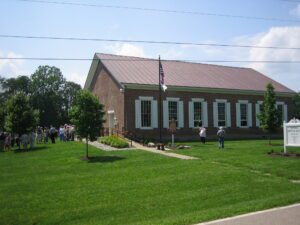
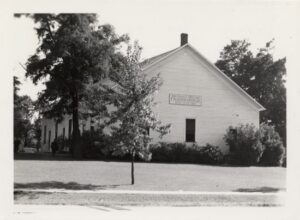
The Hopewell Associate Reformed Church and Cemetery, now known as Historic Hopewell, was founded in 1808 in a log building that was replaced in 1826 with the present building. It was built by the area’s first settlers, mainly Scotch-Irish who left Kentucky and South Carolina because of their opposition to slavery. The church encouraged worship by African Americans and played an important role in the Underground Railroad. It became the parent church for four “Daughter” Presbyterian congregations: Fairhaven in 1835, Oxford in 1837, College Corner in 1849, and Morning Sun in 1876. Reverend Alexander Porter, the first pastor, was committed to education and constructed a school near the Hopewell Spring that still produces clear water. “Old Hopewell” was completely refurbished in 1880, but by 1915 the membership declined and regular services discontinued. Today Hopewell holds Sunday services in the summer and is maintained by a generous and devoted group of volunteers.
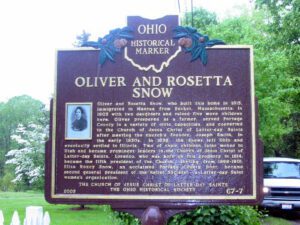
Oliver and Rosetta Snow, who built this home in 1815, immigrated to Mantua from Becket, Massachusetts, in 1805 with two daughters and raised five more children here. Oliver prospered as a farmer, served Portage County in a variety of civic capacities, and converted to the Church of Jesus Christ of Latter-day Saints after meeting the church’s founder, Joseph Smith, in the early 1830s. In 1838, the Snows left Ohio and eventually settled in Illinois. Two of their children later moved to Utah and became prominent leaders in the Church of Jesus Christ of Latter-day Saints. Lorenzo, who was born on this property in 1814, became the fifth president of the Church, serving from 1898-1901. Eliza Roxcy Snow, an acclaimed Portage County poet, became second general president of the Relief Society, a Latter-day Saint women’s organization.
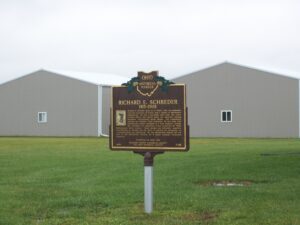
Richard E. Schreder grew up in Toledo, Ohio and graduated from the University of Toledo with a degree in Mechanical Engineering. He was a decorated navy pilot and iconic aviation figure who helped shape the American soaring movement, international glider design, and competitive soaring and piloting flight strategies. He also made high performance gliders available to a wide audience through the affordable kit production of his distinctive HP (High Performance) glider designs. These designs and Schreder’s numerous contributions to aviation and the sport of soaring are recognized as “groundbreaking and pioneering” by the Smithsonian Museum and are part of the Smithsonian National Air & Space Museum’s permanent collection. (continued on other side)
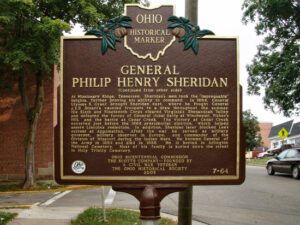
Philip Sheridan was most likely born in County Cavan, Ireland in 1831, but records do not indicate his actual birthplace. His family moved to Somerset when Philip was a child and lived down the avenue from this site. His family later owned the house across the street. His military interest was inspired by “Muster” day and frequent visits from a young West Pointer named William T. Sherman. Sheridan graduated from the United States Military Academy in 1853 and served on the Western Frontier Indian campaigns prior to the Civil War. In 1862, Sheridan became Colonel of the Second Michigan Calvary. At Stones River, Tennessee, he commanded a Division of the Twentieth Corps and stubbornly held General William S. Rosecrans’ right flank, distinguishing himself in battle. (continued on other side)
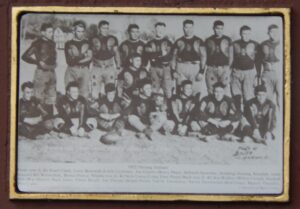
The Oorang Indian football team was founded by LaRue native Walter Lingo (1890-1966), owner of the Oorang Airedale Dog Kennels. The team, comprised of Native American Indians, played in the National Football League (NFL) in 1922-23. The star player and coach was Jim Thorpe (1887-1953), a Sac and Fox Indian. Thorpe gained international fame as a two-time gold medal winner (decathlon and pentathlon) in the 1912 Olympics and was acclaimed as the “World’s Greatest Athlete.” The team gave LaRue the distinction of being the smallest community ever to have an NFL franchise.
On this site are re-interred 118 exhumed remains from Lot 17, Friends Burying Grounds, adjacent to Damascus Friends Church on Walnut Street. Among those re-interred here are: Catlit Jones, a scout with Quaker Daniel Boone in Kentucky, a captain in the Revolutionary War, and a recorded Friends minister; and Samuel Coppock Jr., father of Edwin Coppock, who was hanged in 1859 for his part in abolitionist John Brown’s raid on the United States Arsenal at Harpers Ferry, Virginia. The exhumation (2001-2002) was directed by Prof. Dr. John White of Youngstown State University, assisted by staff, students, and volunteers.