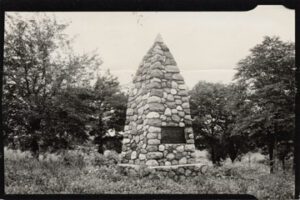
In the heyday of steamboating on the Muskingum, many people made their livelihood on the river. Jane McMillan, known as Old Jane, was one of the few women reported to have piloted boats on the river. In the 1840s she was co-owner of the “Zanesville Packet.” McMillan worked a variety of jobs, from cook to pilot. She was reported to know the twists and turns of the river so well that she could navigate safely at night, something many pilots refused to do. Isaac Newton Hook, a descendant of the earliest settlers in Zanesville, used skills he learned on the Muskingum River as a pilot on the Mississippi during the Civil War. He shipped supplies needed by the Union army. His tomb is in the Brick Church cemetery between Hooksburg and Stockport. He had the grave built out of concrete and above the level of the 1898 flood. The 1913 flood submerged the tomb, but it survived and can be viewed to this day.
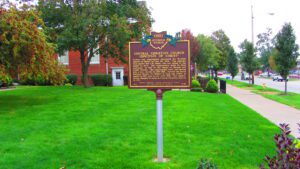
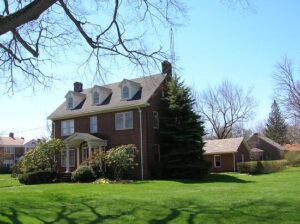
Harvey Howard, a local druggist, built the house at 407 North Market Street around 1860. After many owners, Captain James B. Taylor bought the home in 1893. Taylor commanded Company H of the 120th Ohio Volunteer Infantry during the Civil War. He studied law after the war and moved his practice to Wooster in 1882. Taylor’s wife Emelie died in 1905 and in 1906 Taylor sold the property to become Wooster’s first city hospital. Many of the town’s noted physicians practiced here and the facility was eventually enlarged to accommodate 30 beds. The house was a hospital until 1943, when Central Christian Church purchased it. The church used the building for education programs and restored much of its decor, including four fireplaces, inlaid floors, and bronze door hardware.
Administration Building built in 1931. Chapter House built in 1962. Commemorating American Red Cross Centennial, 1881-1981.
Early Western Reserve burial grounds, 1804-1848. Grave sites of 12 Revolutionary War veterans and Mary Chesney, member of pioneer Warren family and for whom local D.A.R. chapter was named.
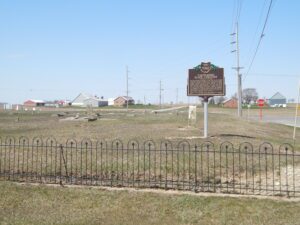
The Carthagena Black Cemetery (Union Cemetery) is a remnant of approximately 70 documented rural black and mulatto settlements established in Ohio before the Civil War. In the charged atmosphere following race riots in Cincinnati in 1829, Quaker abolitionist Augustus Wattles led 15 black families north in 1835. In 1837 Wattles purchased 189 acres where the cemetery is located. Headstones date from 1840, the year mulatto Charles Moore, platted the Village of Carthagena. Wattles and mulatto clergymen Sam Jones and Harrison Lee were Underground Railroad conductors. Wattles moved to Kansas in 1855. By 1860, more than 100 black and mulatto families, totaling 600 people, owned over 10,000 acres. (Continued on other side)
Myron T. Herrick, Governor of Ohio from 1904 to 1906, was born in Huntington Township in 1854 and lived here until age 12. A respected Cleveland attorney and businessman, Herrick was a friend and confidant to Senator Mark Hanna and Presidents McKinley, Taft, and Harding. His public service career culminated in two appointments as ambassador to France, from 1912 through the outbreak of World War I in 1914, and again from 1921 until his death in 1929. Enormously popular with the French people, Herrick escorted Charles Lindbergh in Paris after his historic 1927 transatlantic flight.
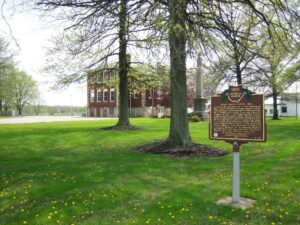
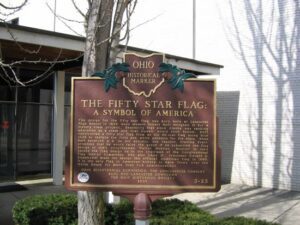
The design for the fifty star flag was born here at Lancaster High School in 1958 when student Robert Heft designed it for a history class project. Reasoning that since Alaska was seeking admission as a state and that Hawaii would soon follow, Heft constructed a fifty star flag from an old 48-star flag using blue cloth to replace the field and white adhesive for the stars. When Heft received a B- on his project, his teacher, Stanley Pratt, promised that he would raise the grade if he submitted the flag design to their congressman, Walter Moeller. Moeller in turn passed the flag design on to the chairman of the Congressional Flag Design Committee, who also liked it. President Dwight D. Eisenhower made the design the official American flag in 1960. It is the only flag in American history to have flown over the White House for more than five administrations.
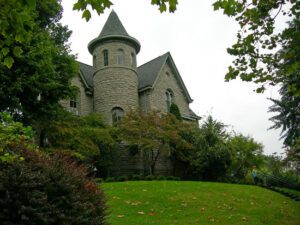
George W. Campbell originally built this highly picturesque structure in 1854. Designed with Romanesque and Norman Revival architectural features – a round tower, arched windows and doorways – and constructed of locally mined blue limestone, the home is representative of the work of architect W. Russell West. Campbell, a nationally eminent horticulturist, had a small vineyard to the east of the house where he developed and improved a variety of fruits, most notably the world famous Delaware Grape. Following Campbell’s death in 1898, the house was sold to Dr. Aaron J. Lyons and Mrs. Abbie Parish and presented to Ohio Wesleyan University, serving for more than 70 years as Lyons Art Hall.
During the Indian Wars of 1790-1795, the United States built a chain of forts in the contested area of what is today western Ohio. These forts were built as a result of various tribes of the region attacking the encroaching American population as they moved north of the Ohio River. In October 1791, General Arthur St. Clair, governor of the Northwest Territory, set out on a mission to punish the tribes and on October 12, ordered his forces to build Fort Jefferson, the fourth link in that chain of forts stretching north from Fort Washington (Cincinnati) to Fort Deposit (Waterville). Each fort was generally a hard day’s march of each other, and the site was chosen because of nearness to a supply of fresh water. The fort was named in honor of Secretary of State Thomas Jefferson.