

, OH
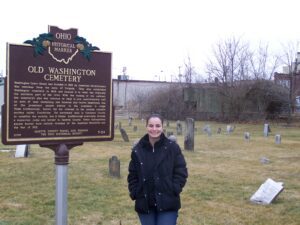
Washington Court House was founded in 1810 by American Revolutionary War veterans from the state of Virginia. They also established Washington Cemetery in 1810 and located it in what was originally the southern part of the town. With the coming of the railroad, the cemetery’s size was reduced to what is now approximately half an acre of land containing one hundred and twelve headstones. One of the prominent people buried in the cemetery is Judge Wade Loofborough, known for his interest in the utopian socialist society called Fourierism. He purchased land in Clermont County to establish the society, but it failed. Loofborough eventually became a respected judge and lawyer in Fayette County. Other distinguished people buried here include veterans of the American Revolution and the War of 1812.
, OH
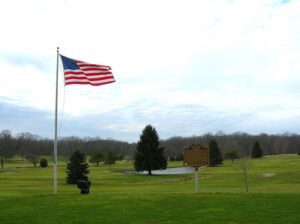
Golfer and World War II veteran William J. Powell, excluded from playing on many American golf courses because of his race, overcame the indignity of discrimination by creating his own course. Hand built in two years and opened in 1948, Clearview Golf Club is the first golf course in the United States designed, built, and owned by an African-American. The acclaimed course harmonizes with the landscape and bears many design elements of traditional British courses. A triumph of perseverance over discrimination, Clearview represents the historic postwar era when athletes first broke the “color line” in American sports.
, OH
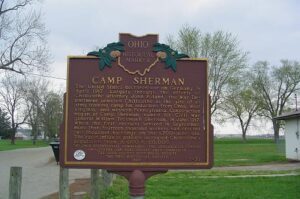
The United States declared war on Germany in April 1917. Largely through the efforts of Chillicothe attorney John Poland, the War Department selected Chillicothe as the site of an army training camp for inductees from Ohio, West Virginia, and western Pennsylvania. Construction began at Camp Sherman, named for Civil War general William Tecumseh Sherman, in June 1917. When the first recruits arrived in September, more than fourteen thousand workers had erected two thousand buildings on the 1,700-acre site. The rapid influx of soldiers increased Chillicothe’s population from 16,000 to 60,000.
, OH
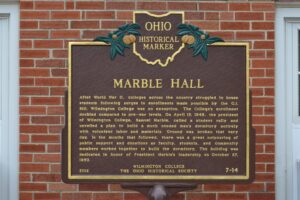
After World War II, colleges across the country struggled to house students following surges in enrollments made possible by the G.I. Bill. Wilmington College was no exception. The College’s enrollment doubled compared to pre-war levels. On April 13, 1948, the president of Wilmington College, Samuel Marble, called a student rally and unveiled a plan to build a much needed men’s dormitory entirely with volunteer labor and materials. Ground was broken that very day. In the months that followed, there was a great outpouring of public support and donations as faculty, students, and community members worked together to build the dormitory. The building was dedicated in honor of President Marble’s leadership on October 27, 1950.
, OH
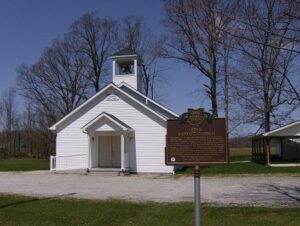
Thirteen African American families migrated to Pebble Township in Pike County in the early 1820s from Virginia. Some of the families were former slaves while others were freeborn people of color. Their farm knowledge and skill helped to make them prosperous, angering some of their white neighbors who began a campaign of harassment. Ten of the original African American settlers eventually moved away, but despite the difficulties with the white population, other African Americans continued to arrive to the settlement. They founded a church, later known as the Eden Baptist Church, built a meeting hall, and organized a school. Several of the families were also involved in the activity of the Underground Railroad. The PP Settlement thrived until the 1950s when, for economic reasons, residents moved to other communities.
, OH
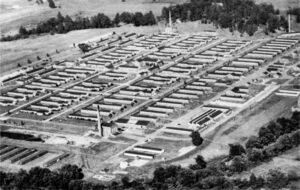
During the Second World War, the U.S. Army constructed a 131-building hospital on level farmland a quarter mile northwest of this marker. The army built the facility as a 1,520-bed hospital in the winter and spring of 1942-’43. It was later expanded to 168 buildings with a 2,000-bed capacity, including a German POW camp for 234 prisoners engaged in hospital work. Between June 1943 and March 1946, when the facility closed, 17,608 veterans were treated here, most having returned with injuries received in the European or Pacific theaters of war. Convalescence and rehabilitation were the hospital’s primary missions. Most patients returned to active duty when they recovered. After the war, the facility became the Cambridge State Hospital, which treated mentally ill and developmentally disabled Ohioans until 2008. Thereafter, the facility became the privately-operated Cambridge Behavioral Hospital and the state-operated Cambridge Developmental Center.
, OH
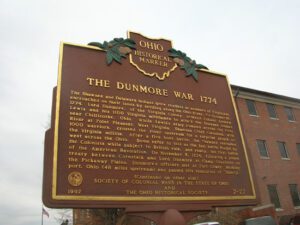
The Shawnee and Delaware Indians grew restless as numbers of Virginians encroached on their lands by settling along the Ohio River. On October 10, 1774, Lord Dunmore, of the Virginia Colony, ordered Colonel Andrew Lewis and his 1100 Virginia militiamen to attack the Shawnee Indians near Chillicothe, Ohio. While Lewis’s army camped across the Ohio River at Point Pleasant, West Virginia, Shawnee Chief Cornstalk, with 1000 warriors, crossed the river upstream for a surprise attack on the Virginia militia. After a five hour battle, the Shawnee retreated west across the Ohio. Some refer to this as the last battle fought by the Colonists while subject to British rule, and really, the first battle of the American Revolution. On November 5, 1774, following a peace treaty between Cornstalk and Lord Dunmore at Camp Charlotte on the Pickaway Plains, Dunmore’s officers met at Fort Gower, Hockingport, Ohio (48 miles upstream) and passed this resolution of “liberty”: (continued on other side)
, OH
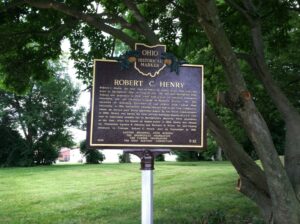
Robert C. Henry, the first African-American mayor of an Ohio city, was born in Springfield, Ohio, on July 16, 1921. He attended Springfield High School and graduated in 1939. After high school, he attended Wittenberg University and the Cleveland College of Mortuary Science. He also received an honorary Doctorate of Law degree from Central State University. In 1961, Springfield citizens elected him to the City Commission, where he served until being appointed mayor by his fellow commissioners in 1966. Henry was among the first African-American mayors of a U.S. city, and is especially notable due to Springfield’s majority white population at the time. After his tenure as mayor ended in 1968, Henry was chosen by presidents Lyndon B. Johnson and Richard M. Nixon for fact- finding missions in Vietnam. Robert C. Henry died on September 8, 1981.