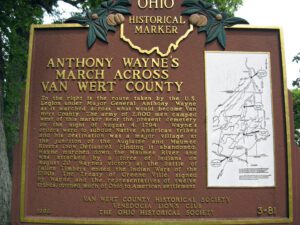
To the right is the route taken by the U.S. Legion under Major General Anthony Wayne as it marched across what would become Van Wert County. The army of 2,800 men camped west of this marker near the present cemetery on the night of August 4, 1794. Wayne’s orders were to subdue Native American tribes and his destination was a major village at the junction of the Auglaize and Maumee Rivers (now Defiance). Finding it abandoned, Wayne marched down the Maumee River and was attacked by a force of Indians on August 20. Wayne’s victory at the Battle of Fallen Timbers ended the Indian Wars of the 1790s. The Treaty of Greene Ville, signed by Wayne and the representatives of twelve tribes, opened much of Ohio to American settlement. Side one includes a map on the right hand side of the marker showing the route of Wayne’s army through the eastern third of Van Wert County.
After American militia troops forcibly ended the 1812 siege of Fort Wayne, General James Winchester’s Army of the Northwest marched down the north side of the Miami [Maumee] River to stop or retard advancing British troops sent to aid in the siege of Fort Wayne. After three days of difficult march, Ensign James Liggett of the 17th Regiment, volunteered to lead a group of four spies or scouts to the site of the old Fort Defiance. Liggett’s small force was surprised and killed on or about September 25 near here. The Americans tried twice to recover the bodies, but met with ambush from hostile Native Americans sympathetic to the British. Their bodies were finally recovered and buried in a common grave. Besides Liggett, they included Wyatt Stepp, Guy Hinton, William Bevis, and Nathaniel Mitchell of Woodford County, Kentucky, all of Captain McCracken’s Company, 1st Rifle Regiment, Kentucky Volunteer Militia.
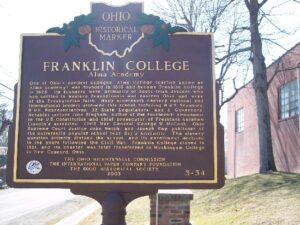
One of Ohio’s earliest colleges, Alma College (earlier known as Alma Academy) was founded in 1818 and became Franklin College in 1825. Its founders were primarily of Scots-Irish descent who had settled in western Pennsylvania and eastern Ohio and were of the Presbyterian faith. Many nineteenth-century national and international leaders attended this school, including 8 U.S. Senators, 9 U.S. Representatives, 32 State Legislators, and 2 Governors. Notables include John Bingham, author of the Fourteenth Amendment to the U.S. Constitution and chief prosecutor of President Abraham Lincoln’s assassins; Civil War General George W. McCook; Ohio Supreme Court Justice John Welch; and Joseph Ray, publisher of the universally popular school text Ray’s Arithmetic. The slavery question bitterly divided the school, and its enrollment declined in the years following the Civil War. Franklin College closed in 1921, and its charter was later transferred to Muskingum College in New Concord, Ohio.
Intersection of Main Street and Township Road 39 (High Street)
Roundhead
, OH
Upon this site, in the late 18th and early 19th centuries, stood Chief Roundhead’s Wyandot Indian village. This flourishing agricultural community later gave way to white settlement and Hardin County’s first town was laid out here in 1832. Roundhead, or Stiahta, was celebrated for his capture of American General James Winchester during the War of 1812. Roundhead is believed to be buried in this vicinity.
The museum of the Mercer County Historical Society, the Riley Home represents six generations of the Riley family in the county. The first Riley to arrive here was Captain James Riley, who surveyed the area in 1819, after it was opened to American settlement following the Treaty of Saint Marys in 1818. Captain Riley was elected to the Ohio General Assembly in 1823. Captain Riley’s son, James Watson Riley platted Celina in 1834, was Mercer County’s Clerk of Courts, and then represented the area in the Ohio General Assembly beginning in 1843. (Continued on other side.)
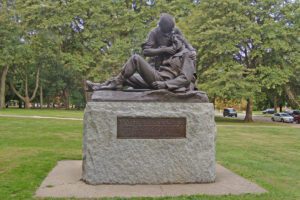
Mary Ann Ball was born in this vicinity in 1817 and began her nursing career at age 20. When the Civil War broke out in 1861, Mary at the age of 45 went to the soldiers’ aid. Ignoring rank, protocol, and allegiance, she pursued fearlessly and with inexhaustible energy her mission to care for the sick and wounded. Rebel, Union, and Negro soldiers all received the same attention. She risked enemy fire, especially through Grant’s Western Campaign and Sherman’s Georgia Campaign, to rescue suffering men, often going out at night to hunt for the fallen. When the victorious armies of the North were reviewed in Washington at the war’s end, “Mother Bickerdyke” road her faithful white horse beside the generals and colonels. Veterans along the line of march gave her the loudest cheers.
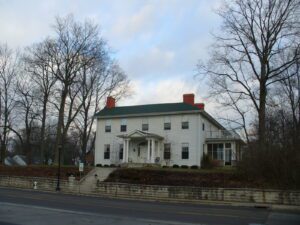
One of the most effective political orators of his era, Tom Corwin (nicknamed “the Wagon Boy” for his War of 1812 service) resided here from 1839 until his death. A Whig stump speaker known for his wit and eloquence, he was elected governor of Ohio in 1840 and campaigned for William Henry Harrison in his presidential victory that year. Corwin served six terms in Congress and one in the Senate, where he spoke out against the Mexican War in 1847. He also served as secretary of the treasury in the Fillmore administration and as President Lincoln’s minister to Mexico. Built and first occupied by Corwin’s brother-in-law Phineas Ross in 1818, the Corwin House is representative of Federal-style architecture of this period.
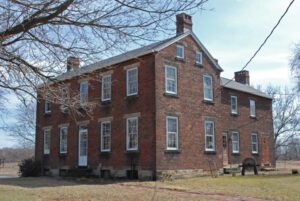
Maple-Dell was the home of John Butler, a Quaker who expressed his religious faith by working for humanitarian causes. An early Goshen Township teacher, Butler opened his home to orphans, the homeless, and runaway slaves, and devoted 20 years of his life to support the Freedman’s Camps for former slaves. One of the many individuals he sheltered was Edwin Coppock who was hung along with abolitionist, John Brown, after the raid on Harper’s Ferry in 1859. Butler met with President Lincoln and Secretary of War, Edwin Stanton in 1862 to request exemption from military service for Quakers during the Civil War. In 1868, President Grant petitioned the churches to assist in organizing a peace policy for the Indians. Butler prepared and presented to Congress a proposal for treating the Indians humanely including providing them with scientific and industrial education.