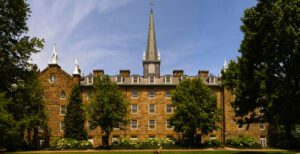
The state’s oldest private institution of higher education, Kenyon College was founded in 1824 in Worthington by Philander Chase, first Episcopal bishop of Ohio, and relocated to Gambier four years later. Both college and village are named for British benefactors, statesman Lord Kenyon and naval hero Lord Gambier. Throughout its history, Kenyon has prepared men and women for leading roles in society, including nineteenth-century graduates Edwin M. Stanton, Abraham Lincoln’s secretary of war, and Rutherford B. Hayes, Ohio governor and U.S. president. In the twentieth century, Kenyon educated such literary luminaries as poet Robert Lowell and novelist E.L. Doctorow. Kenyon has also been an innovator in education-the Advanced Placement Program began as the Kenyon Plan in the 1950s.
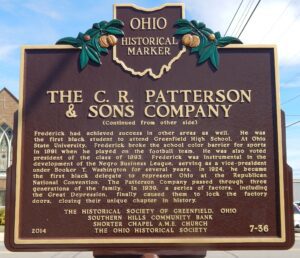
The factory of the C. R. Patterson & Sons Company once stood near here at 138 N. Washington Street. Established in the mid-nineteenth century by the black businessman Charles Richard (C. R.) Patterson and his white partner, J. P. Lowe, the business, originally known as J. P. Lowe & Company, became a successful carriage firm. Patterson became the sole owner in 1893 and changed the name to C. R. Patterson & Sons. After succeeding his father as owner, C. R.’s son, Frederick, became the first known African-American automobile manufacturer. Under his leadership, the company transitioned from building carriages to automobiles, then to trucks and buses to keep up with the changing demands of the transportation industry. (Continued on other side)
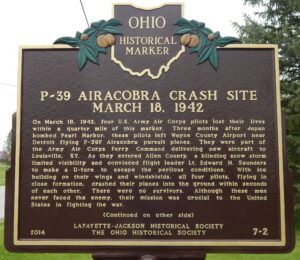
On March 18, 1942, four U.S. Army Air Corps pilots lost their lives within a quarter mile of this marker. Three months after Japan bombed Pearl Harbor, these pilots left Wayne County Airport near Detroit flying P-39F Airacobra pursuit planes. They were part of the Army Air Corps Ferry Command delivering new aircraft to Louisville, KY. As they entered Allen County, a blinding snow storm limited visibility and convinced flight leader Lt. Edward H. Saunders to make a U-turn to escape the perilous conditions. With ice building on their wings and windshields, all four pilots, flying in close formation, crashed their planes into the ground within seconds of each other. There were no survivors. Although these men never faced the enemy, their mission was crucial to the United States in fighting the war.
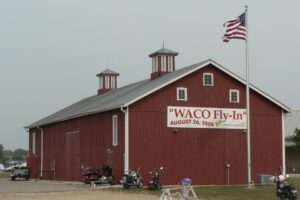
Founded in 1921 as the Weaver Aircraft Company and located in Lorain, Ohio, the Waco Aircraft Company relocated to Troy in March 1923. It was the first aircraft company to use assembly line production and shock strut landing gear. Leading all civilian aircraft production at a ratio of two to one from 1927-1929, the company had sales distributors in 24 countries worldwide. The United States government became the prime contractor of Waco Aircraft Company’s troop/cargo gliders (CG-4A) used extensively during World War II. The company also managed the U.S. Army’s glider program for 15 companies that produced gliders nationwide. The last WACO, model W “Aristrocrat,” was built in Troy in June 1947.
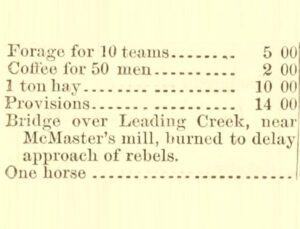
General John Hunt Morgan led a force of 2,000 Confederate cavalrymen into Meigs County on July 18, 1863, during a raid north of the Ohio River. More than 50,000 Union troops and mlitia pursued Morgan across the State of Ohio. At Langsville, in an attempt to delay the Confederate approach, local militia burned the bridge near McMaster’s grist mill. This was the first burned bridge encountered by the Confederates on their trek across Kentucky, Indiana and Ohio. A young Confederate soldier, shot and killed by a local resident, was buried near this site. After suffering losses at Buffington Island, Morgan surrendered eight days later near West Point in Columbiana County. The surrender field was the northernmost point reached by Confederate forces during the Civil War.
The Muskingum River forms at the confluence of the Tuscarawas and Walhoning rivers at Roscoe Village and flows south approximately 100 miles to the Ohio River at Marietta. During the first half of the nineteenth century, fugitive slaves from Virginia crossed the Ohio River and followed the Underground Railroad lines north toward Canada. Four Underground Railroad lines converged in Roscoe Village on the Muskingum River. The first followed the river north out of Marietta through Rainbow and Waterford. An Ohio River crossing at Belpre connected runaways with the Muskingum River at Putnam in Muskingum County. Two others came from the west through Granville in Licking County and New Concord in Muskingum County. From Roscoe Village, fugitive slaves sometimes traveled from station to station along the Ohio-Erie Canal that was completed in 1825. The canal ended at Lake Erie where the runaway slaves were assisted in crossing into Canada.
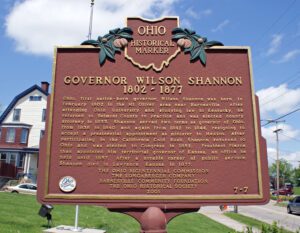
Ohio, first native-born governor, Wilson Shannon was born in February 1802 in the Mt. Olivet area near Barnesville. After attending Ohio University and studying law in Kentucky, he returned to Belmont County to practice and was elected county attorney in 1833. Shannon served two terms as governor of Ohio, from 1838 to 1840 and again from 1842 to 1844, resigning to accept a presidential appointment as minister to Mexico. After participating in the California Gold Rush, Shannon returned to Ohio and was elected to Congress in 1852. President Pierce then appointed him territorial governor of Kansas, an office he held until 1857. After a notable career of public service, Shannon died in Lawrence, Kansas, in 1877.
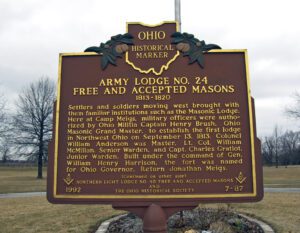
Settlers and soldiers moving west brought with them familiar institutions such as the Masonic Lodge. Here at Camp Meigs, military officers were authorized by Ohio Militia Captain Henry Brush, Ohio Masonic Grand Master, to establish the first lodge in Northwest Ohio on September 13, 1813. Colonel William Anderson was Master, Lt. Col. William McMillan, Senior Warden, and Capt. Charles Gratiot, Junior Warden. Built under the command of Gen. William Henry Harrison, the fort was named for Ohio Governor, Return Jonathan Meigs.