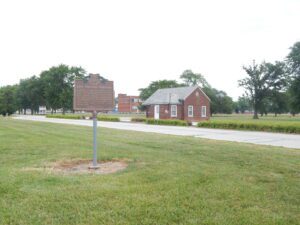
Established as Camp Perry Proving Ground, March, 1918, and later designated Erie Proving Ground, Erie Ordinance Depot, and Erie Army Depot. Artillery, tank guns, and armor plate were proof tested here during wartime periods. Over 5,000 persons were employed during World War II. Served as a storage, maintenance, and repair facility during peacetime. Closed January, 1967.
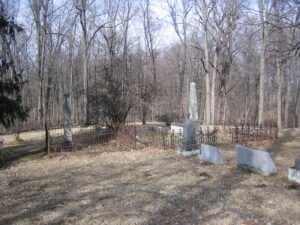
Spring, 1800, Benjamin Green and family become the first legal settlers in Licking County, followed by the Stadden family; Col. John Stadden marries Elizabeth Green on Christmas Day. Spring, 1801, clearings cut for cabins on Hog Run; Johnny Appleseed plants his orchards. 1808, John Beard family settles. 1810, first burial. 1811-41, these families bury six Revolutionary War veterans.
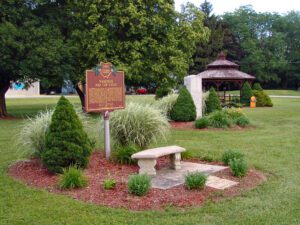
The Wakeman Red Caps, perhaps one of the area’s best semi-pro baseball teams during the 1930s and 40s, first played night baseball under lights installed at Wakeman Field on July 24, 1935. The Field, no longer extant, was bounded by Hyde, Clark, Pleasant, and Townsend (Ohio Route 303) streets. The game was played only two months after Franklin D. Roosevelt switched on lights at Crosley Field for the Cincinnati Reds. The Red Caps were part of the Wakeman Baseball Club, an organization which was founded in 1889 and was sponsored by Charles S. Clark, Sr., and others. For aspiring local baseball players, playing night baseball for the Red Caps was a great honor. Wakeman Field was annually graced with Abe Saperstein’s Ethipian Clowns, an African-American traveling baseball team, and also saw appearances by Tom Manning, Satchel Paige, Josh Gibson, Al Schacht, Jesse Owens, and other sports greats.
Camp Latty was located at the corner of Riverview and Glenwood Avenues in Napoleon, Ohio and included Glenwood Cemetery in its grounds. This camp was named for Judge Alexander S. Latty, a staunch supporter of the Union. From October to December 1861 the 68th Regiment was organized. The 68th Regiment then took part in the Battles of Fort Donelson, Shiloh, the Siege of Corinth, the Battles of Hatchies’s Bridge, Port Gibson, Raymond, Champion Hill, the Siege of Vicksburg, the Meridian Campaign, the Atlanta Campaign, the Battle of Kennesaw Mountain, the Battle of Atlanta, the Siege of Atlanta, the Battle of Jonesboro, Sherman’s March to the Sea, the Carolinas Campaign, the Battle of Bentonville, the Surrender of Johnston’s Army, and the Grand Review in Washington, D.C. The 68th Regiment served in every Confederate State except Florida and Texas. (Continued on other side)
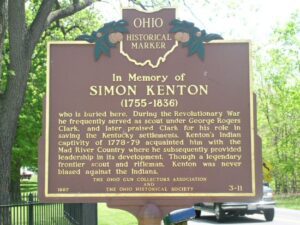
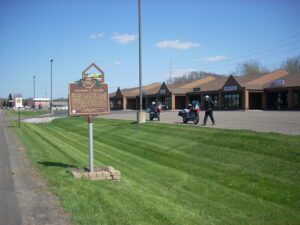
Simon Kenton who is buried here. During the Revolutionary War he frequently served as scout under George Rogers Clark, and later praised Clark for his role in saving the Kentucky settlements. Kenton’s Indian captivity of 1778-79 acquainted him with the Mad River Country where he subsequently provided leadership in its development. Though a legendary frontier scout and rifleman, Kenton was never biased against the Indians.
Charles E. Wilson was born on July 18, 1890 in Minerva. After earning a degree in electrical engineering from the Carnegie Institute of Technology in 1909, he joined the Westinghouse Electric Company in Pittsburgh before moving to General Motors in Detroit in 1919. By January 1941, Wilson had become president of General Motors, and during World War II directed the company’s huge defense production efforts, earning him a U.S. Medal of Merit in 1946. While still with General Motors, President Dwight Eisenhower selected him as secretary of defense in January 1953. During his confirmation hearings, Wilson said, “What was good for the country was good for General Motors and visa versa,” but was interpreted as saying solely, “What’s good for General Motors is good for America.” He served Eisenhower for four years, reorganizing the department of defense to effectively deal with missile and nuclear technology. He died in Norwood, Louisiana, on September 26, 1961.
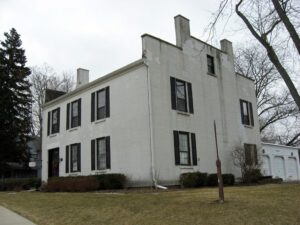
Old Wood County Jail 1847-1870. Built in 1847, during the Presidency of Polk, when Perrysburg was the County Seat, and used as the Jail and Infirmary until 1870. Continued to serve as the Perrysburg Jail until 1899, sold by the town in 1918. Acquired and restored by Mr. and Mrs. Charles W. Hoffmann in 1954. Listed in the Historic American Building Survey and National Register of Historical Landmarks, Library of Congress.
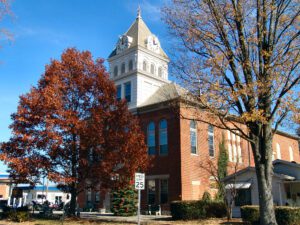
The Richwood Opera House and Town Hall was erected in 1890 as a community center designed to house the town council chambers, fire department, jail and opera house. The Richardsonian Romanesque styled building served Richwood in all these capacities for nearly 75 years. The Opera House was the site of minstrel shows, concerts, movies, lecture courses, revivals, farmers’ institutes, commencements, and community meetings. The second floor gymnasium was used for a men’s independent basketball league, dance classes, and as a teen center after World War II. Construction of an interurban railway running between Richwood and the resort town of Magnetic Springs in 1906 provided an expanded audience for the Opera House. (continued on other side)