SE corner of E Marietta Street and Creamery Street
Woodsfield
, OH
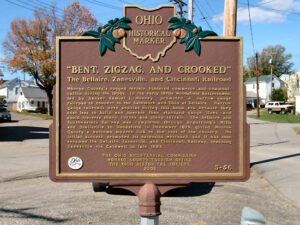
Monroe County’s rugged terrain hindered commerce and communication during the 1800s. In the early 1870s Woodsfield businessmen, led by banker Samuel L. Mooney, promoted a narrow-gauge railroad to connect to the Baltimore and Ohio at Bellaire. Narrow gauge railroads were popular during this boom era because they cost less to build and operate than standard-gauge lines and could traverse sharp curves and steep terrain. The Bellaire and Southwestern Railway was completed through Armstrong’s Mills and Beallsville to Woodsfield in December 1879, giving Monroe County a welcome modern link to the rest of the country. Its initial success prompted its extension westward, and it was soon renamed the Bellaire, Zanesville, and Cincinnati Railway, reaching Zanesville via Caldwell in late 1883.
The Independent Order of Odd Fellows (IOOF) traces its origins to mid-18th-century England, where it served as a mutual benefit society for traveling workmen. Odd Fellowship moved to the United States in 1819; the first Ohio lodge was established in 1830, and the Canfield Lodge was instituted in 1850. The charter members of this lodge were E.J. Estep, John G. Kyle, James Powers, W. M. Prentice, and William W. Whittlesey. Many of the early members of this lodge were businessmen, lawyers, physicians, and tradesmen. Lodge 155 remains one of the oldest active lodges in northeastern Ohio. (continued on other side)
The historic Law Farm (circa 1846) is situated in a broad valley formed by the confluence of Little Stillwater Creek and Plum Run in Monroe Township. Henry Law (1812-1869) immigrated from Ireland to Ohio in 1830. He married Elizabeth McMillan (1818-1892) in 1839, and they moved to their Monroe Township farm by 1846. The couple had eleven children and raised cattle, sheep, and other crops. By 1860, their farm was one of the most productive in Harrison County. In recognition of its agricultural and Scots-Irish immigration history, the Henry Law Farm Historic District was listed on the National Register of Historic Places in 2002. Its contributing buildings (1846-1920) included: two houses; a summer kitchen; tool, milk, coal, smoke houses; multiple barns; carriage houses; and other outbuildings.
Through the terms of his will, British absentee landowner Samuel Gist (c.1723-1815) freed his 350 Virginia slaves and provided funds for their relocation, the purchase of land and homes, and the establishment of schools and churches. Gist’s executors acquired over 2,000 acres of land in Ohio, including two large tracts in Scott and Eagle townships in Brown County in 1819. In 1831 and 1835, an agent of the Gist estate purchased 207 acres in Fairfield Township (now Penn Township), Highland County, and divided the acreage into thirty-one lots. The Gist Settlement in Highland County was the last to be purchased and settled. In 1857, the Ohio Legislature granted the Highland County Court of Common Pleas control over the freedmen’s trust monies. In 2003 descendants of the freed Gist slaves still inhabited part of the original settlement.
On this site stood the Main Gatehouse of the Anna Dean Farm, estate of Barberton town founder and industrialist Ohio C. Barber. The Anna Dean Farm was not only a lavish estate but also a farming showcase built to promote and develop scientific agricultural practices in the United States.
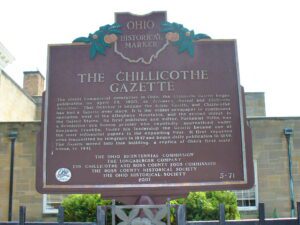
The oldest commercial enterprise in Ohio, the Chillicothe Gazette began publication on April 25, 1800, as Freeman’s Journal and Chillicothe Advertiser. That October it became the Scioto Gazette, and Chillicothe has had a Gazette ever since. It is the oldest newspaper in continuous operation west of the Allegheny Mountains, and the second oldest in the United States. Its first publisher and editor, Nathaniel Willis, was a Revolution-era Boston printer who reputedly apprenticed under Benjamin Franklin. Under his leadership the Gazette became one of the most influential papers in the expanding West. It first reported news transmitted by telegraph in 1847 and began daily publication in 1849. The Gazette moved into this building, a replica of Ohio’s first statehouse, in 1941.
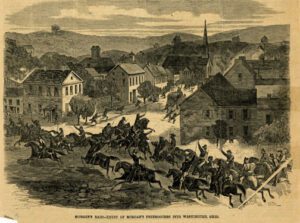
General John Hunt Morgan of Kentucky led a force of Confederate calvarymen into Meigs County during a forty-six day raid north of the Ohio River. The advance forces burned Benjamin Knight’s carding mill and sawmill, the Shade River Bridge, and pillaged local businesses in Chester on July 18, 1863, while waiting for the rest of the column to catch up. This two-hour halt delayed General Morgan’s arrival at the ford at Buffington Island until after dark, allowing Union troops to arrive before he could make his escape. General Morgan surrendered eight days later near West Point in Columbiana County, the northernmost point ever reached by Confederate forces during the Civil War.
Myron T. Herrick, Governor of Ohio from 1904 to 1906, was born in Huntington Township in 1854 and lived here until age 12. A respected Cleveland attorney and businessman, Herrick was a friend and confidant to Senator Mark Hanna and Presidents McKinley, Taft, and Harding. His public service career culminated in two appointments as ambassador to France, from 1912 through the outbreak of World War I in 1914, and again from 1921 until his death in 1929. Enormously popular with the French people, Herrick escorted Charles Lindbergh in Paris after his historic 1927 transatlantic flight.