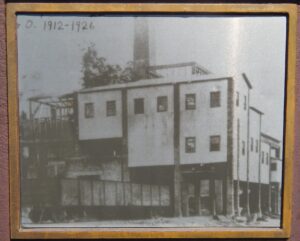
Approximately 150 feet east stood the Hisylvania Coal Company Mine No. 22 tipple, in use from 1912 to 1925. The company name was derived from combining “Ohio” and “Pennsylvania,” home states of its founders. Coal came from the mine portal in small railcars, was cleaned and sized in the tipple, and loaded into gondolas for shipment. The Mine No. 22 tipple had a brick and concrete frame, likely the only one of this type in Ohio. When demolished in 2000, it was one of the last tipples still standing as a reminder of Ohio’s 1880-1920 coal boom and the Hocking Valley coal field’s contribution during this era.
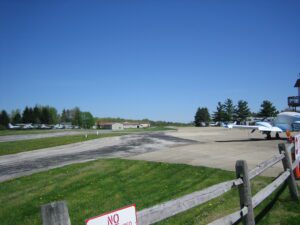
Daniel E. Weltzien, pilot and hometown son, dreamed of a flying community – one where every family would have a plane in their garage for work or play. In June 1965, the Williams Farm on Acme Hill became a runway with taxiways to every home. Young men and women came for flying lessons, and now traverse the world in space, the military, and commercially. Surviving fire, tornadoes, an earthquake, Ohio winters, and severe crosswinds, students still come here to take their first flight and become pilots. In Ohio, birthplace of aviation pioneers, this is “SKYPARK” THE FLYING COMMUNITY, a first in Ohio because a man dared to dream.
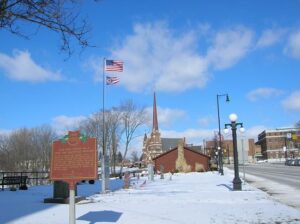
Old Erie received its original charter on October 19, 1803, from the Grand Lodge of Connecticut. In 1808, the lodge joined with five other Ohio lodges to organize the Grand Lodge of Ohio. The first man to preside as Grand Master of the Grand Lodge of Ohio was Governor Samuel Huntington, a member of Old Erie Lodge. [Masonic Emblem]
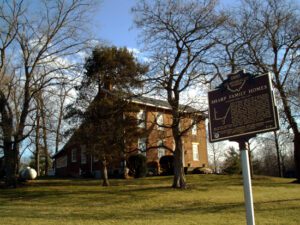
The Sharp family homes and their locations on N. State Street and Africa Road mark an important route through Westerville on the Underground Railroad. The family patriarch, Garrit Sharp, was an original settler of Sharp’s Settlement, now Westerville, and donated land for and helped organize the first Methodist church. He is also associated with the founding of Blendon Young Men’s Seminary, which was acquired by Otterbein College, an institution with enrollment open to African Americans and women from its inception in 1847. He and his sons were all noted abolitionists who, along with Bishop William Hanby and Otterbein president Lewis Davis, assisted southern slaves on their road to freedom. From the Sharp homes, slaves would have proceeded north to the house of Samuel Patterson on Africa Road and along Alum Creek to the Quaker settlement near Marengo in Morrow County.
Acclaimed author and illustrator of juvenile literature Lois Lenski was born in Springfield in 1893, grew up in Anna, and graduated from Sidney High School. In 1915, Lenski graduated from The Ohio State University and moved to New York City to work and study art. After illustrating several children’s books in the early 1920s, she began writing and illustrating her own stories. Lenski specialized in historical fiction and regional themes–eventually publishing nearly one hundred carefully-researched books.
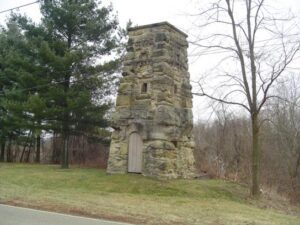
These three stone water towers were erected by local craftsmen in 1892 and serviced the Ohio Hospital for Epileptics until 1950. The sandstone of the uncoursed masonry walls was quarried from the surrounding hills. The hospital facility, a former Union Hospital site during the Civil War, was the first of its kind in the United States. The towers were restored in 1981-1982.
Camp Latty was located at the corner of Riverview and Glenwood Avenues in Napoleon, Ohio and included Glenwood Cemetery in its grounds. This camp was named for Judge Alexander S. Latty, a staunch supporter of the Union. From October to December 1861 the 68th Regiment was organized. The 68th Regiment then took part in the Battles of Fort Donelson, Shiloh, the Siege of Corinth, the Battles of Hatchies’s Bridge, Port Gibson, Raymond, Champion Hill, the Siege of Vicksburg, the Meridian Campaign, the Atlanta Campaign, the Battle of Kennesaw Mountain, the Battle of Atlanta, the Siege of Atlanta, the Battle of Jonesboro, Sherman’s March to the Sea, the Carolinas Campaign, the Battle of Bentonville, the Surrender of Johnston’s Army, and the Grand Review in Washington, D.C. The 68th Regiment served in every Confederate State except Florida and Texas. (Continued on other side)
Southeast of this point are the Big and Little tunnels. They were links in the 73-mile Sandy and Beaver Canal which connected the Ohio River with the Ohio and Erie Canal. Shifts of Irish laborers worked night and day with hand drills and blasting powder to cut the 1,060-yard Big Tunnel which opened for commercial use in 1850 and was abandoned two years later, a victim of the railroad.