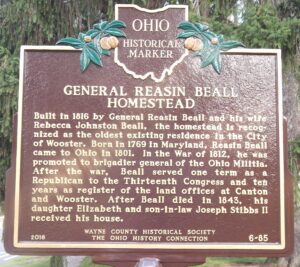
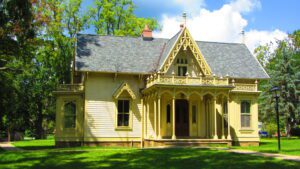
Built in 1816 by General Reasin Beall and his wife Rebecca Johnston Beall, the homestead is recognized as the oldest existing residence in the City of Wooster. Born in 1769 in Maryland, Reasin Beall came to Ohio in 1801. In the War of 1812, he was promoted to brigadier general of the Ohio militia. After the war, Beall served one term as a Republican to the Thirteenth Congress and ten years as a register of the land offices at Canton and Wooster. After Beall died in 1843, his daughter Elizabeth and son-in-law Joseph Stibbs II received his house.
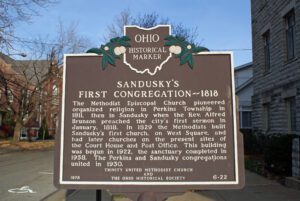
The Methodist Episcopal Church pioneered organized religion in Perkins Township in 1811, then in Sandusky when the Rev. Alfred Brunson preached the city’s first sermon in January, 1818. In 1829 the Methodists built Sandusky’s first church, on West Square, and had later churches on the present sites of the Court House and Post Office. This building was begun in 1922, the sanctuary completed in 1958. The Perkins and Sandusky congregations united in 1930.
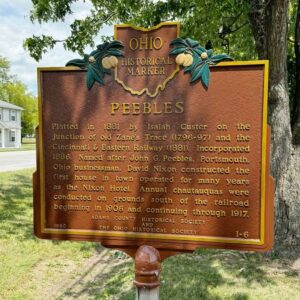
Platted in 1881 by Isaiah Custer at the junction of Zane’s Trace (1796-97) and the Cincinnati and Eastern Railway (1881). Incorporated 1886. Named after John G. Peebles, Portsmouth, Ohio, businessman. David Nixon constructed the first house in town, operated for many years as the Nixon Hotel. Annual chautauquas were conducted on grounds south of the railroad beginning in 1906 and continuing through 1917.
1806 – Built his log cabin home in Heaton Park, Vienna Avenue. 1806/07 – Constructed a grist mill, dam and mill race along Mosquito Creek. 1809 – Manufactured first bar iron in Ohio. 1812/13 – Constructed “Maria” blast furnace. 1820 – Built his residence at 1355 Robbins Avenue. 1834 – Platted 54 downtown lots. Names settlement “Nilestown.”
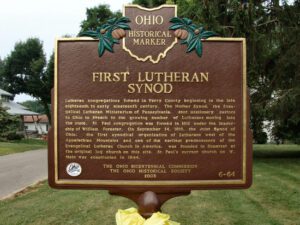
Lutheran congregations formed in Perry County beginning in the late eighteenth to early nineteenth century. The Mother Synod, the Evangelical Lutheran Ministerium of Pennsylvania, sent missionary pastors to Ohio to preach to the growing number of Lutherans moving into the state. St. Paul congregation was formed in 1812 under the leadership of William Forester. On September 14, 1818, the Joint Synod of Ohio, the first synodical organization of Lutherans west of the Appalachian Mountains and one of the earliest predecessors of the Evangelical Lutheran Church in America, was founded in Somerset at the original log church on this site. St. Paul’s current church on W. Main was constructed in 1844.
In 1938 the president of Kenyon College, Gordon Keith Chalmers, brought one of the nation’s most distinguished poets and critics, John Crowe Ransom, to the Gambier Hill. Chalmers brought Ransom to Kenyon College to create a distinguished literary review. With its first appearance late in 1938, The Kenyon Review would become one of the most influential and honored literary magazines in America. Among the authors Ransom published during his two decades as editor were Robert Penn Warren, William Empson, Flannery O’Connor, Doris Lessing, Robert Lowell, and Randall Jarrell. The Kenyon Review also became closely identified with the “New Criticism,” a method of interpreting literature that influenced succeeding generations of readers and teachers around the world. (Continued other side.)
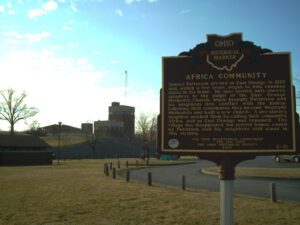
Samuel Patterson arrived in East Orange in 1824 and, within a few years, began to hide runaway slaves in his home. He also invited anti-slavery speakers to the pulpit of the East Orange Methodist Church, which brought Patterson and his neighbors into conflict with the bishop. Following their consciences, they became Wesleyan Methodists and built a new church. A pro-slavery neighbor mocked them by calling their community Africa, and so East Orange was renamed. The village has disappeared, but several homes owned by Patterson and his neighbors still stand in this vicinity.
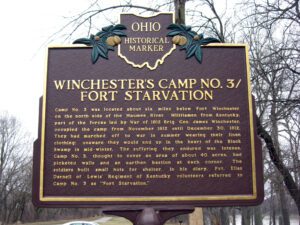
Camp No. 3 was located about six miles below Fort Winchester on the north side of the Maumee River. Militiamen from Kentucky, part of the forces led by War of 1812 Brig. Gen. James Winchester, occupied the camp from November 1812 until December 30, 1812. They had marched off to war in summer wearing their linen clothing; unaware they would end up in the heart of the Black Swamp in mid-winter. The suffering they endured was intense. Camp No. 3, thought to cover an area of about 40 acres, had picketed walls and an earthen bastion at each corner. The soldiers built small huts for shelter. In his diary, Pvt. Elias Darnell of Lewis’ Regiment of Kentucky volunteers referred to Camp No. 3 as “Fort Starvation.”