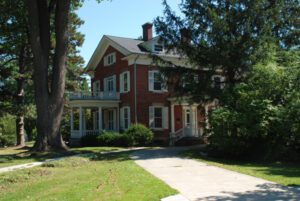
Jabez Lyman Burrell (1806-1900), originally from Massachusetts, built this house in 1852. Burrell made his living as a cattleman and farmer, but devoted much of his time serving the cause of abolitionism, helping slaves, who had escaped the South, get to Sheffield and from there to Lorain and across Lake Erie to Canada. He was also devoted to equal education for all, providing funding to a freedmen’s school in Selma, Alabama, and serving as a trustee of the Oberlin Collegiate Institute, well known for educating African Americans and women. From 1884 to 1934, this was the home of Henry Churchill King (1858-1934), who was the president of Oberlin College from 1902-1927. The Kings added the porches and rear wing and made their home a social center for the college and community. The house is listed on the National Register of Historic Places and is a City of Oberlin Historic Landmark.
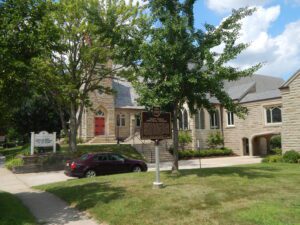
On March 11, 1817, Rev. Roger Searle of Connecticut met with a group of settlers at the home of Zenas Hamilton in Medina Township and founded St. Paul’s Episcopal Church. On April 10, 1817, the congregants cleared land near Weymouth and built a log church, which served as a school, place of worship for other dominations, and meeting house. The congregation eventually moved to Medina to serve the village’s growing population. Around 1883, noted Detroit architect Gordon W. Lloyd designed a new church in the Victorian Gothic style, thereafter described as “incomparably the finest Episcopal church in any country town at the time.” The first service was held on December 19, 1884. St. Paul’s was listed on the National Register of Historic Places in 1982 and is the oldest congregation in Medina County still in existence.
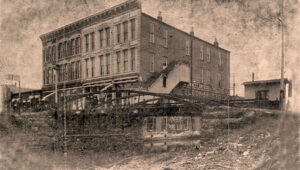
Emmitt-Greenbaum Building, 200 North Market Street, was built around 1878 by businessman and politician James Emmitt (1806-1893) to replace his 1837 wooden warehouse. The brick three-story Italianate building featured five vertical cast iron belts of simulated stone, a projecting cornice, reeded pilasters, and a “fortress-like fourteen bay front.” A covered wooden stairway on the building’s south side originally projected over the canal. Charles Louis Greenbaum (1871-1935) purchased the building in 1912 and opened his department store advertising it as “The Store with The Goods!” Over 140 years, the Emmitt-Greenbaum building was occupied by Jas. Emmitt Dry Goods, Hoffman’s, Greenbaum’s, Armbruster and Armbruster, Waverly Drugs, and the Bee Hive Tavern. A structural collapse after decades of deterioration condemned the building and the southwestern half was razed in 2021.
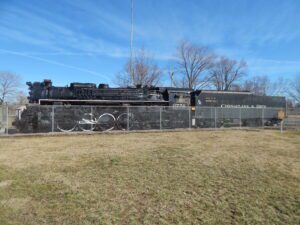
Granville T. Woods was a pivotal African American inventor during the late 19th and early 20th centuries. Woods’ invention of the telegraph device that enabled railway companies to know the location of each of their trains. This new technology greatly enhanced train scheduling and reduced the frequency of fatal collisions throughout the railway industry. From 1878 through 1880 Woods was a railroad locomotive engineer employeed by the Springfield, Jackson and Pomeroy Railroad Company and later by the Dayton and Southeastern Railroad. With frequent stops in Washington Courthouse and extensive leisure time, Woods learned telegraphy from a local telegraph operator. (Continued on other side)
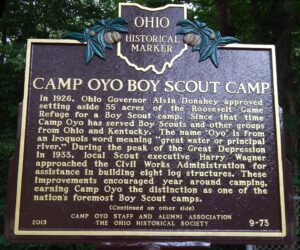
In 1926, Ohio Governor Alvin Donahey approved setting aside 55 acres of the Roosevelt Game Refuge for a Boy Scout camp. Since that time Camp Oyo has served Boy Scouts and other groups from Ohio and Kentucky. The name ‘Oyo’ is from an Iroquois word meaning “great water or principal river.” During the peak of the Great Depression in 1933, local Scout executive Harry Wagner approached the Civil Works Administration for assistance in building eight log structures. These improvements encouraged year around camping, earning Camp Oyo the distinction as one of the nation’s foremost Boy Scout camps. (Continued on other side)
Legend has it that Mogadore’s first settler, Ariel Bradley, was a spy for George Washington in October, 1776. As a nine year old boy, Ariel crossed British lines on a supposed errand to the nearest grist mill and returned with troop positions and tent counts. In 1801, Ariel left Connecticut to make his new home in what would be Ohio. In 1807, he built a log cabin on a 146 acre plot of farm land that cost $335. Until 1825 the new community had been named Bradleyville, but Ariel did not want the area named after him. Martin Kent was building a residence and a sailor, John Robinson, climbed to the top of the framework, pulled a flask of whiskey from his pocket. Breaking the flask on the last beam of construction, Robinson shouted “Three cheers for Mogador,” which is a large city in Morocco, thusly christening the area Mogadore.
Song writer and minister of the United Brethren Church, Hanby was an Otterbein College graduate, class of 1858, known throughout the world for the inspiring songs, “Darling Nellie Gray,” “Up on the Housetop,” and “Who is He in Yonder Stall.” Hanby House in Westerville is maintained as a memorial honoring Benjamin and his father, Bishop William Hanby.
David Stearns, the first permanent settler, built a log cabin near this site on the “ridge” (Lorain Road) in 1816. Stearns was given this land by his father, Elijah, who had bought 1,002 acres from the Olmsted family. This area of North Olmsted was first called Kingston, renamed Lennox in 1823, and Olmsted in 1829. In 1827, Stearns donated his cabin to the community to be used as the first schoolhouse. In 1852 the cabin was moved to Butternut and Dover Center and continued to serve as a school.