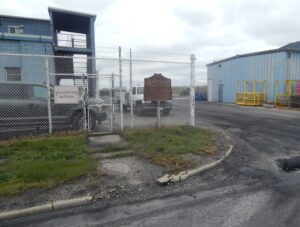
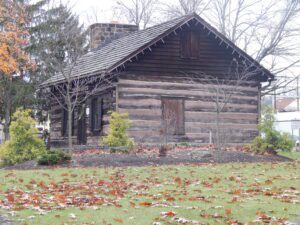
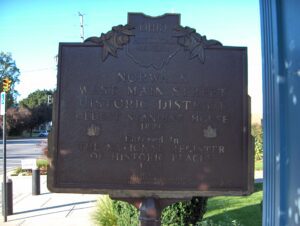
Near this site scout Peter Navarre built in 1807 a log cabin close by an Ottawa Indian Village of 60 whitewashed cabins. Here he maintained friendly relations between white settlers and Chief Autokee. The 1833 Treaty of Maumee gave 320 acres of this region to the Indians who later sold the isle for $1,000. Presque Isle is now at the heart of Port of Toledo activity.
This log building was constructed in 1801 by David Hoge on the west side of Third Street. It served as his home and was the first Federal land office in that part of the Northwest Territory known as the Seven Ranges. In 1809 it was moved and 12 years later encased in a brick structure where it was discovered in 1940. It has been preserved by the citizens of Jefferson County.
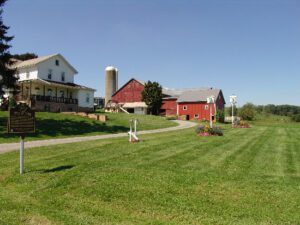
Jonas Stutzman, from Somerset County, Pennsylvania, came to this site in 1809 to clear land for farming and to build a log home for his family. He was the first permanent settler in the eastern portion of what would in 1825 become Holmes County. Jonas and his wife Magdalena Gerber Stutzman were of the Amish faith–descendants from a group of strict Protestant Anabaptists with origins in Switzerland and Holland and dating from the 16th -century Protestant Reformation. Some of their beliefs, including separation of church and state, refusal to take oaths, pacifism, and believer’s baptism, were perceived as threats to the state church and government. Persecuted by both Catholics and Protestants, Anabaptists migrated and some came to the New World, many at the invitation of Pennsylvania’s William Penn. The Stutzmans and other early Amish pioneer setters-Millers, Hershbergers, Hochstetlers, Weavers, Troyers, Masts, and Schrocks-founded here what has become the largest Amish settlement in North America.
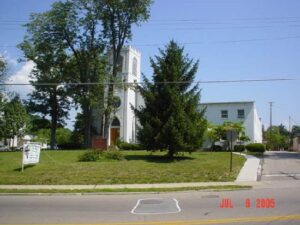
Founded in 1797 in the log cabin of the Reverend Francis McCormick, the Milford Methodist Church is the oldest of the denomination in the Northwest Territory and Ohio. Pioneer worshipers walked many miles through the wilderness to attend its circuit rider services. The present sanctuary was consecrated on Christmas Day, 1835. The bell tower and Sunday School rooms were 1870 additions.
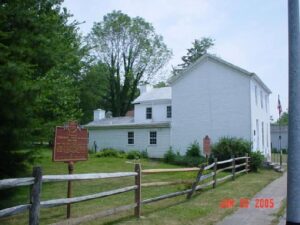
U.S. Grant, general-in-chief of the Armies of the United States, 18th president and first native Ohioan to be elected chief executive, lived in this house from 1824 to 1839. Jesse R. Grant, his father, built the original part fronting Water Street in 1824 and later built an addition fronting Main Cross Street, now Grant Avenue. “This place remained my home, until at the age of seventeen, in 1839, I went to West Point.” Memoirs of U.S. Grant
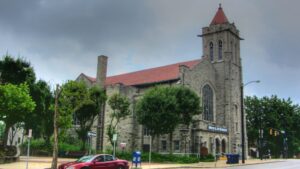
Oldest Religious Congregation in north-central Ohio. First Methodist Sermon preached at the “spring” in 1809 by Rev. James Copus. Services then conducted in blockhouse, 1811; in first court house, 1813; at church home of Dr. William B. James, 1814; first church building located N.W. corner Park Avenue East and Adams, 1820; present site in 1870. All land donated by General James Hedges, a distinguished member.