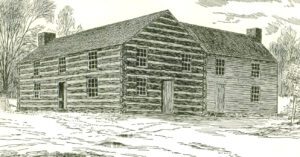
With the Division Act of 1800, the U.S. Congress divided the Northwest Territory at a line essentially the present boundary of Indiana and Ohio. The Indiana Territory stood west of the line. The name Northwest Territory was retained for the land east of the line and Chillicothe became its capital. The legislature for the territory convened in Chillicothe in November 1800. Since there were no public buildings in which the legislature could meet, its session was held in a two-story log house that stood on this site called “Abrams’ Big House.” It was so called for its owner, Basil Abrams. During the War of 1812, the building served as the barracks for the 19th U.S. Regiment of Infantry. Thereafter, it was known as the “old barracks” until it was razed circa 1840.
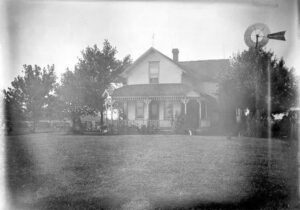
First a farming community, later a railroad crossroads in southern Hancock County, Arlington was one of the county’s earliest settlements. Gen. William Hull opened a trail into the area during the War of 1812 as he crossed Buck Run at Eagle Creek. He led his army to the Blanchard River to establish Ft. Findlay. Robert Hurd owned extensive tracts of land in the area, and his sons were the first recorded settlers, building a log cabin near this site in 1834. The rich farmland and abundant water soon attracted other settlers to the vicinity of “Hurdtown.” The name was changed to “Arlington” when the village was formally surveyed in November, 1844.
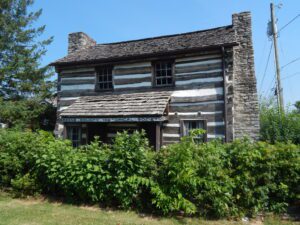
James Sr. and Rebecca (Junkin) Galloway moved with their family to Greene County from Kentucky in 1798, constructing their first home, a small log cabin. Galloway built the present structure around 1799 near the bend in the Little Miami River near what is now Goes Station on U.S. 68. In 1936, the Greene County Historical Society moved the home to the corner of Second and Monroe streets and then to the present site in 1965. The 1974 Xenia Tornado caused serious damage to the building, which has been restored and maintained by the historical society. James Sr. served as a hunter during the American Revolution, procuring game for the army, and while in Ohio, was the first treasurer of Greene County. His son James Jr. served as the first County Surveyor.
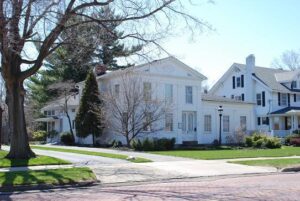
Among the fifty-four buildings that comprise the Mentor Avenue District are examples of Federal, Greek Revival, Early Romanesque Revival, Italianate, Second Empire, Queen Anne, and twentieth century eclectic styles. Renowned master builder Jonathan Goldsmith (1783-1847), whose Federal and Greek Revival designs define the so-called “Western Reserve” style, built at least two of these houses; the Denton-Powers House (ca. 1820) is representative. The Mentor Avenue District was added to the National Register of Historic Places in 1979. The Painesville City Hall, the Sessions House (157 Mentor Avenue) and the Smead House (187 Mentor Avenue) are also listed individually on the National Register.
In 1918, Charles Young made a desperate attempt to convince the U.S. Army that he was fit for duty. The Army’s highest-ranking Black officer, he had been medically retired and not given a command during World War I. To demonstrate his fitness, he rode 497 miles from his home in Wilberforce, Ohio, to Washington, D.C. Leaving on June 6 he made the journey in 17 days, 16 on horseback and 1 resting. Averaging 31 miles each day, he rode 45 minutes and walked 15 minutes every hour. Upon his arrival, Young met with Secretary of War Newton Baker. Pressured by the Black press and the White House, Baker hedged. He recalled Young to active duty a year later and assigned him to Camp Grant, Illinois, just five days before the end of the war.
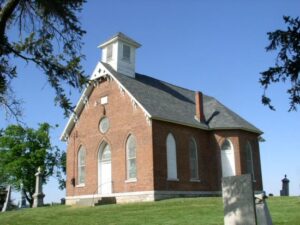
The first Mt. Tabor Church, a log meetinghouse, was erected on this site in 1816. It stood on land originally selected by Griffith and Martha Evans for a graveyard at the death of their daughter circa 1812. Deeds show the Evans family gave two and one half acres of land “for the purpose of erecting a meetinghouse and establishing a burying site.” Camp meetings, religious gatherings popular in frontier Ohio, were held on the hillside west of the meetinghouse. Simon Kenton was converted at a Mt. Tabor camp meeting in 1819. The log meetinghouse burned in 1824 and was replaced with a brick church on the same spot. In 1881, the present brick church was completed and dedicated.
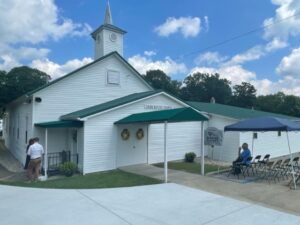
Union Baptist Church, established in 1819, is one of Ohio’s early Black churches. Its pastor and members were active on the Underground Railroad from that early date. Between the 1840s-1860s Black churches along the route to and from nearby Poke Patch assisted over 200 escaped slaves. Members met in their homes until able to obtain a log cabin (circa 1879) on a Blackfork farm. In 1919, a larger church was built on land given by The Cambria Clay Products Company. The adjacent cemetery has over fifty veterans from the Civil, Spanish American, both World, Korean, and Vietnam wars. Donald Russell Long, laid to rest in 1966, received a posthumous Congressional Medal of Honor. Union Baptist Church, the historic foundation of the Poke Patch-Blackfork community, celebrates an annual Church Anniversary to honor its legacy.
This pioneer village, which was united with its downriver rival, Vistula, to be incorporated as Toledo in 1837, was platted by Cincinnati businessmen in 1817. The “Panic” of 1819 caused the enterprise to default. The village was re-platted in 1832. A two-story log warehouse along Swan Creek was the first important structure. The village was named for Captain James Lawrence, War of 1812 naval hero.