

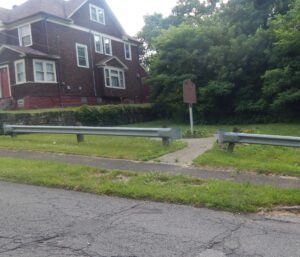
, OH
Oscar D. Boggess (1832-1907) was born in Virginia, the son of a slave and her master. He and his family were granted freedom in the will of his father and master. The will was contested up to the United States Supreme Court, which upheld Boggess’ freedom. Boggess moved to Pennsylvania at age 20, and during the Civil War, joined the 43rd United States Colored Troops. He earned the Butler Medal of Honor for bravery at the Battle of the Crater near Petersburg, Virginia, in July 1864. Boggess moved to Youngstown after the war, and worked as a stonemason. He was a charter member of Tod Post 29, Grand Army of the Republic, in Youngstown, and a co-founder of the Oak Hill Avenue African Methodist Episcopal Church, the city’s first African American religious congregation. The Boggess home, formerly located near this site, hosted the church’s first meetings in 1870.
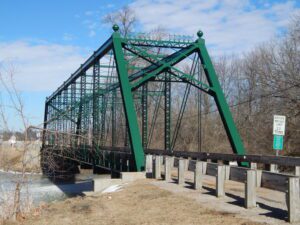
, OH
The Bridgeport Iron Bridge, often called the Streng Road Iron Bridge, was built in 1914. It replaced a wooden covered bridge built in 1869 by Reuben L. Partridge (1823-1900) and Isaac J. Grummons (1828-1921), which was damaged by the flood of 1913. The 200′ steel superstructure uses a pin-connected Pratt Through truss design and was constructed by the Central Concrete & Construction Company, Canton, Ohio, at a cost of $8,987. The original substructure abutments were constructed by John A. Maugans (1861-1933) for $3,248, but have since been replaced. In 1992 and 1993, the bridge was renovated under the leadership of County Engineer Steve A. Stolte and Assistant Engineer Jeff Stauch.
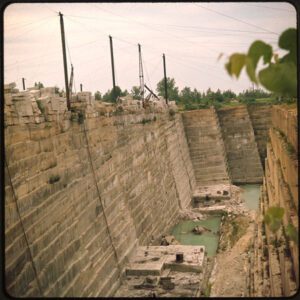
, OH
For more than ninety years, this area was the heart and soul of Berea’s sandstone quarries. In the early 1830s, John Baldwin discovered that the area’s sandstone deposits made superb grindstones and building stones. In the 1840s, thriving sandstone quarries developed and became Berea’s lifeblood. Searching for the “American Dream,” German, Irish, Italian, Hungarian, and Polish immigrants, among others, came here to work. The quarries eventually encompassed nearly 250 acres and consumed the fashionable houses of Berea’s “South Side” and the buildings of Baldwin University. The Cuyahoga County Court House, Ohio’s Capitol, and Canada’s parliament buildings are among many structures in North America and Europe constructed of Berea sandstone. Decreasing demand for sandstone and the Great Depression closed the last of Berea’s quarries in the mid-1930s.
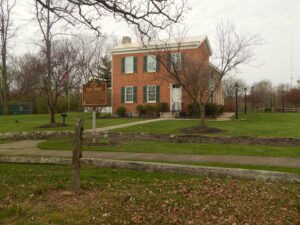
, OH
Elisha Morgan purchased 48.6 acres in Fairfield Township, part of the Symmes Purchase, in 1817. The Farm Mansion was built shortly after he settled the land. The house incorporates two prevalent architectural styles in southwest Ohio in the nineteenth century. The original front portion is an example of Federal style architecture while the 1858 rear addition represents the Greek Revival style. Built earlier than most farmsteads in the township, the Mansion is a rare example of an early farmhouse that has survived despite suburban development. The Mansion is listed on the National Register of Historic Places.
, OH
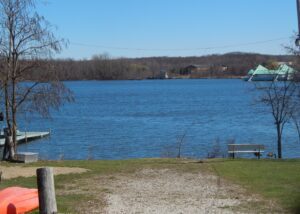
Geauga Lake, a scenic destination for visitors to northeast Ohio, was initially named “Giles Pond” after settler Sullivan Giles (1809-1880). In 1856, the predecessor of the Erie Railroad stopped at “Pond Station,” spurring the area’s growth. In the 1880s, locals established picnic grounds, a dance hall, and other facilities for those seeking a country getaway. Picnic Lake Park, later Geauga Lake Park, opened in 1887 and thereafter offered rides, a roller rink, photo gallery, billiard hall and bowling alley, among other attractions. In 1888, the Kent House hotel opened on the southeast side of the lake. In the century that followed, more attractions were added, including SeaWorld of Ohio, and the park expanded. In 2007, the melodic sounds of the carousel and the echoing screams from the “Big Dipper” roller coaster ceased when the park closed. (Continued on other side)
, OH
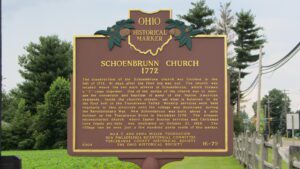
In December 1772, Brother David Zeisberger and his followers began the construction of Schoenbrunn schoolhouse. The school was built in the Tuscarawas Valley on land given to Zeisberger in the spring of 1771 by the Delaware Native Americans as a Moravian mission to the Delaware. With the land, Zeisberger laid out the town of Schoenbrunn or “Beautiful Spring.” The school served Delaware Indian children, who were taught from special textbooks prepared in the Delaware and German languages by Zeisberger. John Heckewelder, who taught at the school, is recognized as the first schoolteacher in Tuscarawas County. The present reconstructed schoolhouse was dedicated on July 29, 1928 on the 155th anniversary of the completion of the school’s construction. The village can be seen just a few hundred yards south of this marker.
, OH
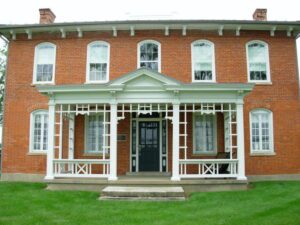
Known as the “Halfway House,” the Gooding House and Tavern was built by George B. Gooding halfway between the towns of Worthington and Delaware in 1827. Its location was influenced by construction of the Columbus and Sandusky Turnpike that was chartered by the State of Ohio the year before. Also known as the “Mud Pike,” the turnpike was slow and difficult for travelers and could take nearly a day to travel 10 miles. The Gooding House was the perfect place for stagecoach drivers to change teams of horses and for travelers to rest and have refreshments. George Gooding also prospered as a farmer with over 1,000 acres of land. This stately brick farmstead remained in the Gooding family for 175 years with each succeeding generation adding its imprint on the property. The Gooding House and Tavern was listed on the National Register of Historic Places in 2005 and restored in 2007.
, OH
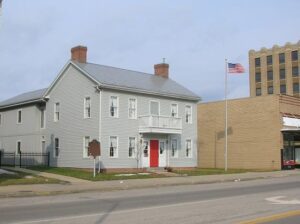
One of seven native Ohioans to serve as president of the United States, William McKinley (1843-1901) was born at this site. The original house was moved from this site and ultimately destroyed by fire. The McKinleys lived here until 1852 when they moved to Poland, Ohio, where William attended the Poland Seminary. He briefly attended Allegheny College in Pennsylvania, but poor health and family financial strain forced him to return to Ohio. As an enlistee in the 23rd Ohio Volunteer Infantry during the Civil War, McKinley rose to the rank of major. After the war, he settled in Canton and practiced law. Elected to Congress in 1876, McKinley favored high protective tariffs, a policy he continued to support as President.(Continued on other side)