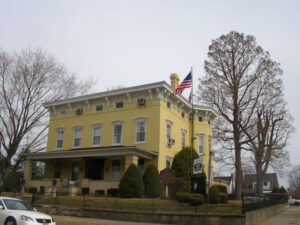
John Campbell (1818-1891), founder of Ironton, was an ironmaster and president of the Ohio Iron & Coal Company, a Presbyterian, and an abolitionist. This house and barn, which he built in 1850, became a stop on the Underground Railroad for slaves crossing the Ohio River from Kentucky. Fugitives were concealed here and furnace wagons transported the escapees northward by way of Campbell’s furnaces in Lawrence and Jackson counties.
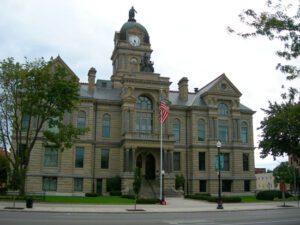
Hancock County was organized March, 1828, court being held in a log schoolhouse. In 1833, a frame courthouse was built. It served until 1840, when a brick structure went up on this site. During the oil and gas boom of the 1880’s, the present courthouse was erected at a cost of $305,272, and dedicated Oct. 27, 1888.
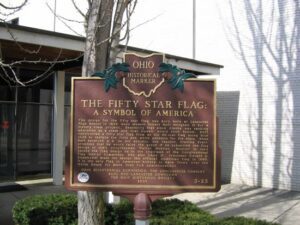
The design for the fifty star flag was born here at Lancaster High School in 1958 when student Robert Heft designed it for a history class project. Reasoning that since Alaska was seeking admission as a state and that Hawaii would soon follow, Heft constructed a fifty star flag from an old 48-star flag using blue cloth to replace the field and white adhesive for the stars. When Heft received a B- on his project, his teacher, Stanley Pratt, promised that he would raise the grade if he submitted the flag design to their congressman, Walter Moeller. Moeller in turn passed the flag design on to the chairman of the Congressional Flag Design Committee, who also liked it. President Dwight D. Eisenhower made the design the official American flag in 1960. It is the only flag in American history to have flown over the White House for more than five administrations.
St. Joseph Catholic Church, called the cradle of the faith in Ohio, was the first Catholic church in the state. In 1809, Jacob and Catharine Dittoe deeded Father Edward Fenwick, who had traveled from Kentucky, 320 acres of ground to build the church. The original church, dedicated on December 6, 1818, by Father Fenwick and Father Nicholas Dominic Young, was a log cabin with a bare dirt floor measuring 18 feet by 22 feet. Father Fenwick was soon installed as the first Bishop of Cincinnati. Construction on the present church began in 1839.
Here in 1887, frustrated locals destroyed the Six Mile Reservoir when legal efforts to close it failed. Years after any boat ran on the Wabash & Erie Canal, its water source, the 2,000-acre reservoir, became a stagnant, uncultivable breeding ground for disease-carrying mosquitos. Legislative attempts to abandon the canal and reservoir failed because manufacturers in Defiance used the waterway to float logs downstream. On the night of April 25, 1887, 200 men calling themselves “The Dynamiters” carried a banner that read, “No Compromise! The Reservoir Must Go!” and converged here, overpowered citizen guards, gouged the banks of the reservoir, dynamited the bulkhead and lock, and burned down the lockkeeper’s house. The next day, Governor Joseph B. Foraker denounced the acts of the “mob of lawless and rioting men.” (Continued on other side)
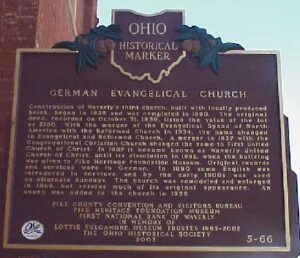
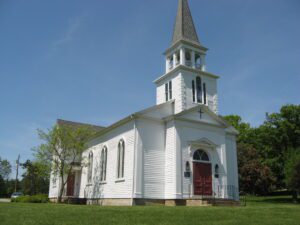
Construction of Waverly’s third church, built with locally produced brick, began in 1859 and was completed in 1860. The original deed, recorded on October 31, 1859, listed the value of the lot as $180. With the merger of the Evangelical Synod of North America with the Reformed Church in 1934, the name changed to Evangelical and Reformed Church. A merger in 1957 with the Congregational Christian Church changed the name to First United Church of Christ. In 1987 it became known as Waverly United Church of Christ, until its dissolution in 1992, when the building was given to Pike Heritage Foundation Museum. Original records and services were in German. In 1890 some English was introduced in services, and by the early 1900s was used on alternate Sundays. The church was remodeled and enlarged in 1869, but retains much of its original appearance. An annex was added to the church in 1959.
The first home of the oldest Episcopal parish in the Connecticut Western Reserve, the St. James Episcopal Church was built between 1827 and 1828. Philander Chase, first Bishop of the Diocese of Ohio, consecrated it in 1829. The belfry and steeple were added in 1881. It was moved to this site from its original Market Street location in 1972 after the parish built a new church. Renamed the St. James Meeting House, it is the anchor of a community of historic buildings that includes the Beardsley-Walter-Diehm House (circa 1828), the Oswald Detchon House (circa 1840), and the Schiller-Chuey Summer Kitchen. The oldest known structure in Boardman, the St. James Meeting House was added to the National Register of Historic Places in 1979.
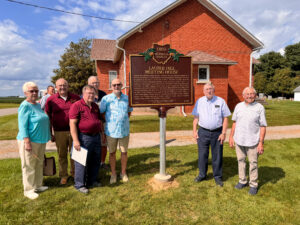
In 1834, immigrant families from the Upper Rhine River Valley villages of Mulhausen (France) and Schaffhausen (Switzerland) first met in Marshallville, Ohio. They decided to travel west by canal boat and purchase farmland in what became Fulton County in 1850. Joseph Bates, a knowledgeable hunter and navigator, brought them to German Township. On August 22, 1834, Bates and his hired men erected a log cabin for Christian Lauber and the first families arrived at “Lauber Hill” the following day. The farming community grew and by the 1880s included a Reformed Mennonite Church, a German Baptist Church, a Froehlich Evangelical Church, the Barneth (Bernath) one-room school, the Werrey Cabinetmaker’s Shop, the Roth Sawmill, the Uhlrich Wagon Shop, the Wise Brickworks, and the Leu Blacksmith Shop.