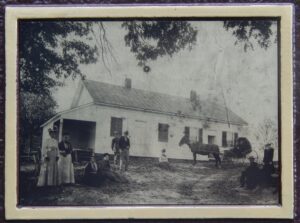
Congregations of the Religious Society of Friends (Quakers), called “meetings”, worshiped in plain meeting houses. On this site stood the last Richland Friends Meeting House, built in 1872. Ninety-four Friends established the meeting in 1826 and it endured for 147 years. The cemetery is where many generations of members of this meeting are buried. The faith, based on pacifism and simplicity, blossomed in the region during the first half of the 19th century. (Continued on other side)
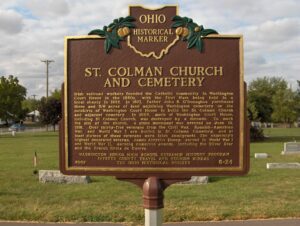
Irish railroad workers founded the Catholic community in Washington Court House in the 1850s, with the first Mass being held in a local shanty in 1852. In 1871, Father John B. O’Donoghue purchased three and 5/8 acres of land adjoining Washington cemetery on the outskirts of Washington Court House to build the St. Colman Church and adjacent cemetery. In 1885, much of Washington Court House, including St. Colman Church, was destroyed by a tornado. To mark the site of the church, a stone monument was erected on June 19, 1916. Over thirty-five veterans from the Civil War, Spanish-American War, and World War I are buried in St. Colman Cemetery, and at least sixteen of these veterans were Irish immigrants. The cemetery’s highest decorated veteran, James Aloysius Ducey, served in World War I and World War II, earning numerous awards, including the Silver Star and the French Croix de Guerre.
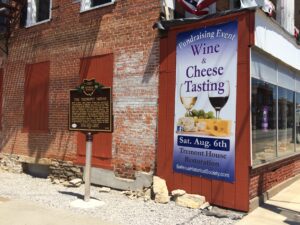
Built in 1846, the Tremont House was opened by Loel and Samuel B. Chandler to serve stagecoach traffic on the Maumee Pike (U.S. Route 20). Briefly a hotel, this Bellevue landmark has housed grocery and hardware stores, a pharmacy, and even a cigar factory. The third floor ballroom hosted community events and fraternal organizations such as the Independent Order of Odd Fellows (IOOF). The building’s west side is on the western boundary of the Firelands region of the Connecticut Western Reserve. An example of Greek Revival architecture, the Tremont House was listed on the National Register of Historic Places in 2006.
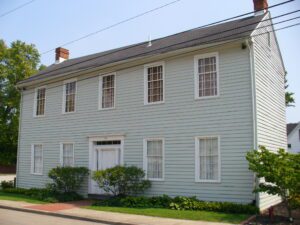
First Lady Lucy Ware Webb Hayes was born in this four-room Federal Vernacular house in 1831. Well educated for her time, she attended local schools, took classes in the preparatory department of Ohio Wesleyan University in Delaware, and graduated from Wesleyan Female College in Cincinnati in 1850. She married lawyer and future U.S. President Rutherford B. Hayes in 1852. They raised five children to adulthood. As a colonel’s wife during the Civil War, “Mother Lucy” boosted morale for the soldiers of the 23rd Ohio Volunteer Infantry regiment. In 1870, during Hayes’ first term as governor of Ohio, Lucy helped establish the Ohio Soldiers’ and Sailors’ Orphans’ Home as a state institution. (continued on other side)
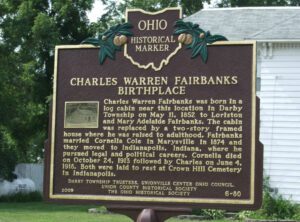
Charles Warren Fairbanks was born in a log cabin near this location in Darby Township on May 11, 1852 to Loriston and Mary Adelaide Fairbanks. The cabin was replaced by a two-story framed house where he was raised to adulthood. Fairbanks married Cornelia Cole in Marysville in 1874 and they moved to Indianapolis, Indiana, where he pursued legal and political careers. Cornelia died on October 24, 1913 followed by Charles on June 4, 1918. Both were laid to rest at Crown Hill Cemetery in Indianapolis.
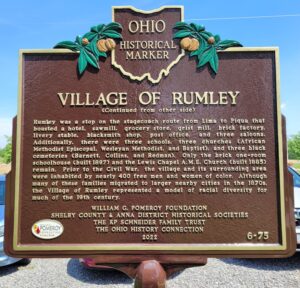
The Temple of Rumley Church is of one of two remaining buildings in what once was Rumley, a thriving African American community in Shelby County. On May 19, 1837, the village was surveyed for Amos Evans, who built his hewed log dwelling and store. Brothers Joel and George Goings (aka. Goens), freed black men from Monongalia County, Virginia, purchased 80 acres of land that same year. They settled with their families near Rumley in Van Buren Township along with other free men and women of color, including former slaves. Joel Goings erected the first brick house in 1841, using bricks from his own brickyard. By 1846, the Rumley community stretched over 7,000 acres and included the Collins, Redman, Williams, Davis, Lett, and Brown families. (Continued on other side)
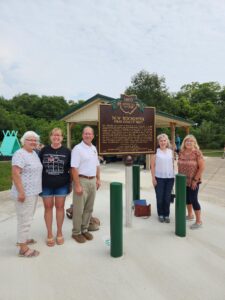
New Rochester was platted in 1835 in an area recognized as a vital transportation hub through the Great Black Swamp. The 18-acre plat was situated on a high bluff overlooking the Maumee River. A 2009 archaeological survey discovered stone tools and evidence of 4,000 years of habitation. When Paulding County was organized in March 1839, New Rochester was designated as its county seat. On November 21, 1839, three associate judges of the common pleas court appointed a clerk pro tem and sheriff. As no courthouse was built by April 1840, the court convened in a room above H.N. Curtis’s General Store. At that time, New Rochester was a flourishing village with thirty to forty families, three hotels, three stores, two blacksmiths, a post office, a school, and three taverns. (Continued on other side)
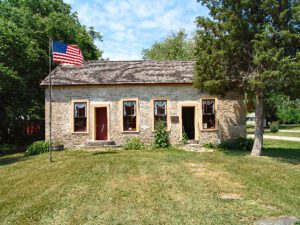
Built in 1822, this native limestone structure was the home of Benajah Wolcott, first keeper of the Marblehead Lighthouse (originally called the Sandusky Bay Light), and his second wife, Rachel Miller Wolcott. Benajah maintained the lighthouse from 1822 until his death ten years later. After Benajah’s passing the U.S. Government appointed Rachel as the keeper, making her the first female lighthouse keeper on the Great Lakes. The building is the oldest known residence still standing in Ottawa County and is a fine example of a “hall-and-parlor house,” an early American home design.