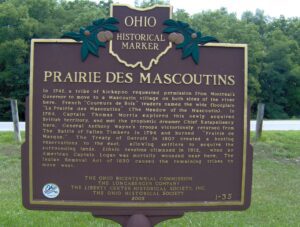
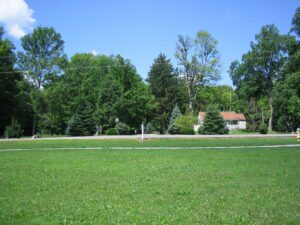
In 1742, a tribe of Kickapoo requested permission from Montreal’s Governor to move to a Mascoutin village on both sides of the river here. French “Coureurs de Bois” traders named the wide floodplain “La Prairie des Mascoutins” (The Meadow of the Mascoutin). In 1764, Captain Thomas Morris explored this newly acquired British territory, and met the prophetic dreamer Chief Katapelleecy here. General Anthony Wayne’s troops victoriously returned from The Battle of Fallen Timbers in 1794 and burned “Prairie de Masque.” The Treaty of Detroit in 1807 created a hunting reservation to the east, allowing settlers to acquire the surrounding lands. Ethnic tensions climaxed in 1812, when an American Captain Logan was mortally wounded near here. The Indian Removal Act of 1830 caused the remaining tribes to move west.
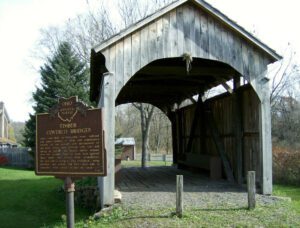
This covered bridge, over Middle Run, Elkrun Township, Columbiana County, is the shortest covered bridge in the United States still standing on a once-used public highway, having a clear span of 19 feet and 3 inches. It is an example, rarely found covered, of the simplest, most basic truss design, the two-panel king post truss. It has withstood the rigors of time and traffic since the 1870s and stands in eloquent testimony of the fine craftsmanship of the early Ohio bridge builders.
Fort Amanda State Memorial, OH 198, 1/4 mile S of Ft. Amanda Road, Lima
Lima
, OH
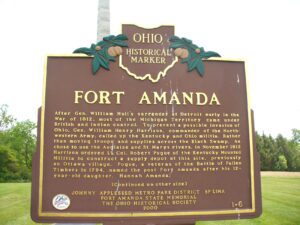
After Gen. William Hull’s surrender at Detroit early in the War of 1812, most of the Michigan Territory came under British and Indian control. To prevent a possible invasion of Ohio, Gen. William Henry Harrison, commander of the Northwestern Army, called up the Kentucky and Ohio militia. Rather than moving troops and supplies across the Black Swamp, he chose to use the Auglaize and St. Marys rivers. In November 1812 Harrison ordered Lt. Col. Robert Pogue of the Kentucky Mounted Militia to construct a supply depot at this site, previously an Ottawa village. Pogue, a veteran of the Battle of Fallen Timbers in 1794, named the post Fort Amanda after his 12-year-old daughter, Hannah Amanda. (continued on other side)
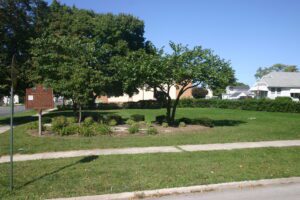
This monument marks the square of the village of Risdon founded 1832. The land was owned by John Gorsuch, who settled here with his family in a clearing along the Portage River in 1831. He had a plat of the area made by David Risdon, Seneca County surveyor, after who the town was named. This plat was officially recorded September 13, 1832. The village of Risdon had the first church and post office, and has the oldest house in Fostoria.
Regular and militia troops under General James Wilkinson built this supply post and defensive fortification in March 1792 in preparation for Gen. “Mad Anthony” Wayne’s campaign against the Indians of the Northwest Territory, following disastrous expeditions in 1790 and 1791. Built near a “fine spring gushing out of the bank, ” the 120-foot square palisade fort had a four-sided bastion at each corner. Future U.S. president William Henry Harrison served in the detachment that built the fort. On November 6, 1792, Miami Chief Little Turtle and approximately 200 warriors attacked a force of Kentucky militia under Maj. John Adair camped outside the fort. Six Kentuckians and an unknown number of Indians died in the skirmish. The fallen soldiers were buried fifty paces west of the fort, beneath the “Whispering Oak.”
SW corner of W. Monroe Street and S. Washington Street
New Bremen
, OH
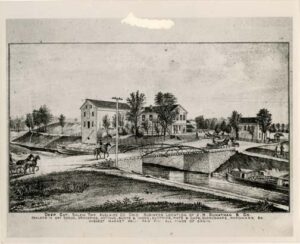
Begun in 1833, the Miami Extension Canal linked the Miami Canal in Dayton to the Wabash & Erie Canal at Junction. Engineering difficulties, epidemics, and the Panic of 1837 delayed completion of the Extension until June 1845, when the packet boat Banner first navigated the almost 250 miles distance from Cincinnati to Toledo in three days. New Bremen was the northern terminus for a period while work continued northward on the Extension. Designated the Miami & Erie Canal in 1849, it served as the primary avenue of commerce and military transport, and as a “post road” before the railroad era. The Miami & Erie remained in use until 1913, long after the canal era had passed. Along the course of the canal, New Bremen was the approximate midway point between Cincinnati and Toledo.
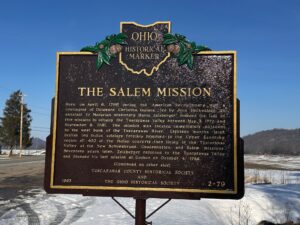
Here, on April 6, 1780 during the American Revolutionary War, a contingent of Delaware Christian Indians, led by John Heckwelder, an assistant to Moravian missionary David Zeisberger, founded the last of five missions to occupy the Tuscarawas Valley between May 3, 1772 and September 8, 1781. The mission was located immediately adjacent to the west bank of the Tuscarawas River. Eighteen months later, British led Indian soldiers forcibly removed to the Upper Sandusky region all 400 of the Indian converts then living in the Tuscarawas Valley at the New Schoenbrunn, Gnadenhutten, and Salem missions. Seventeen years later, Zeisberger returned to the Tuscarawas Valley and founded his last mission at Goshen on October 4, 1798.
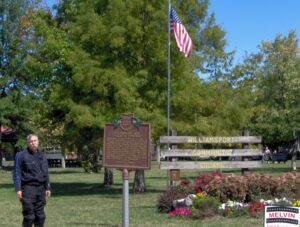
In 1772-73 missionary David Jones visited Blue Jacket’s Town, a settlement of 12 cabins downstream on the east bank and Pickaweekee, a Shawnee town, on the west bank. Deercreek Methodist Circuit Deacon, Dr. Edward Tiffin, met settlers after 1798. Dr. Tiffin was later elected first governor of Ohio. A station of Virginia bounty-land settlers, “Williams Town,” assembled here around 1797. Mill sites, established before Pickaway County, flourished in the dense oak forest of Deercreek Township. Frontier hotels in Williamsport prospered due to the “healthful” sulphur springs.