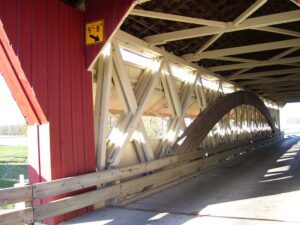
Constructed in 1873, the Bigelow Bridge spans approximately 100 feet across Little Darby Creek. Reuben Partridge built the superstructure at a cost of $12.50 per linear foot ($1,500). Bercupile & Snell built the masonry foundation at a cost of $7.00 per perch (a perch is approximately 25 cubic feet). Partridge built bridges throughout Union County and the surrounding area from 1866 until his death in 1900. The covered bridge is named for Eliphas Bigelow, an early resident of Union County, who built the nearby Bigelow House on the south side of Post Road (SR 161) in 1846. Union County Engineer employees rehabilitated the bridge from 1989 to 1991 by installing a new support system. The Partridge trusses currently carry only the weight of the original bridge. The rehabilitation project received the 1992 Engineered Timber Bridge Award from the National Forest Products Association.
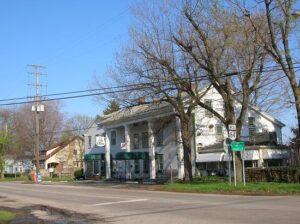
First known as the Webster House, later as the New England House, and finally as the Old Tavern, this inn has served travelers on the old Cleveland-Buffalo Road (now State Route 84) since before Ohio became a state. As traffic on the old Indian trail increased and it became a post and stage road, the two original log cabins, built in 1798 and later, were converted to this two-and-a-half story inn between 1815 and 1820. While the tavern was the scene of Civil War-era parties and dances in the second-floor ballroom, local tradition suggests it offered much more clandestine hospitality to escaping slaves as a station on the Underground Railroad. The Unionville Tavern was added to the National Register of Historical Places in 1973.
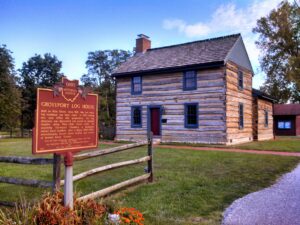
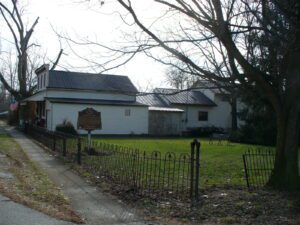
Built on Main Street, circa 1815, this two story log residence was later sided. In 1974 during new post office site preparation, the log structure was discovered and moved to present location along Ohio-Erie Canal route. In adjoining Groveport Cemetery a monument honors local resident, John S. Rarey (1828-1866), internationally known horse trainer and owner of famous horse, Cruiser.
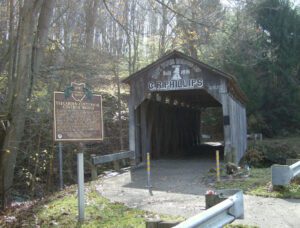
The Teegarden-Centennial Covered Bridge, constructed primarily of white oak is of Multiple King Post design spanning 67 feet. It was built nearly 100 years after the birth of the nation. Located on Eagleton Road, just off Teegarden Road, it is still at its original location, spanning the Middle Fork of the Little Beaver Creek in Eagleton’s Glen Park. It remained in use until 1992 when it was bypassed by a new concrete structure. The official contract for the construction of the bridge was awarded to Jeremiah C. Mountz in June of 1875. The stonework for the abutments was awarded to David Reese and painting of the original structure to George W. Akin in 1876. Members of Highland Christian Church came here to be baptized by immersion. There were over 250 covered bridges in Columbiana County, including at least 16 railroad covered bridges. The Teegarden-Centennial Covered Bridge is one of only five still remaining.
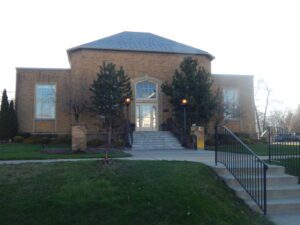
Listed on the National register of Historic Places in 1974, this building was the post office from 1940 through 1986. It is an example of the Colonial Revival style common in the 1930s and 1940s. The exterior brick work, large Palladian window, and simple design were common in the building plans for era post offices. This simplicity enabled unskilled workers to be employed in public works projects. The building’s interior still has the original portico, wood and marble-paneled walls, terrazzo floors, and mailing lobby. (Continued on other side)
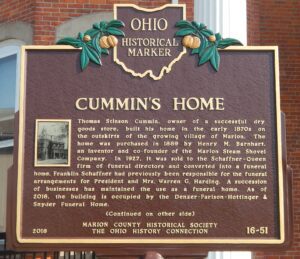
Thomas Stinson Cummin, owner of a successful dry goods store, built his home in the early 1870s on the outskirts of the growing village of Marion. The home was purchased in 1889 by Henry M. Barnhart, an inventor and co-founder of the Marion Steam Shovel Company. In 1927, it was sold to the Schaffner- Queen firm of funeral directors and converted into a funeral home. Franklin Schaffner had previously been responsible for the funeral arrangements for President and Mrs. Warren G. Harding. A succession of businesses has maintained the use as a funeral home. As of 2016, the building is occupied by the Denzer-Farison-Hottinger & Snyder Funeral Home. (Continued on other side)
Oscar D. Boggess (1832-1907) was born in Virginia, the son of a slave and her master. He and his family were granted freedom in the will of his father and master. The will was contested up to the United States Supreme Court, which upheld Boggess’ freedom. Boggess moved to Pennsylvania at age 20, and during the Civil War, joined the 43rd United States Colored Troops. He earned the Butler Medal of Honor for bravery at the Battle of the Crater near Petersburg, Virginia, in July 1864. Boggess moved to Youngstown after the war, and worked as a stonemason. He was a charter member of Tod Post 29, Grand Army of the Republic, in Youngstown, and a co-founder of the Oak Hill Avenue African Methodist Episcopal Church, the city’s first African American religious congregation. The Boggess home, formerly located near this site, hosted the church’s first meetings in 1870.
The foundation for the first Welsh settlement in Ohio was laid on June 29, 1801, when William and Morgan Gwilym purchased land in what is now Morgan Township at the Cincinnati Land Office. The Welsh, who settled in Pennsylvania beginning in the late eighteenth century, moved westward and settled here in 1802. This area was also the major terminus for the 1818 migration from Montgomeryshire and Cardiganshire in Wales. In 1803 a Congregational Church was organized and services were held in members’ homes or outdoors. A brick Meetinghouse, complete with a Welsh death door leading to the cemetery, was constructed in 1824. The building now serves as the Community House. The present brick church was built in 1854. For many years, the library, formed in 1852, was housed in the New London Special School District building that stood on this site. (Continued on other side)