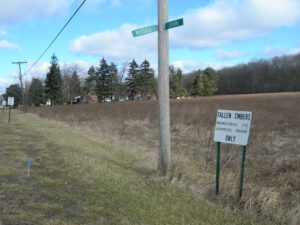
The Battle of Fallen Timbers, fought on August 20, 1794, is one of the most significant events relating to post-Revolutionary War America. Major General “Mad” Anthony Wayne led the Federal Army, known as The Legion of the United States against a confederacy of Native Americans led by Miami Chief Little Turtle and Shawnee war chief Blue Jacket. Defeat in battle and lack of help from their nearby British allies disheartened the tribes and lead to the 1795 Treaty of Greenville. The Treaty secured United States control of the Northwest Territory and ultimately resulted in the formation of five new states-Ohio, Indiana, Michigan, Illinois, and Wisconsin. (continued on other side)
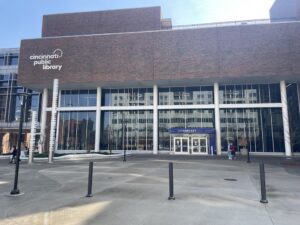
Among the first in America, Cincinnati’s public library dates from March 14, 1853. A public reading room opened in 1856, but funding remained a problem until 1867, when local school board president Rufus King II secured legislation for a renamed Cincinnati Public Library. In 1869, King lured leading librarian William Frederick Poole to organize Cincinnati as a national model for the growing public library movement. Poole designed 19th century America’s most advanced library at 629 Vine Street, which fully opened in 1874. Becoming a countywide system in 1898, the Public Library of Cincinnati and Hamilton County was a pioneer in the 20th century with special services for the blind and for children, bookmobile services, and circulation of audiovisual materials. (continued on other side)
Toledo State Hospital opened in January 1888 as the Toledo Asylum for the Insane. Originally located immediately south of this cemetery, the hospital was designed to function as a self-contained community for 650 people. Patients lived in large cottages, surrounded by a post office, church, library, male and female hospital, strong wards, bakery, and dining hall. People were admitted with mild to severe forms of mental illness, and a variety of other disabling conditions, including developmental, medical or neurological, as well as for addictions, injuries, and old age. Work became a form of treatment, with patients involved in construction, farming, laundry, and other jobs to help maintain the hospital. Patients could also participate in recreational activities from gardening to playing in the hospital band. The State Hospital became home for many, as hospitalization could last a lifetime, often spanning decades. (continued on other side)
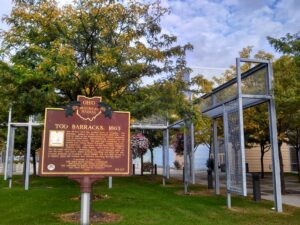
One of five Civil War military posts in Columbus, Tod Barracks, named in honor of Governor David Tod, was built in 1863 as the headquarters for military administration in central Ohio. Necessitated by Lincoln’s call for 300,000 new troops, the post was constructed in two months with United States Engineer, Captain John Tod, as supervisor. Carpenters of the 88th Ohio Volunteer Infantry from Camp Chase, three miles west, built it. Tod Barracks served as a recruiting depot, a rendezvous point for new recruits, and place where soldiers mustered-out after the war. Located adjacent to Columbus’ Union Station, the post also served as a transfer point for soldiers and officers traveling through Ohio. (continued on other side)
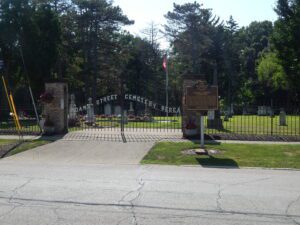
Known as the “Village Cemetery,” this was Berea’s main burial ground from 1834 to the 1880s. However, in 1886, the Cleveland Stone Co. purchased quarries adjacent to the cemetery, where Coe Lake is today. Quarrying had already caused flooding and landslides in the area. Local stories say that the company operated too near to the edge of cemetery, causing a landslide in the northwest corner that exposed some graves. Worried families moved their loved ones’ remains to other cemeteries, including those of five Civil War veterans. Pioneering families, 16 Civil War veterans, 3 mayors of Berea, several quarry owners, and many ordinary people still rest here. Of the original 589 burials, 40% were children. (Continued on other side)
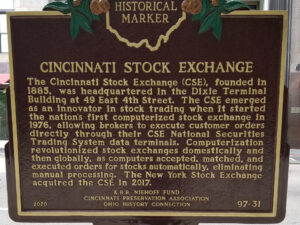
The Cincinnati Stock Exchange (CSE), founded in 1885, was headquartered in the Dixie Terminal Building at 49 East 4th Street. The CSE emerged as an innovator in stock trading when it started the nation’s first computerized stock exchange in 1976, allowing brokers to execute customer orders directly through their CSE National Securities Trading System data terminals. Computerization revolutionized stock exchanges domestically and then globally, as computers accepted, matched, and executed orders for stocks automatically, eliminating manual processing. The New York Stock Exchange acquired the CSE in 2017.
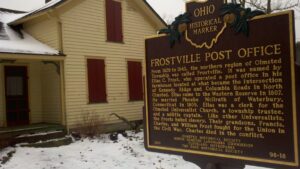
The North Olmsted Historical Society was founded in 1953 and became incorporated as a non-profit association in 1961. A year later, Frostville Museum opened in the Prechtel House. The society took on the challenge of preserving the history of the entire original township and became the Olmsted Historical Society in 1969. The Frostville Museum has grown from one house to a small village. Volunteers are dedicated to preserving the past and the present for the future. In August 2010, First Lady Michelle Obama designated the society as a Preserve America Steward. Frostville is an affiliate of the Cleveland Metroparks.
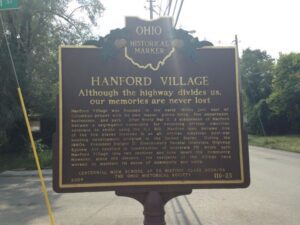
Hanford Village was founded in the early 1900s just east of Columbus proper with its own mayor, police force, fire department, businesses, and park. After World War II, a subdivision of Hanford became a segregated community for returning African American veterans to settle using the G.I. Bill. Hanford then became one of the few places involved in an all African American post-war housing development program in the United States. During the 1960s, President Dwight D. Eisenhower’s Federal Interstate Highway System Act resulted in construction of Interstate 70 which split Hanford Village into two sections and tore apart the community. However, since the division, the residents of the village have worked to maintain its sense of community and unity.