NE corner of S. Main Street and Zoar Road / Bayou Street
South Lebanon
, OH
Deerfield was laid out around 1795 and in 1802 Major Benjamin Stites, his son Benjamin, Jr., and John Gano officially recorded the village’s plat. A part of the great tide of Americans moving into the Northwest Territory (and Ohio after 1803), Deerfield’s early inhabitants included Revolutionary war veteran Ephraim Kibbey as well as Andrew Lytle, Nathan Kelly, William Snook, and War of 1812 veteran David Sutton. Deerfield was so called because it was a settlement in Deerfield Township, Hamilton County in the 1790s. (Continued on other side)
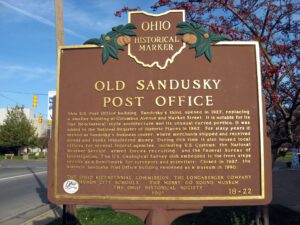
This U.S. Post Office building, Sandusky’s third, opened in 1927, replacing a smaller building at Columbus Avenue and Market Street. It is notable for its fine Neoclassical-style architecture and its unusual curved portico. It was added to the National Register of Historic Places in 1982. For sixty years it served as Sandusky’s business center, where merchants shipped and received goods and banks transferred money. During this time it also housed local offices for several federal agencies, including U.S. Customs, the National Weather Service, armed forces recruiting, and the Federal Bureau of Investigation. The U.S. Geological Survey disk embedded in the front steps serves as a benchmark for surveyors and scientists. Closed in 1987, the historic Sandusky Post Office building reopened as a museum in 1990.
Trenton’s founder, Michael Pearce, came to the area in 1801. The original village of 33 lots was named Bloomfield. When the post office was established in 1820, it was named Trenton to honor the founder’s home state of New Jersey. Pearce’s son-in-law, Squier Littell, was the first resident doctor in Butler County. Originally settled by the English, Trenton saw a migration of Germans by 1840. By 1851, the farming community became a grain center with the introduction of the Cincinnati, Hamilton, and Dayton Railroad. Further development occurred when a franchise was granted to operate interurban electric traction cars through the village in 1896. Early commercial endeavors were Dietz, Good & Company grain elevator, Trenton Foundry, and Magnode Corporation. By 1991, the largest industries were Miller Brewing Company and Cinergy/Cincinnati Gas & Electric.
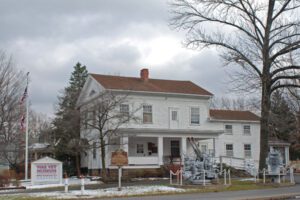
The Canfield War Vet Museum was chartered in 1988 by American Legion Post 177 and Ladies Auxiliary to collect and preserve items and history from American wars. The building that houses the museum was built in 1809 by Comfort S. Mygatt, a Revolutionary War veteran, and later, passed through several generations of the Church family. Colonel James Madison Nash, a Civil War officer, lived here for a time, giving the house its nickname, “The Colonel’s House.” The structure stands as the oldest building in Canfield on its original site. The carding barn on the rear of the property was built in 1810 to process sheep wool. The Wall of Honor at this site honors war veterans, in particular, the Revolutionary War veterans interred in Canfield cemeteries and the 18 Canfield men who lost their lives in World War II.
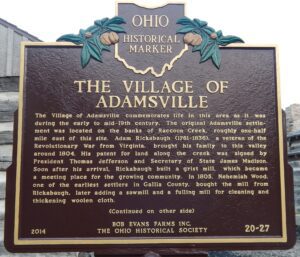
The Village of Adamsville commemorates life in this area as it was during the early to mid-19th century. The original Adamsville settlement was located on the banks of Raccoon Creek, roughly one-half mile east of this site. Adam Rickabaugh (1761-1836), a veteran of the Revolutionary War from Virginia, brought his family to this valley around 1804. His patent for land along the creek was signed by President Thomas Jefferson and Secretary of State James Madison. Soon after his arrival, Rickabaugh built a grist mill, which became a meeting place for the growing community. In 1805, Nehemiah Wood, one of the earliest settlers in Gallia County, bought the mill from Rickabaugh, later adding a sawmill and a fulling mill for cleaning and thickening woolen cloth. (Continued on other side)
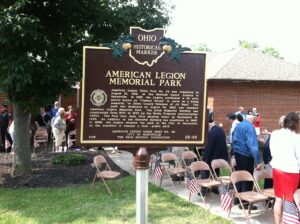
American Legion Union Post No. 79 was organized on August 21, 1919, at the National Guard Armory in Marysville. In 1927, the Legion purchased a 24 acre parcel known as “Clement Woods” to serve as a living memorial “to Union County Veterans of All Wars”. The park was dedicated on August 24, 1927, and renamed American Legion Memorial Park. The brick Memorial Building was constructed from 1937 to 1938 by the Works Progress Administration (WPA). The Post held their first meeting there on September 12, 1938. An addition to the Memorial Building was completed in 1960. In 1989, the Legion donated the park to the City of Marysville on the condition it remains a free, public park.
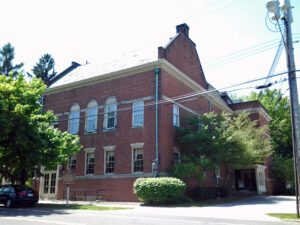
The Canfield WPA Memorial Building was constructed by the Works Progress Administration, a federal government program instituted by President Franklin D. Roosevelt as an effort to aid the United States in its recovery from the Great Depression of the late 1920s and 1930s. Local merchant Arron Weisner donated lands on the west side of Broad Street for the proposed project. A six member committee, comprised of two persons each representing the Argus Masonic Lodge, the American Legion, and the Village of Canfield, determined that the building be “a community building built around community projects.” Through local subscription and $60,000 in federal funds, the WPA project moved forward. The Youngstown architectural firm of W.H. Cook and W. Canfield designed the building in the Colonial Revival style. A ground breaking ceremony was held on December 20, 1935. During World War II, the United States government maintained offices in the building. (Continued on other side)
Indian Ridge Golf Club, 2600 Oxford Millville Road
Oxford
, OH
A cemetery was established on the site in 1811 and became the final resting place for many of the area’s early pioneer families. The Hanover Township Trustees obtained title to the land in 1823 from John and Anna Farnsworth, and it was expanded for additional plots in 1879. Unfortunately many burials remain unmarked or can be located only by primitive limestone markers above them. The oldest readable headstone is dated 1816. (continued on the other side)