Originally called Westfield Township, Samuel Fowler purchased this area in 1798 from the Connecticut Land Company for $12,903.23 while living in Westfield, Massachusetts. His brother Abner arrived the following year to survey the land and separate it into smaller plots that could be sold to people wanting to settle here. A Revolutionary War veteran, Abner was the first to arrive here and also the first recorded death in 1806, the same year that his son Abner Fowler II married the first school teacher in Fowler Ester Jennings. In 1817, Samuel Fowler gave five acres of land to Fowler Center to be used as a park or “common” with the provision that no permanent building ever be built on it. At about the same time, the township name was changed to Fowler to honor its founding family. Agriculture was and remains the main occupation in the Fowler area.
NW corner of Cross Roads Road NE and Beckel Avenue
Sandyville
, OH
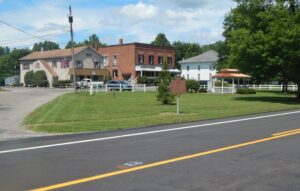
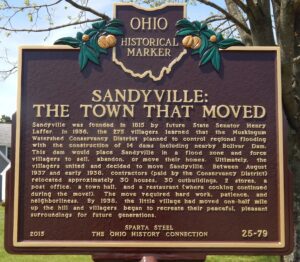
Sandyville was founded in 1815 by future State Senator Henry Laffer. In 1936, the 275 villagers learned that the Muskingum Watershed Conservancy District planned to control regional flooding with the construction of 14 dams including nearby Bolivar Dam. This dam would place Sandyville in a flood zone and force villagers to sell, abandon, or move their homes. Ultimately, the villagers united and decided to move Sandyville. Between August 1937 and early 1938, contractors (paid by the Conservancy District) relocated approximately 30 houses, 30 outbuildings, 2 stores, a post office, a town hall, and a restaurant (where cooking continued during the move!). The move required hard work, patience, and neighborliness, By 1938, the little village had moved one-half mile up the hill and villagers began to recreate their peaceful, pleasant surroundings for future generations.
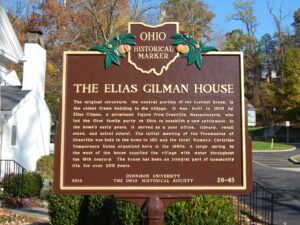
The original structure, the central portion of the current house, is the oldest frame building in the village. It was built in 1808 by Elias Gilman, a prominent figure from Granville Massachusetts, who led the first family party to Ohio to establish a new settlement . In the home’s early years, it served as a post office, library, retail store, and select school. The initial meeting of the Freemasons of Granville was held in the home in 1811 and the local Women’s Christian Temperance Union organized here in the 1880s . A large spring to the west of the house supplied the village with water throughout the 19th century . The house has been an integral part of community life for over 200 years.
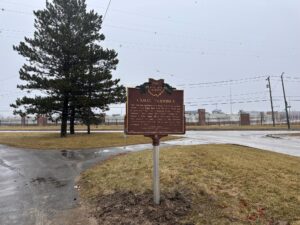
The original northernmost lock in a canal system which linked Lake Erie with the Ohio River was located near the foot of LaSalle Street. Indiana’s Wabash & Erie Canal (1843-1874) joined Ohio’s Miami & Erie Canal (1845-1913) near Defiance and shared the same course to this location. Toledo’s Swan Creek side cut became the northern terminus in 1864.
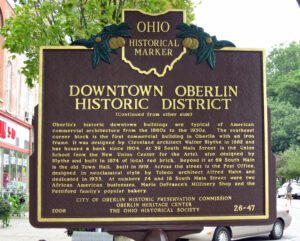
The intersection of Main and College streets has been the center of Oberlin since the town and college were founded in 1833. The first downtown buildings were made of wood and were destroyed by a series of spectacular fires. The first college building, Oberlin Hall, stood on the southwest corner of College and Main and included recitation rooms, a dining hall, chapel, offices, and lodging. In 1887, Akron architect Frank Weary designed the large brick building at numbers 5 to 13 West College. Number 23 West College (Gibson Block) once housed a silent movie theater on the second floor. East College Street’s historic buildings include the Apollo Theater, which showed Oberlin’s first talking movie on May 11, 1928. From 1897 to 1929, an interurban streetcar line connected Oberlin’s downtown to Cleveland. Oberlin’s downtown historic district was placed on the National Register of Historic Places in 2003.
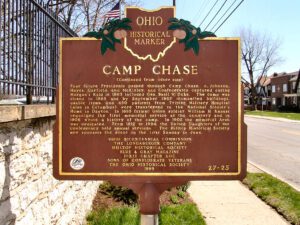
Camp Chase was a Civil War camp established in May 1861, on land leased by the U.S. Government. Four miles west of Columbus, the main entrance was on the National Road. Boundaries of the camp were present-day Broad Street (north), Hague Avenue (east), Sullivant Avenue (south), and near Westgate Avenue (west). Named for former Ohio Governor and Lincoln’s Secretary of the Treasury Salmon P. Chase, it was a training camp for Ohio soldiers, a parole camp, a muster-out post, and a prisoner-of-war camp. As many as 150,000 Union soldiers and 25,000 Confederate prisoners passed through its gates from 1861-1865. By February 1865, over 9,400 men were held at the prison. More than 2,000 Confederates are buried in the Camp Chase Cemetery.
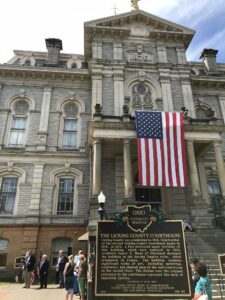
Licking County was established in 1808. Construction of the current Licking County Courthouse began in 1876. In 1879, a fire destroyed upper portions of this building, which was replaced in 1880. Architect Henry E. Myer of Cleveland designed the building in the Second Empire Style, which originated in France. The building contains significant works of art, including paintings, sculptures, and stained glass in the west courtroom on the second floor. The statues over the original entrances to the courthouse represent the ideal of impartial justice. (Continued on/from other side)
Thomas Burk Sr. purchased a quarter section of federal land here in 1804. A school house was erected on this purchase in 1809. That same year, a road from Williams’ Mill (Millville) was blazed and a saw mill was built on Indian Creek west of this marker. Obadiah Welliver opened a tavern on his purchase in 1812. Burk sold his grist mill in 1818 and it is thought that the hamlet around this mill was called Dogtown because of a vicious dogfight there. In 1825, Reily Post Office was established at Welliver’s Tavern. That year a woolen mill with textile production machinery was built by Elias Sayres, near the saw mill. Multi-millionaire Elias Jackson (“Lucky”) Baldwin (1828-1909), the founder of Santa Anita Racetrack near Los Angeles, was born here.