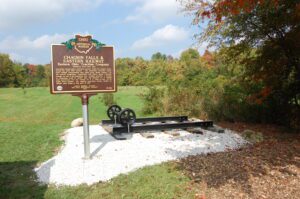
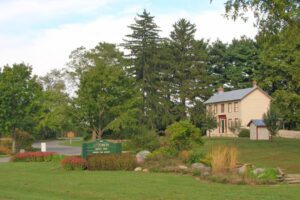
From east to west, the Chagrin Falls and Eastern Interurban Railway crossed the Muggleton Farm (now South Russell Village Park) at this location and connected the Chagrin Valley with Hiram, Garrettsville, and Middlefield. Its sister interurban, the Cleveland and Chagrin Falls Electric Railway served points west. Soon after their formation, the Everett-Moore Syndicate merged the two lines into the extensive interurban rail network, The Eastern Ohio Traction Company. The EOTC and its predecessors operated from 1899-1925, mainly moving mail, farm goods, and passengers. In 1914, the more rural line from Chagrin Falls traveling eastward became the first major interurban in the United States to cease operations. It is believed that declining use, insufficient power for the railway, and a failed line extension to Youngstown were likely factors contributing to the line’s demise.(Continued on other side)
This area of western Hancock County is a part of the Maumee River Watershed known as “Indian Green.” Wyandot Indians chose this area for hunting and ceremonial grounds along the Blanchard River in the 1700s because it was next to the river, yet high enough to avoid frequent flooding. One-half mile east of this location is a Liberty Township cemetery. It is located upon a sand ridge once used as a burial ground by Indians, hence the name “Indian Green.”
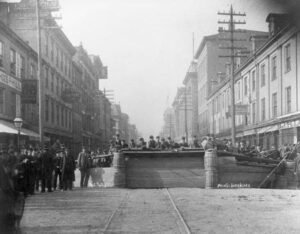
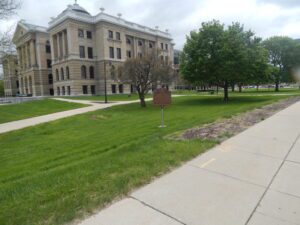
In March 1884, public confidence of Cincinnati law enforcement was extremely low. The public believed that murderers and other serious offenders were not brought to justice promptly or received little punishment. Civil unrest was brought to a boil when a seventeen-year-old was sentenced to only twenty years for manslaughter after brutally murdering his employer. On March 28, thousands of citizens stormed the county jail and courthouse. The riots lasted three days requiring forces from the Sheriff’s Office, city police, and local and state militia to restore order. Fifty-four people were killed and more than 200 wounded. The courthouse and jail suffered enormous damage, and valuable records were destroyed from the assault and fire. The riot gained international notoriety and helped pave the way for removal of political favoritism and a larger police force.
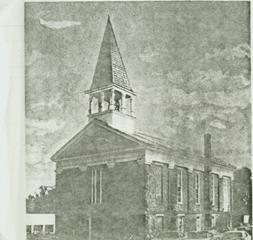
This site has long served the religious, education, and public interests of the residents of Mechanicsburg. A local Methodist congregation built its first church here in 1820, and the townspeople also used the structure as its village school. The Methodists replaced their original structure in 1837, using brick as the main building material. As the Methodist congregation grew, however, it was determined that a larger, more permanent structure was needed. As a result, the Mechanicsburg First Methodist Church was built here in 1858, and it served the congregation until 1894 when an African American based Second Baptist congregation purchased the building at a cost of $2,850. Besides religion and education, the site was also used as Mechanicsburg’s first cemetery. That cemetery lasted until the Maple Grove Cemetery was established and burials at this site were relocated there. [continued on other side]
The first canal boat arrived in Toledo from Indiana in 1843 via the Wabash & Erie Canal. The Miami & Erie Canal from Cincinnati was completed in 1845. It joined the W & E Canal near Defiance and they shared the same course along the Maumee River. The final section of the canal from Toledo’s Swan Creek Side Cut to Manhattan and passed across the present courthouse square.
Cheshire Village Park, E. Main Street at the river
Cheshire
, OH
In 1955, at the age of 67, Emma Rowena “Grandma” Gatewood became the first woman to hike the 2,050 mile Appalachian Trail alone and in one season. The Gallia County, Ohio resident hiked the Appalachian Trail again in 1957 and 1964, becoming the first to walk its length three times. In 1959, she hiked the Oregan Trail, from Independence, Missouri to Portland, Oregon. She was a founder of the Buckeye Trail and life member of the Buckeye Trail Association, which named part of the trail after her. Grandma Gatewood was born in 1887 on a farm near Mercerville, one of 15 children, and died in 1973 at the age of 85, the mother of 11 and “grandma” to many more. SHe was inducted into the Appalachian Trail Hall of Fame in 2012.
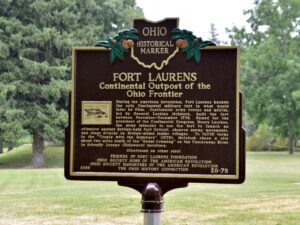
During the American Revolution, Fort Laurens became the only Continental military fort in what would later be Ohio. Continental army troops and militia, led by General Lachlan McIntosh, built the fort between November-December 1778. Named for the president of the Continental Congress, Henry Laurens, the army intended to use the fort to launch an offensive against British-held Fort Detroit, observe enemy movements, and stage attacks on British-allied Indian villages. To fulfill terms in the “Treaty with the Delaware” (1778), McIntosh chose a site about two miles south of the “Great Crossing” on the Tuscarawas River in friendly Lenape (Delaware) territory. (Continued on other side)
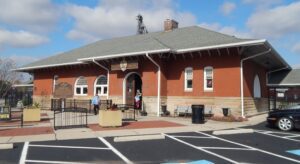
Construction of the Columbus, Piqua, and Indiana Central Railroad started in 1850 and was finished in 1854. Later referred to as the “Panhandle Railroad,” it ran from Columbus to Bradford. During the Civil War, the line carried supplies and troops and it was extended from Bradford to Richmond, Indiana. President Lincoln’s funeral train traveled the route on April 29, 1865. Eventually, three railway lines crossed Urbana: the Big Four, the Pennsylvania, and the Erie. “Corn brooms,” woolen cloth, horse carriages, and tinware were shipped by railroad to national markets and regular passenger service carried residents to destinations across the country, including Chicago, St. Louis, New York, and Washington, D.C. (Continued on other side)