Construction of the Ohio and Erie Canal, beginning in Cleveland and running south to Portsmouth, began in 1825. As a means to pay for debts on the community’s 5,500 acres of Tuscarawas County land, members of the Society of Separatists of Zoar contracted to construct this portion of the canal. They received $21,000 for this work, which was completed in 1827. Surplus goods were transported on Society owned and operated canal boats to outside markets via the Ohio and Erie Canal, which also brought manufactured items into Zoar. (continued on other side)
The house of Ebenezer Zane was built here in 1805. The structure was the meeting place for the First Methodist Quarterly Conference in 1819 where over 300 settlers in the area and about sixty members of the Wyandot tribe came together. Although the cabin was reconstructed in 1997, it is a symbol of harmonious relations between American settlers and the Wyandot in the years before the latter’s removal from Ohio in 1842.
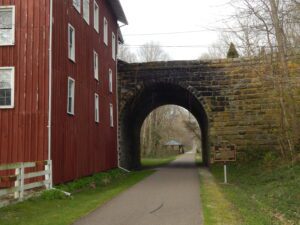
Stone Arch at Howard, Ohio. The arch at Howard, built in 1874, is a bridge for U.S. Route 36 over the old Cleveland, Mt. Vernon, and Delaware Railroad bed, a part of the Kokosing Gap Trail. Samuel Israel, Sr. (1810-1889) sold the right to quarry nearby stone for the arch to Robert S. McKay (1813-1885) and his son William (1845-1892). R.S. McKay & Son employed local stone masons, shown here, to build the arch according to the contract with the railroad. (Continued on other side)
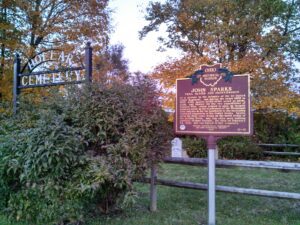
As a private in the infantry of the 1st United States Regiment, and during the years 1805 to 1807, John Sparks (1758-1846) acted as guide, scout, and hunter for the two expeditions of Zebulon Pike, which helped to open up largely unknown areas in the headwaters of the Mississippi River and also in the far Southwest to the increasing westward expansion of the United States. Sparks spent his later years living on the north banks of the Licking River, and was often seen walking barefoot around Newark. He died on February 28, 1846, and was buried in this cemetery.
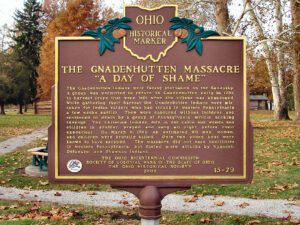
The Moravian Church in America began missionary work among the Delaware and Mohican tribes of North America in the mid-18th century. David Zeisberger, one of the best-known Moravian missionaries, came to the Ohio country with Delaware converts from a mission in western Pennsylvania and founded Schoenbrunn in the Tuscarawas Valley on May 3, 1772. Josua, a Mohican convert and missionary leader, led Mohican and Munsee Christians downriver and settled Gnadenhutten (“Tents of Grace”) on October 9, 1772. Zeisberger served as lead missionary at both villages. By 1775, there was an estimated 200 inhabitants in the village. The British, along with Wyandot and Delaware allies, suspected the Christian Indians of aiding the Americans. To ensure their allegiance to the British, the inhabitants of Gnadenhutten were forcibly removed in 1781 and taken to Captives’ Town on the Sandusky River.
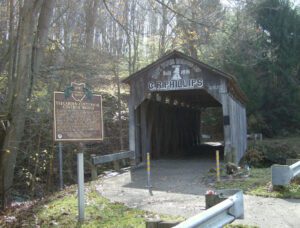
The Teegarden-Centennial Covered Bridge, constructed primarily of white oak is of Multiple King Post design spanning 67 feet. It was built nearly 100 years after the birth of the nation. Located on Eagleton Road, just off Teegarden Road, it is still at its original location, spanning the Middle Fork of the Little Beaver Creek in Eagleton’s Glen Park. It remained in use until 1992 when it was bypassed by a new concrete structure. The official contract for the construction of the bridge was awarded to Jeremiah C. Mountz in June of 1875. The stonework for the abutments was awarded to David Reese and painting of the original structure to George W. Akin in 1876. Members of Highland Christian Church came here to be baptized by immersion. There were over 250 covered bridges in Columbiana County, including at least 16 railroad covered bridges. The Teegarden-Centennial Covered Bridge is one of only five still remaining.
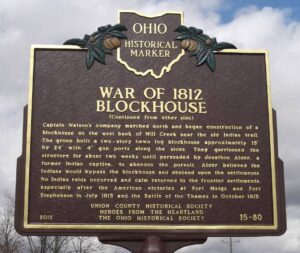
Following the American surrender of Fort Detroit in August 1812, panic spread along the Ohio frontier in fear of possible Indian attacks. The boundary of the Indian territory lay approximately 14 miles to the north at the Greenville Treaty line. Ohio Governor Return Jonathan Meigs, Jr. called out the Ohio Militia to defend the frontier and to construct blockhouses to guard against Indian attacks. A local militia company of 70 men was raised in present Union and Madison Counties to protect the settlements along Big Darby Creek. David Watson served as captain with Frederick Lloyd as first lieutenant.
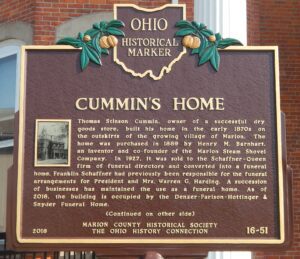
Thomas Stinson Cummin, owner of a successful dry goods store, built his home in the early 1870s on the outskirts of the growing village of Marion. The home was purchased in 1889 by Henry M. Barnhart, an inventor and co-founder of the Marion Steam Shovel Company. In 1927, it was sold to the Schaffner- Queen firm of funeral directors and converted into a funeral home. Franklin Schaffner had previously been responsible for the funeral arrangements for President and Mrs. Warren G. Harding. A succession of businesses has maintained the use as a funeral home. As of 2016, the building is occupied by the Denzer-Farison-Hottinger & Snyder Funeral Home. (Continued on other side)