

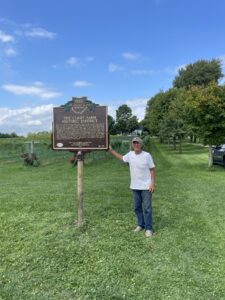
, OH
George Curry (1819-1885) was one of seven children born to a tenant sheepherder in the Cheviot Hills of Scotland. He immigrated to Ohio during the 1840s and married Scottish immigrant Agnes Milligan (1830-1893) in 1855. The couple moved to Licking County in 1865, and purchased 160-acres of farmland in 1873 to establish a sheep farm. They soon became known for their fine Spanish Merino herd. In the late nineteenth century, Ohio was a leader in the wool trade, with Licking County leading the state’s wool production by 1870. At the time of his death, George Curry was “a well-known stock dealer, and was greatly esteemed” in the community. Five generations of George and Agnes Curry’s family lived and farmed their Licking County land, until it was divided into parcels and sold in 1979.
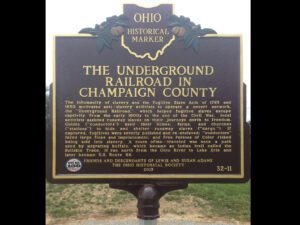
, OH
The inhumanity of slavery and the Fugitive Slave Acts of 1793 and 1850 motivated anti-slavery activists to operate a covert network, the “Underground Railroad,” which helped fugitive slaves escape captivity. From the early 1800s to the end of the Civil War, local activists assisted runaway slaves on their journeys north to freedom. Guides (“conductors”) used their homes, farms, and churches (“stations”) to hide and shelter runaway slaves (“cargo.”) If captured, fugitives were severely punished and re-enslaved; “conductors” faced large fines and imprisonment, and Free Persons of Color risked being sold into slavery. A route often-traveled was once a path used by migrating buffalo, which became an Indian trail called the Bullskin Trace. It ran north from the Ohio River to Lake Erie and later became U.S. Route 68.
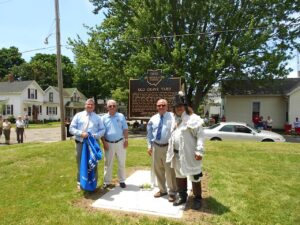
, OH
In 1805, a burial ground was dedicated to Champaign County at the intersection of Ward and Kenton Streets, which was then at Urbana’s town limits. It remained open until 1856. Among those interred there was Elizabeth Kenton, eight-year-old daughter of Simon Kenton. When she died in 1810, Kenton, the county jailer, was forbidden from crossing out of the town limits due to his unpaid debts. After following the funeral procession as far as he could, he watched Elizabeth’s burial from across the street. Also buried there were unknown soldiers from the War of 1812; Captain Arthur Thomas and son, who were killed by Native Americans in August 1813; four Bell children, who died in the tornado of March 22, 1830; and numerous early settlers of Champaign County. Many, but not all, were reinterred and rest in Oak Dale Cemetery.
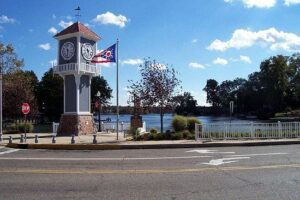
, OH
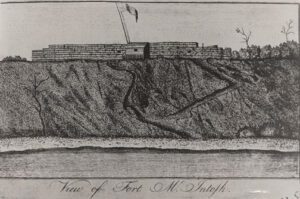
The land on which Coventry Township is situated was ceded in 1785 to the United States by the Delaware, Chippewa, Ottawa, and Wyandot tribes under the Treaty of Fort McIntosh. The area was a choice location for Native Americans, settlers, and fur traders due to the abundant bodies of water and proximity to the Portage Path, a land connection between the Tuscarawas and Cuyahoga rivers and Lake Erie. In 1788, Coventry Township was initially part of Washington County, the first county formed in the Ohio Territory. After Moses Warren finished a survey in 1797, a succession of county splits located Coventry Township in Jefferson County, Trumbull County, Portage County, and, finally, Summit County in 1840. The township originally encompassed Summit Lake and the lands south to the southern line of the Western Reserve (Green-New Franklin lines). Daniel Haines was the first resident to settle in Coventry Township in 1806.
, OH
In 1785, American Indian tribal leaders from the Chippewa, Delaware, Ottawa, and Wyandot met with representatives sent by the United States Congress to sign the controversial Treaty of Fort McIntosh. The treaty surrendered control of Native American lands in southern and eastern Ohio to the United States government. Most Indians rejected the validity of the treaty and rather than improving relations, the Treaty of Fort McIntosh only intensified the tensions that existed between the United States government and the Indian tribes. This marker signifies the eastern most portion of the American Indian territory outlined by the treaty. The Portage Path, a trail used by American Indians as a portage between the Cuyahoga and Tuscarawas rivers, became a part of this boundary line.
, OH
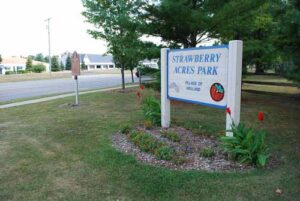
Ice Age glaciers formed the distinct landscape of the Oak Openings Region, which is dominated by rolling sand dunes and wet prairies interrupted by clusters of oak trees. Although the sandy soil did not support agriculture well, the early settlers of Springfield Township and the Village of Holland raised cranberries and other fruits. Encompassing nearly 130 square miles, the Oak Openings Region was designated as one of America’s “Last Great Places” by The Nature Conservancy and is home to over 180 rare and endangered species. Local legend holds that prior to the Battle of Fallen Timbers in 1794, Miami Chief Little Turtle and Shawnee Chief Blue Jacket passed through the Oak Openings and met at a council with Wyandot chiefs on the hill near the Springfield Township Cemetery.
, OH
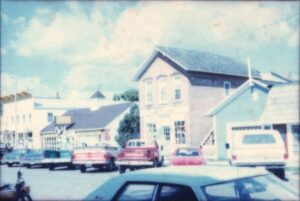
Born in Rhode Island, John Pray (1783-1872) moved to the Maumee River Valley from New York shortly after serving in the War of 1812 and completing a prospecting tour in Ohio. He built a dam across the river to Granger Island and in 1821 constructed a water-powered gristmill, the first on the lower Maumee. In 1831, he laid out the Village of Waterville with the first 50 lots. The Columbian House, a stagecoach inn constructed by Pray in 1828 and expanded in 1837, was for years the commercial and social center of Waterville and accommodated travelers from cities such as Detroit and Cincinnati. From this building, he operated the village’s post office. When Wood County was organized in 1820, Pray became a commissioner until Lucas County was formed from part of Wood in 1835. For nine years he served as Justice of the Peace in Waterville. He and his wife Lucy raised eleven children to adulthood. Circa 1854 he constructed his home, which today overlooks Pray Park.
, OH
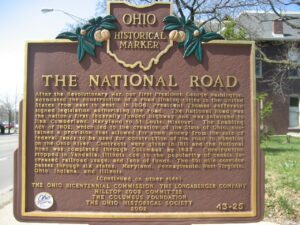
After the Revolutionary War, our first President, George Washington, advocated the construction of a road linking cities in the United States from east to west. In 1806, President Thomas Jefferson signed legislation authorizing the road. The National Road was the nation’s first federally funded highway and was intended to link Cumberland, Maryland to St. Louis, Missouri. The Enabling Act of 1802, which led to the creation of the state of Ohio, contained a provision that allowed for some money from the sale of federal lands to be used for construction of the road to Wheeling on the Ohio River. Contracts were given in 1811 and the National Road was completed through Columbus by 1833. Construction stopped in Vandalia, Illinois due to the popularity of canals, increased railroad usage, and lack of funds. The 591-mile corridor passes through six states: Maryland, Pennsylvania, West Virginia, Ohio, Indiana, and Illinois.