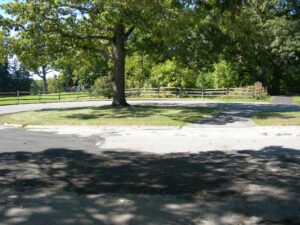
Ottawa Park, the largest city park, was developed in the early 1890s on the 280-acre farm of John B. Ketcham. Based on a design by the famous landscape architect, Frederick Law Olmsted, Ottawa Park was intended to be central to a vast park and boulevard system. By 1920 the Toledo Park movement had provided fifteen parks totaling nearly 1400 acres.
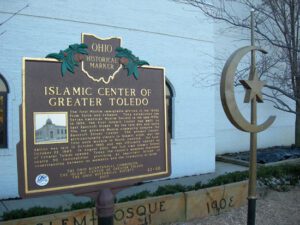
The first Muslim immigrants arrived in the 1900s from Syria and Lebanon. They established the Syrian American Muslim Society in the late 1930s. In 1954, the first Islamic Center was built on East Bancroft Street. By the late 60s and early 70s, the growing Muslim community outgrew the Bancroft Street Center. The present Center, architecturally classic in Islamic style, was the first such mosque in North America. Its foundation was laid in October 1980 and was officially opened on October 22, 1983. In August 2001, the full time Islamic School of Greater Toledo opened. Today, the Center’s members represent nearly 30 nationalities, providing an important bridge of understanding between its members and the community at large.
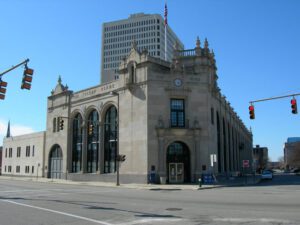
The Toledo Blade is the city’s oldest continuing business. The newspaper was first published on December 19, 1835, during the Ohio-Michigan boundary dispute known as the “Toledo War.” The name is derived from that conflict and the famous swords of Toledo, Spain. A copy of the first edition and two gift swords from that Spanish city are displayed inside the Blade Building.
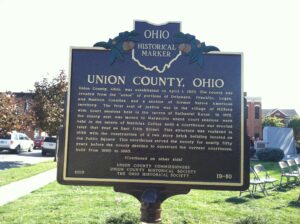
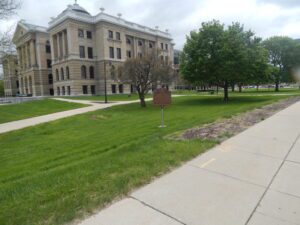
Union County, Ohio, was established on April 1, 1820. The county was created from the “union” of portions of Delaware, Franklin, Logan, and Madison Counties, and a section of former Native American territory. The first seat of justice was in the village of Milford with court sessions held in the tavern of Nathaniel Kazar. In 1822, the county seat was moved to Marysville where court sessions were held in the tavern of Matthias Collins until a courthouse was erected later that year on East Fifth Street. This structure was replaced in 1838 with the construction of a two story brick building located on the Public Square. This courthouse served the county for nearly fifty years before the county decided to construct the current courthouse, built from 1880 to 1883.
The first canal boat arrived in Toledo from Indiana in 1843 via the Wabash & Erie Canal. The Miami & Erie Canal from Cincinnati was completed in 1845. It joined the W & E Canal near Defiance and they shared the same course along the Maumee River. The final section of the canal from Toledo’s Swan Creek Side Cut to Manhattan and passed across the present courthouse square.
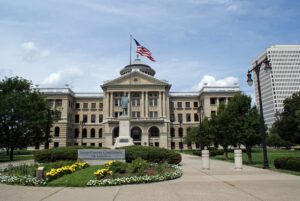
Lucas County was named for Governor Robert Lucas who championed Ohio’s cause in the “Toledo War,” a boundary dispute arising when both Ohio and the Michigan Territory claimed this area. The Ohio legislature created Lucas County on June 20, 1835. The first court session convened in a Toledo schoolhouse during the pre-dawn hours of September 7 to avoid the Michigan militia.
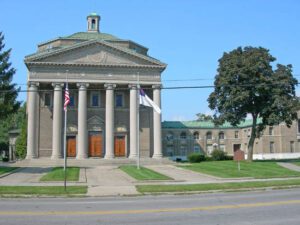
Founded in 1833, this is the oldest congregation organized within Toledo’s original boundaries. From 1844 to 1913 the church occupied a succession of three meeting houses on St. Clair Street. In 1913 First Church merged with Central Congregational Church. The pews and eight stained glass windows from the 1878 church were incorporated into this meeting house which was dedicated in 1916.
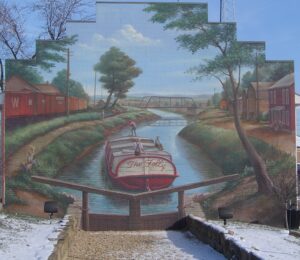
During the 1830s, the Ohio & Erie Canal was built through Newark. The Lockmaster’s House was home to the lockmaster of Lock #9. In 1852, the first railroad locomotive steamed into Newark, signaling the beginning of the end for the canal. By 1871, the Baltimore & Ohio Railroad took over the Lockmaster’s House and the encompassing land, and built the Little Red House on the corner for the stationmaster and telegraph operator. Passenger and freight stations, a freight yard, and roundhouse were constructed nearby and served as a B&O Division Point. In 1881, the Scheidler Machine Works built a factory to manufacture steam engines and sawmills. This building now houses The Works Museum. In 1890, an electric interurban railway line connected Newark’s B&O Station to the Toledo & Ohio Central station in Granville. By 1908, the old canal was filled-in. Interurban service ended in 1929 when the city purchased buses.