

, OH
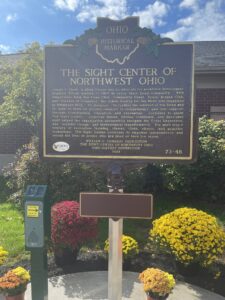
Joseph F. Clunk, a blind Ohioan and an advocate for workforce development, inspired Toledo leaders in 1923 to serve their blind community. With cooperation from the Lions Club, Community Chest, Toledo Rotary Club, and Chamber of Commerce, the Toledo Society for the Blind was organized in November 1923. Its purpose, “to further the interest of the blind and to open to them all possible avenues to independence and self-support, through investigation, education, and recreation,” continues to guide The Sight Center. Generous donors, tireless volunteers, and dedicated staff helped the organization successfully navigate the Great Depression, war, societal change, and technological transformation. For more than a century of innovative training, classes, clubs, clinics, and assistive technology, The Sight Center continues to empower independence and enrich the lives of people who are blind or have low vision.
, OH
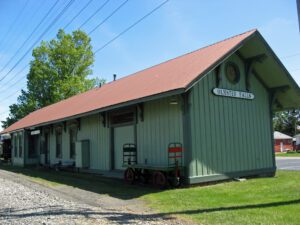
The Lakeshore and Michigan Southern Railroad built the Olmsted Falls Depot in 1876 as a part of major improvements made along the line between Cleveland and Toledo. The depot replaced a smaller flag stop station in Olmsted Falls at the Columbia Road railroad crossing. By 1909, the depot was moved from Mapleway Drive on rollers by a locomotive to this site to be closer to the heart of the village. In the early 20th century, ten trains a day stopped here. One was the “Plug,” which took commuters between Olmsted Falls and Cleveland. By mid-century, cars and planes had largely replaced train travel. The last regularly scheduled train stopped here in 1949 and service ended completely in 1960. The depot became the home of the Cuyahoga Valley and Westshore Model Railroad Club in 1977 and was listed on the National Register of Historic Places in 2000.
, OH
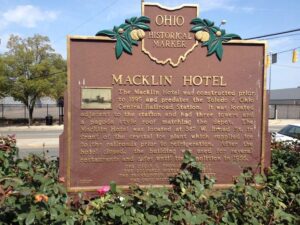
The only remaining Columbus railroad station, The Toledo & Ohio Central (T&OC) Railroad Station was constructed in 1895 and was the departure point for William McKinley when he left for Washington D.C to be sworn in as president. Designed by noted Columbus architects Joseph Warren Yost & Frank L. Packard, the pagoda style roof and tower have become Columbus icons. By 1900, the T&OC was purchased by the rival Hocking Valley Railroad and in 1911 the tracks were elevated above Broad Street. Later the New York Central Railroad gained control and used the station until 1930 when passenger service was transferred to Union Station in Columbus. Restored after the 1913 Flood and major fires in 1910 and 1975, the station was headquarters for the Central Ohio Volunteers of American from 1930 to 2003. The building was placed on the National Register of Historic Places in 1973.
, OH
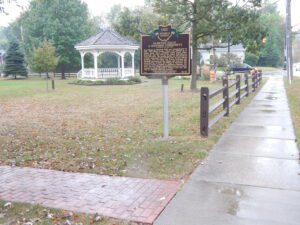
In 1795, the Connecticut Land Company auctioned twenty-five square miles of land known as Plum Creek Township. Aaron Olmsted, a sea captain, purchased almost half of the property. Although Olmsted died before ever seeing his land, in 1829, his son Charles offered to donate books to the area in exchange for changing the settlement’s name from Lenox to Olmsted. In 1815, shoemaker James Geer and his family became the first permanent American residents to settle in the southern end of the area. Geer’s farm was on what is now Columbia Road.
, OH
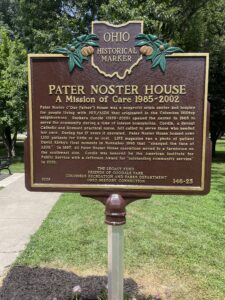
Pater Noster (“Our Father”) House was a nonprofit crisis center and hospice for people living with HIV/AIDS that originated in the Columbus Hilltop neighborhood. Barbara Cordle (1939-2020) opened the center in 1985 to serve the community during a time of intense homophobia. Cordle, a devout Catholic and licensed practical nurse, felt called to serve those who needed her care. During the 17 years it operated, Pater Noster housed over 1,100 patients for little or no cost. LIFE magazine ran a photo of patient David Kirby’s final moments in November 1990 that “changed the face of AIDS.” In 1997, all Pater Noster House operations moved to a farmhouse on the southwest side. Cordle was honored by the American Institute for Public Service with a Jefferson Award for “outstanding community service” in 2002.
, OH
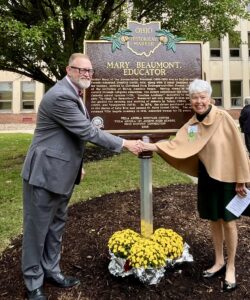
Mother Mary of the Annunciation Beaumont (1818-1881) was an English-born, French educated Ursuline Sister, she arrived in Cleveland from Boulogne-sur-Mer, France, in 1850, accompanied by three other Ursulines and a lay teacher. Invited to Ohio by Bishop Amadeus Rappe, the Ursulines vowed to improve society through religious education. That same year, Beaumont established the city’s first Catholic school (grades 1-12), “Ursuline Academy,” and dedicated it to teaching girls “to think for themselves.” Beaumont not only taught at area parishes, she ably guided the opening and staffing of schools in Toledo (1854), Tiffin (1863), and Youngstown (1874). In 1874, the Ursulines purchased property on the Shores of Lake Erie and opened St. Mary’s School (1878). The school, re-named Villa Angela Academy in 1941, educated women for 112 years.