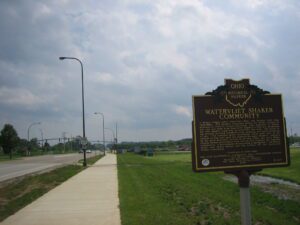
A Shaker village called Watervliet, Ohio, was located here from 1806-1900. The Shakers, originally called the United Society of Believers in Christ’s Second Appearing, were followers of Mother Ann Lee who came from Manchester, England in 1774 and established the first Shaker community in Watervliet, New York. The tenets of the religion included communal living, celibacy, and public confession of sins. The frenzied dance movements, which were part of the worship of their sect, gave the members the name “Shakers.” Attracted by the great Kentucky revivals in the late 1700s and early 1800s, Eastern Shaker missionaries came west to find converts and establish communities. A discontented Presbyterian congregation in the Beaver Creek area called Beulah was the nucleus for the Watervliet Shaker community. (continued on other side)
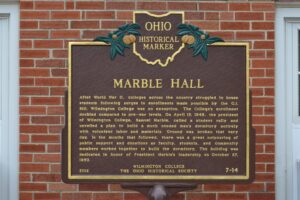
After World War II, colleges across the country struggled to house students following surges in enrollments made possible by the G.I. Bill. Wilmington College was no exception. The College’s enrollment doubled compared to pre-war levels. On April 13, 1948, the president of Wilmington College, Samuel Marble, called a student rally and unveiled a plan to build a much needed men’s dormitory entirely with volunteer labor and materials. Ground was broken that very day. In the months that followed, there was a great outpouring of public support and donations as faculty, students, and community members worked together to build the dormitory. The building was dedicated in honor of President Marble’s leadership on October 27, 1950.
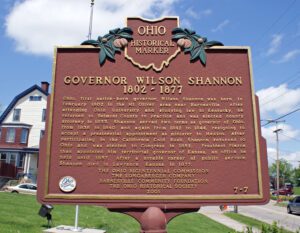
Ohio, first native-born governor, Wilson Shannon was born in February 1802 in the Mt. Olivet area near Barnesville. After attending Ohio University and studying law in Kentucky, he returned to Belmont County to practice and was elected county attorney in 1833. Shannon served two terms as governor of Ohio, from 1838 to 1840 and again from 1842 to 1844, resigning to accept a presidential appointment as minister to Mexico. After participating in the California Gold Rush, Shannon returned to Ohio and was elected to Congress in 1852. President Pierce then appointed him territorial governor of Kansas, an office he held until 1857. After a notable career of public service, Shannon died in Lawrence, Kansas, in 1877.
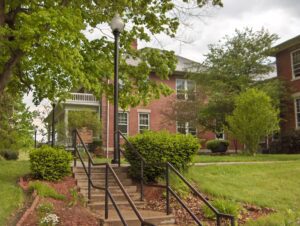
In the first quarter of the nineteenth century, when the general public believed that the insane and paupers could be rehabilitated into productive citizens, the Ohio Legislature gave authorization to county commissioners to establish county “poor houses.” The Athens County Home, formerly known as the Athens County Infirmary, opened on this site in 1857 to provide care for indigent citizens of Athens County. When fire destroyed the original building in 1903, a new building was constructed from 1904-1905, designed with the capacity to house up to one hundred people. When it was built, it was considered to be one of the finest and most modern charitable institutions of its time. The facility continued to provide housing for indigent and elderly residents until 1997 when the County Commissioners closed the home and it became a primary location for the delivery of social services in Athens County. (continued on the other side)
The Hopewell Associate Reformed Church and Cemetery, now known as Historic Hopewell, was founded in 1808 in a log building that was replaced in 1826 with the present building. It was built by the area’s first settlers, mainly Scotch-Irish who left Kentucky and South Carolina because of their opposition to slavery. The church encouraged worship by African Americans and played an important role in the Underground Railroad. It became the parent church for four “Daughter” Presbyterian congregations: Fairhaven in 1835, Oxford in 1837, College Corner in 1849, and Morning Sun in 1876. Reverend Alexander Porter, the first pastor, was committed to education and constructed a school near the Hopewell Spring that still produces clear water. “Old Hopewell” was completely refurbished in 1880, but by 1915 the membership declined and regular services discontinued. Today Hopewell holds Sunday services in the summer and is maintained by a generous and devoted group of volunteers.
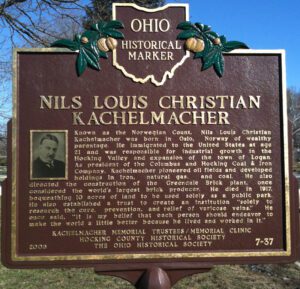
Known as the Norwegian Count, Nils Louis Christian Kachelmacher was born in Oslo, Norway of wealthy parentage. He immigrated to the United States at age 21 and was responsible for industrial growth in the Hocking Valley and expansion of the town of Logan. As president of the Columbus and Hocking Coal & Iron Company, Kachelmacher pioneered oil fields and developed holdings in iron, natural gas, and coal. He also directed the construction of the Greendale Brick plant, once considered the world’s largest brick producer. He died in 1917, bequeathing 10 acres of land to be used solely as a public park. He also established a trust to create an institution “solely to research the cure, prevention, and relief of varicose veins.” He once said, “It is my belief that each person should endeavor to make the world a little better because he lived and worked in it.”
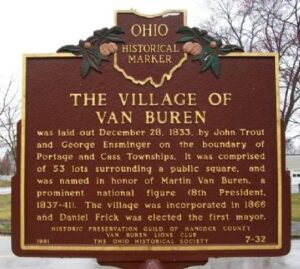
The Village of Van Buren was laid out December 28, 1833, by John Trout and George Ensminger on the boundary of Portage and Cass Townships. It was comprised of 53 lots surrounding a public square, and was named in honor of Martin Van Buren, a prominent national figure (8th President, 1837-41). The village was incorporated in 1866 and Daniel Frick was elected the first mayor.
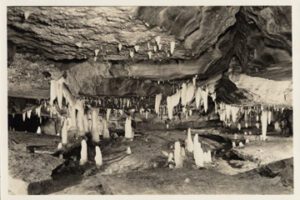
In 1897, a farm boy investigating the disappearance of water into a sinkhole in a nearby field discovered this system of subterranean passageways. Digging down a few feet, he found an opening to a cave that had begun forming perhaps several thousand years earlier during the Ice Age in soluble limestone bedrock that was approximately 400 million years old. Ground water dripping down from the cavern’s ceiling continues to form stalactites, stalagmites, and mineral coatings on the cavern’s walls, floor, and ceiling. A portion of Ohio Caverns near the discovery site was opened to the public in 1897, but that section closed in 1925 when a more extensive and geologically interesting part of the cave was discovered. Ohio Caverns is the largest known cave system in the state and is widely considered to be the most beautiful of all Ohio caves.