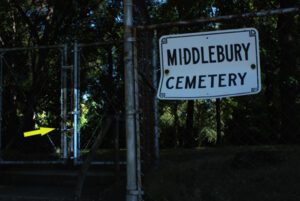
This burying ground was the first public cemetery located within Akron’s boundaries. It was also known as the “Old Cemetery” and the “Newton Street Cemetery.” Deacon Titus Chapman donated this land in 1808 as a burying ground, and he was probably the first person interred here when he died later that year. Early Akron settlers and their descendents, including veterans of the American Revolution, are buried here. Some of the gravestones were among the finest brought to the Western Reserve from Connecticut. The Middlebury Cemetery was used until 1853.
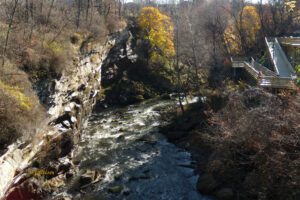
In 1879, local hardware store owners L.W. Loomis and H.E. Parks established a summer resort at Front Street and Prospect Avenue. The High Bridge Glens and Caves park spanned both sides of the Cuyahoga River and featured a dance and dining pavilion, scenic trails and overlooks, cascades and waterfalls, deep caverns, curious geological formations, and a suspension footbridge. The park also offered several manmade attractions, including what is believed to have been one of the earliest roller coasters in the area. At the height of its popularity, the park attracted more than 8,000 visitors a day, including Congressman (later president of the United States) William McKinley. (continued on other side)
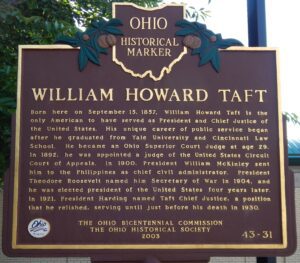
Born here on September 15, 1857, William Howard Taft is the only American to have served as President and Chief Justice of the United States. His unique career of public service began after he graduated from Yale University and Cincinnati Law School. He became an Ohio Superior Court Judge at age 29. In 1892, he was appointed a judge of the United States Circuit Court of Appeals. In 1900, President William McKinley sent him to the Philippines as chief civil administrator. President Theodore Roosevelt named him Secretary of War in 1904, and he was elected president of the United States four years later. In 1921, President Harding named Taft Chief Justice, a position that he relished, serving until just before his death in 1930.
Poland Township Historical Society, 4515 Center Road
Lowellville
, OH
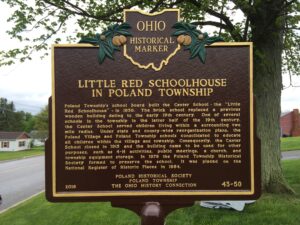
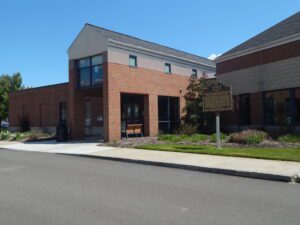
Poland Township’s school board built the Center School- the “Little Red Schoolhouse”- in 1858. The brick school replaced a previous wooden building dating to the early 19th century. One of several schools in the township in the latter half of the 19th century, the Center School served children living within a surrounding two mile radius. Under state and county-wide reorganization plans, the Poland Village and Poland Township schools consolidated to educate all children within the village and township. Consequently, the Center School closed in 1915 and the building came to be used for other purposes, such as 4-H activities, public meetings, a church, and township equipment storage. In 1979 the Poland Township Historical Society formed to preserve the school. It was placed on the National Register of Historic Places in 1984.
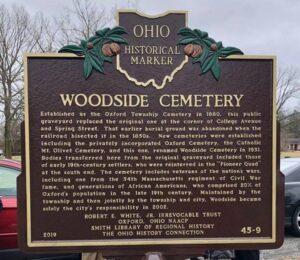
Established as the Oxford Township Cemetery in 1880, this public graveyard replaced the original one at the corner of College Avenue and Spring Street. That earlier burial ground was abandoned when the railroad bisected it in the 1850s. New cemeteries were established including the privately incorporated Oxford Cemetery, the Catholic Mt. Olivet Cemetery, and this one, renamed Woodside Cemetery in 1931. Bodies transferred here from the original graveyard included those of early 19th-century settlers, who were reinterred in the “Pioneer Quad” at the south end. The cemetery includes veterans of the nation’s wars, including one from the 54th Massachusetts regiment of Civil War fame, and generations of African Americans, who comprised 20% of Oxford’s population in the late 19th century. Maintained by the township and then jointly by the township and city, Woodside became solely the city’s responsibility in 2002.
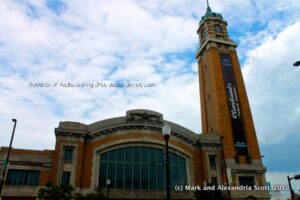
Since opening in 1912, the West Side Market, Cleveland’s oldest continuously operating, municipally-owned market, has been an anchor to the historic Ohio City neighborhood. Built to replace the Pearl Street Market and the Central Market. All three served Cleveland’s growing population in the early 20th century, but only the West Side Market remains. Designed by architects W. Dominick Benes and Benjamin Hubbell, the 30,000 square foot space has a dramatic vaulted Guastavino tile ceiling and a signature clock tower that is 137 feet high. The Seth Thomas clock Company manufactured the clock. (Continued on other side)
John Richards Buchtel was born in Green Township, Ohio. A successful businessman and philanthropist, Buchtel was a leading spirit in the Akron Library Association. He donated to establish the Akron Public Library and served as the First Chairman of the Board. He also donated $31,000 in 1870 to found Buchtel College, which became The University of Akron in 1913, where he often paid the tuition of underprivileged students. He served as the college’s President of the Board of Trustees and served for the board of A & M University, which is now The Ohio State University.
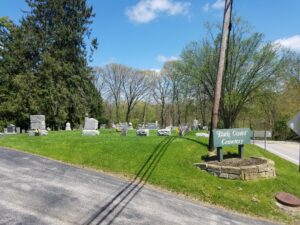
Settlers from New England purchased this land in 1817 for use as a burying ground and to build a meeting house. Located in the center of Bath Township, a part of the Connecticut Western Reserve, the site provided a convenient place for public and religious gatherings and for a cemetery. Out of need, the cemetery was established before the township was founded in 1818. Many of Bath Township’s farming families, as well as both owners and operators of businesses of Bath, are interred in the cemetery. In a tradition originating with Civil War veteran Perry Alexander, the graves of all veterans are marked with an American flag on Memorial Day as a tribute to their service.