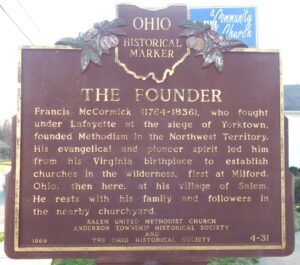
Francis McCormick (1764-1836), who fought under Lafayette at the siege of Yorktown, founded Methodism in the Northwest Territory. His evangelical and pioneer spirit led him from his Virginia birthplace to establish churches in the wilderness, first at Milford, Ohio, then here, at his village of Salem. He rests with his family and followers in the nearby churchyard.
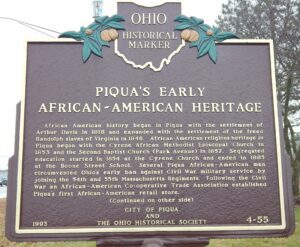
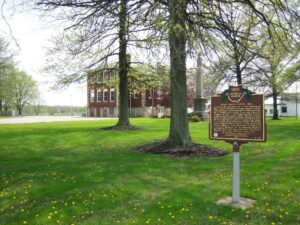
African-American history began in Piqua with the settlement of Arthur Davis in 1818 and expanded with the settlement of the freed Randolph slaves of Virginia in 1846. African-American religious heritage in Piqua began with the Cyrene African Methodist Episcopal Church in 1853 and the Second Baptist Church (Park Avenue) in 1857. Segregated education started in 1854 at the Cyrene Church and ended in 1885 at the Boone Street School. Several Piqua African-American men circumvented Ohio’s early ban against Civil War military service by joining the 54th and 55th Massachusetts Regiments. Following the Civil War an African-American Co-operative Trade Association established Piqua’s first African-American retail store. Continued on/from other side)
Myron T. Herrick, Governor of Ohio from 1904 to 1906, was born in Huntington Township in 1854 and lived here until age 12. A respected Cleveland attorney and businessman, Herrick was a friend and confidant to Senator Mark Hanna and Presidents McKinley, Taft, and Harding. His public service career culminated in two appointments as ambassador to France, from 1912 through the outbreak of World War I in 1914, and again from 1921 until his death in 1929. Enormously popular with the French people, Herrick escorted Charles Lindbergh in Paris after his historic 1927 transatlantic flight.
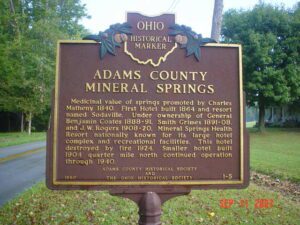
Medicinal value of springs promoted by Charles Matheny, 1840. First hotel built 1864 and resort named Sodaville. Under ownership of General Benjamin Coates 1888-91, Smith Grimes 1891-08, and J. W. Rogers 1908-20. Mineral Springs Health Resort Nationally known for its large hotel complex and recreational facilities. This hotel destroyed by fire, 1924. Smaller hotel built 1904, quarter mile north, continued operation through 1940.
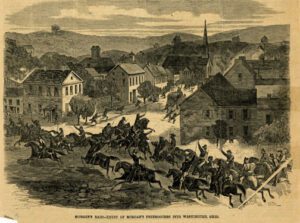
General John Hunt Morgan of Kentucky led a force of Confederate calvarymen into Meigs County during a forty-six day raid north of the Ohio River. The advance forces burned Benjamin Knight’s carding mill and sawmill, the Shade River Bridge, and pillaged local businesses in Chester on July 18, 1863, while waiting for the rest of the column to catch up. This two-hour halt delayed General Morgan’s arrival at the ford at Buffington Island until after dark, allowing Union troops to arrive before he could make his escape. General Morgan surrendered eight days later near West Point in Columbiana County, the northernmost point ever reached by Confederate forces during the Civil War.
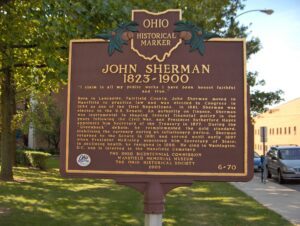
Born in Lancaster, Fairfield County, John Sherman moved to Mansfield to practice law and was elected to Congress in 1854 as one of the first Republicans. In 1861, Sherman was elected to the U.S. Senate. An authority on finance, Sherman was instrumental in shaping federal financial policy in the years following the Civil War, and President Rutherford Hayes appointed him Secretary of the Treasury in 1877. During the “Greenback” debate, he re-implemented the gold standard, stabilizing the currency during an inflationary period. Sherman returned to the Senate in 1881 and served until early 1897 when President McKinley appointed him Secretary of State; in declining health, he resigned in 1898. He died in Washington, D.C. and is interred in the Mansfield Cemetery.
Betsey Mix Cowles dedicated her life to fighting slavery and improving the status of women. Her desire for a formal education led her to Oberlin College, where she completed two years of study in 1840. An advocate of immediate abolition, Cowles lectured on the moral depravity of slavery, opened her home, at this site, to fugitive slaves. Opposed to expansion of slavery into the West, Cowles protested the Mexican War. Cowles served as president of Ohio’s first women’s rights convention (in Salem) in 1850, and the following year wrote a treatise on equal pay for working urban women. She served as the first dean of women at Grand River Institute, and later became one of the first women public school superintendents in Ohio.
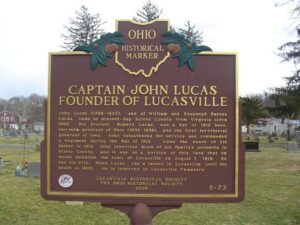
Lucasville Cemetery was originally established as the Lucas Family burying ground, with Susannah Lucas as the first recorded burial on May 4, 1809. Susannah’s husband, Captain William Lucas, a Revolutionary War veteran, is interred here along with the first wife of Governor Robert Lucas, Eliza “Betsy” Brown Lucas. By 1816, the cemetery was used as a public burying ground. Hand carved monuments inscribed with poetry can be found in the old section. Recognized as one of the oldest cemeteries in southern Ohio, Lucasville Cemetery has interred veterans of the Revolutionary War, War of 1812, Civil War, Spanish-American War, World Wars I and II, Korea, and Vietnam.