

, OH
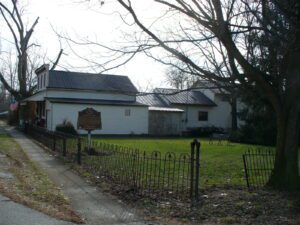
The foundation for the first Welsh settlement in Ohio was laid on June 29, 1801, when William and Morgan Gwilym purchased land in what is now Morgan Township at the Cincinnati Land Office. The Welsh, who settled in Pennsylvania beginning in the late eighteenth century, moved westward and settled here in 1802. This area was also the major terminus for the 1818 migration from Montgomeryshire and Cardiganshire in Wales. In 1803 a Congregational Church was organized and services were held in members’ homes or outdoors. A brick Meetinghouse, complete with a Welsh death door leading to the cemetery, was constructed in 1824. The building now serves as the Community House. The present brick church was built in 1854. For many years, the library, formed in 1852, was housed in the New London Special School District building that stood on this site. (Continued on other side)
, OH
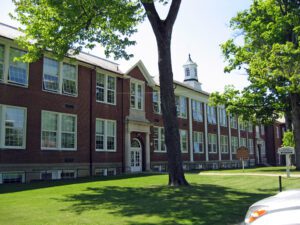
Poland Academy, an elite private school, was established on this site in 1830 and in 1859 graduated its most notable student William McKinley, who became the 25th president of the United States. In 1862, the school changed its name to Poland Seminary and was one of the first schools in northeast Ohio to admit girls on an equal basis. Ida Tarbell, who became a prominent national journalist and author was Preceptress of the Seminary from 1880-1882. William Calhoun graduated from the Seminary and became the U.S. Ambassador to China from 1910-1913. The school became a public institution in 1909 when it became the Poland Seminary High School. In 1972 it was the site of Poland Junior High School and Poland Middle School in 1985.
, OH
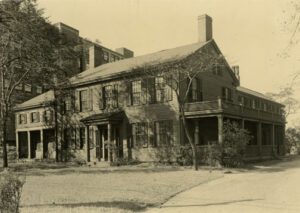
Dunham Tavern is the oldest building still standing on its original site in the City of Cleveland. Once a stagecoach stop on the old Buffalo-Cleveland-Detroit road (modern Euclid Avenue), the tavern dates from 1824. The structure was built by Rufus and Jane Pratt Dunham, who journeyed to the Western Reserve from Mansfield, Massachusetts. The Dunhams sold the tavern in 1853. However, it continued to serve the public until 1857, when it was converted to a private residence. It remained a home until the nineteen thirties, when commercial development threatened the former tavern’s existence. The historic structure was dedicated in 1936 as a museum depicting the life of an early Cleveland pioneer family. Dunham Tavern is listed in the National Register of Historic Places and is a designated Cleveland Landmark building.
, OH
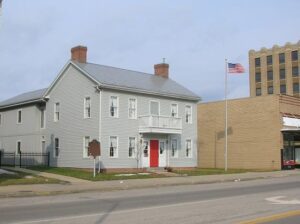
One of seven native Ohioans to serve as president of the United States, William McKinley (1843-1901) was born at this site. The original house was moved from this site and ultimately destroyed by fire. The McKinleys lived here until 1852 when they moved to Poland, Ohio, where William attended the Poland Seminary. He briefly attended Allegheny College in Pennsylvania, but poor health and family financial strain forced him to return to Ohio. As an enlistee in the 23rd Ohio Volunteer Infantry during the Civil War, McKinley rose to the rank of major. After the war, he settled in Canton and practiced law. Elected to Congress in 1876, McKinley favored high protective tariffs, a policy he continued to support as President.(Continued on other side)
, OH
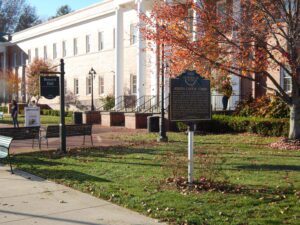
Joseph Carter Corbin’s work in the Reconstruction-era south after the Civil War created many educational opportunities for African Americans. Corbin (1833-1911) was a professor, administrator, journalist, linguist, and musician. Born in Chillicothe, Ohio to free African American parents, he earned his bachelor’s degree and two masters’ degrees from Ohio University, in 1853, 1856, and 1889, respectively. In 1872, Corbin and his wife Mary moved to Arkansas where he served as the state superintendent of public education. In 1875, Corbin was appointed principal of Branch Normal College, which became the University of Arkansas at Pine Bluff. In 1898, he co-founded and became president of the Arkansas Teachers Association. He was also a leader in the Prince Hall Masons, an African American Masonic order. He served as a secretary and Grand Master of the lodge’s Arkansas chapter.
, OH
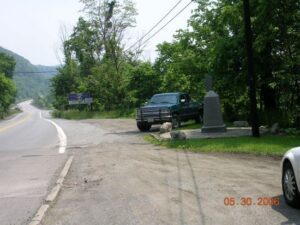
In April 1784, the Continental Congress adopted the Report of Government for the Western Territory, a broad plan drafted primarily by Thomas Jefferson for organizing the United States’ new western lands that were ceded by the states and purchased from Native Americans. One of the most far-reaching legislative acts in American history, the resulting Land Ordinance of 1785, passed on May 20th, established the public land system by which all federal land was surveyed and distributed. The Ordinance established a rectilinear survey system that divided land into townships of six miles square aligned by north-south and east-west baselines, and set aside certain lands for Revolutionary War veterans and for public schools.
, OH
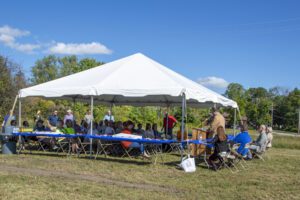
Near this location on May 15, 1823, the first murder trial in Geauga County concluded with the public execution of Benjamin Wright, Jr. On February 1, 1823, Wright stabbed Zophar Warner over a financial dispute, wounding him mortally. The following month, a jury found Wright guilty of murder and ordered that “he be hung by the neck until he be dead.” At the time, executions in Ohio were carried out locally and public hangings were seen by some as social events. The “hanging bee” drew more than 4,000 people, some of whom traveled from upwards of 50 miles to witness the spectacle. One witness wrote, “I felt that he deserved to be hung…but it was an awful site I hope to never the like see again.” Wright’s body was taken to nearby LeRoy for burial and the gallows was dismantled.
, OH
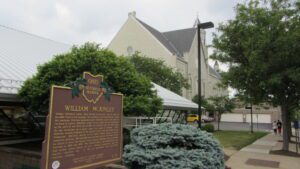
William McKinley’s house, once located at this site, was the scene of his 1896 front porch campaign for President of the United States. During the campaign McKinley addressed about 750,000 people who came to his home in Canton. McKinley’s public service began when he volunteered at the start of the Civil War in 1861 as a private with the Union Army. He was discharged as a major after four years of service. Later McKinley became President of the Canton Y.M.C.A. and the Stark County Prosecutor. McKinley served in the United States House of Representatives between 1877 and 1891 and was then elected Governor of Ohio. He helped to found the Canton Public Library. McKinley won presidential elections in 1896 and 1900. His administration was characterized by high tariffs, money backed by gold, national prosperity, and the Spanish-American War. In 1901 an anarchist shot and killed President McKinley.