

, OH
George Bellows (1882-1925) is widely recognized as one of America’s premier artists. His vivid portrayals of modern urban life have become indelible icons of American art. Born and reared in Columbus, he retained close ties here throughout his life. Bellows gained fame while a young artist in New York, becoming a key figure among a group of artists nicknamed the “Ashcan School” because of their preference for commonplace subjects painted in dark colors. Bellows also excelled at printmaking, and it was largely through his efforts that lithography came to be accepted as a fine art in America. Bellow’s career was unexpectedly cut short by his death from complications following an appendectomy at the age of forty-two.
, OH
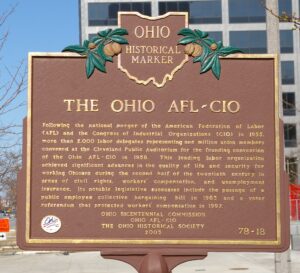
Following the national merger of the American Federation of Labor (AFL) and the Congress of Industrial Organizations (CIO) in 1955, more than 2,000 labor delegates representing one million union members convened at the Cleveland Public Auditorium for the founding convention of the Ohio AFL-CIO in 1958. This leading labor organization achieved significant advances in the quality of life and security for working Ohioans during the second half of the twentieth century in areas of civil rights, workers’ compensation, and unemployment insurance. Its notable legislative successes include the passage of a public employee collective bargaining bill in 1983 and a voter referendum that protected worker’s compensation in 1997.
, OH
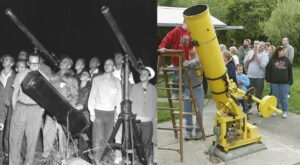
On October 4, 1957 the Soviet Union surprised the world with the launching of Sputnik 1, the world’s first artificial satellite. The Cincinnati Astronomical Society’s Moonwatch Team, organized in 1956 as part of its participation in the International Geophysical Year, was immediately activated by the Smithsonian Astrophysical Observatory (S.A.O.). First observations of satellites were made December 15, 1957. On these grounds, from 1957 to 1964, the Cincinnati Moonwatch Team, principally under the leadership of Tom Van Flandern (1940-2009), spent thousands of man-hours optically observing and recording data to verify the positions of satellites in space. Many times the team compiled the best satellite tracking records in the world. Because of this work The Moonwatch Team and the Cincinnati Astronomical Society were recognized by the S.A.O. as one of its leading teams worldwide.
, OH
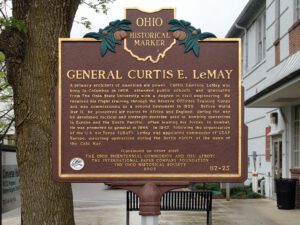
A primary architect of American air power, Curtis Emerson LeMay was born in Columbus in 1906, attended public schools, and graduated from The Ohio State University with a degree in civil engineering. He received his flight training through the Reserve Officers Training Corps and was commissioned as a second lieutenant in 1929. Before World War II, he pioneered air routes to Africa and England; during the war he developed tactical and strategic doctrine used in bombing operations in Europe and the South Pacific, often leading his forces in combat. He was promoted to general in 1944. In 1947, following the organization of the U.S.Air Force (USAF), LeMay was appointed commander of USAF Europe, directing operations during the Berlin Airlift at the dawn of the Cold War. (continued on other side)
, OH
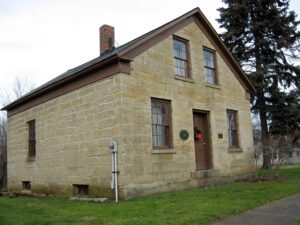
This rare sandstone house was built for Austin (c. 1788-1848) and Roxanna (Sears) Lilly (c. 1793-1868). They came to Dover Township (now Westlake) in 1832 from Ashfield, Massachusetts, an area from which many Dover settlers originated. This lot had been owned by Ozias and Hiram Smith. The Lillys erected this house in about 1844 and lived here until 1867. It is made with sandstone blocks two feet thick, finely tooled and dressed in the front and less elaborately on the sides and rear. The basement is constructed with massive rectangular stone blocks. Thick hewn timbers support the massive roof structure. A brick wing was attached to the east side in about 1850. After 1867, the lot and house had several owners, including George Weston, James Beardsley, and August Trudel. Eventually, Alice (Mrs. Dezso) Ladanyi, the great granddaughter of George Weston, deeded the house to the city of Westlake for use as a museum.
, OH
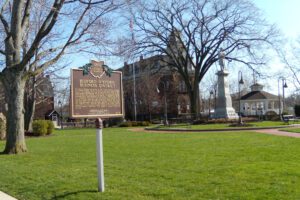
The town of Bedford was settled in 1837. Early residents, Hezekiah and Clarissa Dunham donated the land that serves as Bedford Public Square. The Dunhams built one of the area’s first homes in 1832, which stands at 729 Broadway with the letters H & D above the doorway. Early settlers were attracted to the area by the abundance of natural resources and a large waterfall for mill sites. Bedford also served as a stagecoach stop on the route from Cleveland to Pittsburgh. The road or Turnpike Road as it was called was originally part of the Mahoning Indian Trail. By 1895 the road was renamed Main Street (and later Broadway) when the Akron, Bedford, and Cleveland Railway Company (ABC) traversed the middle of the street carrying passengers. The interurban is called “America’s first high speed long distance electric interurban” with speeds in excess of 60 miles per hour. [continued on other side]
, OH
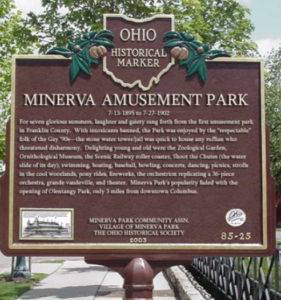
For seven glorious summers, from July 13, 1895 to July 27, 1902, laughter and gaiety rang forth from the first amusement park in Franklin County. With intoxicants banned, the Park was enjoyed by the “respectable” folk of the Gay ’90s – the stone water tower/jail was quick to house any ruffian who threatened disharmony. Delighting young and old were the Zoological Garden, Ornithological Museum, the Scenic Railway roller coaster, Shoot the Chutes (the water slide of its day), swimming, boating, baseball, bowling, concerts, dancing, picnics, strolls in the cool woodlands, pony rides, fireworks, the orchestrion replicating a 36-piece orchestra, grande vaudeville, and theater. Minerva Park’s popularity faded with the opening of Olentangy Park, only 3 miles from downtown Columbus.
, OH
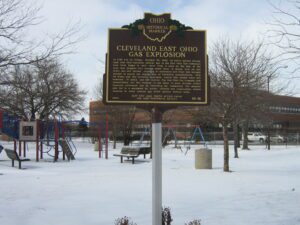
At 2:30 p.m. on Friday, October 20, 1944, an above ground storage tank that held liquefied natural gas in the East Ohio Gas Company’s tank farm began to emit vapor from a seam on the side of the tank that dropped into nearby sewer lines. It mixed with air and sewer gas and ignited, resulting in explosions and fires that brought damage to nearly one square mile of Cleveland neighborhoods. With 79 homes and two factories destroyed, nearly 700 people were left homeless, 131 killed, and 225 injured. The East Ohio Gas Company took responsibility for this tragedy to aid those in need through direct financial assistance and by rebuilding the community. The disaster also led to a movement by public utilities and communities across America to store natural gas below ground without tanks.