

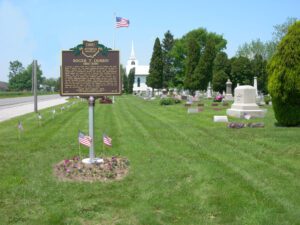
, OH
According to fellow World War II veteran and U.S. Senator Bob Dole, Roger T. Durbin was “the public persona—the beacon—of the drive to build a National World War II Memorial in our nation’s capital.” It started with a conversation between Mr. Durbin and Congresswoman Marcy Kaptur at a local fish fry in February 1987. Enlisting Kaptur’s support, the work to create the memorial began. Described as a “gentleman with a square jaw, twinkling eyes, and churlish grin,” Mr. Durbin committed himself to serving others. He was a rural letter carrier, Richfield Township trustee, and coached Little League baseball. He was a veteran of the Tenth Armored (Tiger) Division and saw action at the Battle of the Bulge. The National WWII Memorial was dedicated May 29, 2004. Although Mr. Durbin did not live to see that day, his determination is the reason it stands.
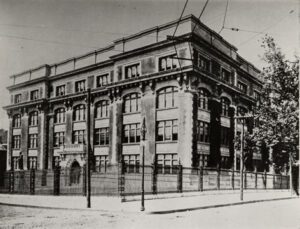
, OH
William and Abigail Cutter Woodward founded Woodward High School, the first public high school west of the Allegheny Mountains, on this site October 24, 1831. Concerned that the poor of Cincinnati had no avenues for education, the Woodwards donated land, time, funding, and expertise to this venture that brought the arts and sciences to “those who have not the means of procuring such advantages themselves.” Notables include Dr. Joseph Ray, principal, 1851-1855, author of several popular mathematics texts; Professor William McGuffey, author of the well-known readers and spellers; and William Howard Taft, Class of 1874, former U.S. President. From 1856-1863, the home of Levi and Catherine Coffin was also located on this site. Both were legendary abolitionishts who helped enslaved people escape to freedom in Canada. Levi is often referred to as the “President of the Underground Railroad.”
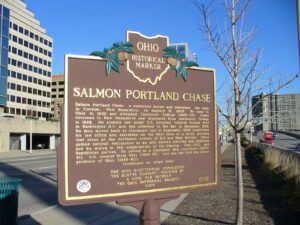
, OH
Salmon Portland Chase, a renowned lawyer and statesman, was born in Cornish, New Hampshire, on January 13, 1808. He came to Ohio in 1820 and attended Cincinnati College (1822-23). Chase returned to New Hampshire and graduated from Dartmouth College in 1826. He studied law under U.S. Attorney General William Wirt in Washington D.C. and was admitted to the bar in December 1829. He then moved back to Cincinnati and in September 1830 established his law office and residence on the first floor of a brick building that stood at the northeast corner of 3rd and Main Streets. Chase gained national recognition as an anti-slavery attorney and politician and by aiding in the organization of the Liberty, Free-Soil, and Republican parties. He served as a Cincinnati city councilman (1840-41), U.S. senator from Ohio (1849-55), and was the first Republican governor of Ohio (1856-60). (continued on other side)
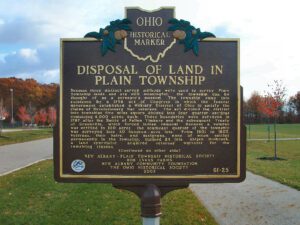
, OH
Because three distinct survey methods were used to survey Plain Township lands and are still meaningful, the township can be thought of as a surveyor’s museum. The township came into existence by a 1796 act of Congress in which the federal government established a Military District of Ohio to satisfy the claims of Revolutionary War veterans. The act divided the district into townships five miles square divided into four quarter-sections containing 4,000 acres each. These boundaries were surveyed in 1797 after the Battle of Fallen Timbers and the subsequent Treaty of Greenville, which forced Indian removal. Because a veteran was entitled to 100 acres, the southeast quarter of the township was surveyed into 40 hundred-acre lots. From 1801 to 1805, veterans, their heirs, and assignees, none of whom settled permanently in the township, claimed 24 lots. Abijah Holbrook, a land speculator, acquired veterans’ warrants for the remaining sixteen. (continued on other side)
, OH
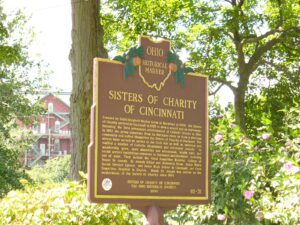
Founded by Saint Elizabeth Bayley Seton in Maryland in 1809, the Sisters of Charity arrived in Cincinnati in 1829 to open a school and an orphanage, becoming the first permanent establishment of Catholic sisters in Ohio. In 1852 the group separated from its Maryland roots to form a diocesan community and called themselves the Sisters of Charity of Cincinnati. The sisters later served as nurses in the Civil War as well as operated and staffed a number of Catholic elementary and secondary schools. As membership grew, their ministries and educational, health care, and social service institutions expanded in Cincinnati and elsewhere, including out of state. They include the Good Samaritan Hospital, College of Mount St. Joseph, St. Joseph Infant and Maternity Home, Santa Maria Social Service Agency, and Seton High School in Cincinnati and Good Samaritan Hospital in Dayton. Mount St. Joseph has served as the motherhouse of the Sisters of Charity since 1884.
, OH
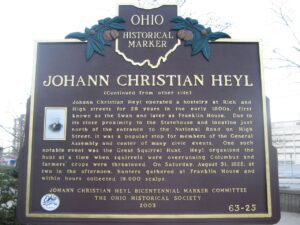
Johann Christian Heyl (1788-1877), the first German and first Lutheran to settle in Columbus, was one of the original 15 settlers of the city. A baker by trade, Heyl came to bake for the soldiers quartered in Franklinton during the War of 1812. He founded the city’s first Lutheran Church and helped financially underwrite the German Theological Seminary, which later became Capital University. An early civic leader, Heyl served on City Council for 14 years, was County Treasurer for 8 years, an associate judge in the Court of Common Pleas for 14 years, was appointed to the first public school board, and was the first Chief of the Fire Department. His Sunbury Road home was a stop on the Underground Railroad. (continued on other side)
, OH
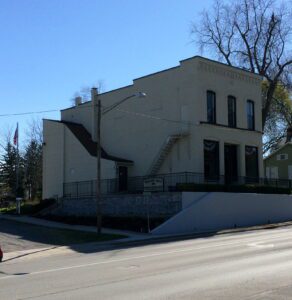
Henry Hanford Wakeman (1840-1879) of New York came to Waterville and became a successful businessman. He conceived the idea of a local Masonic Lodge, which became Wakeman Lodge No. 522 Free and Accepted Masons in 1879, and bequeathed $1,000 toward the construction of a meeting place. In 1880, a cornerstone was laid and this building was dedicated on October 21, 1881. For over 100 years, the Masons held their meetings upstairs while the lower floor was often rented out to a succession of businesses or used for public gatherings. Rising maintenance expenses and lower membership numbers caused the Masons to put Wakeman Hall up for sale in 1995. The Waterville Historical Society purchased the building in 1997 and spent several years rehabilitating it to serve as a local history archive and the Historical Society’s meeting place.
, OH
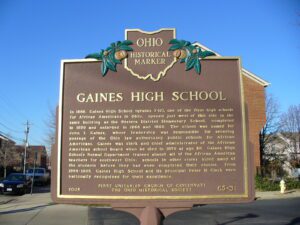
In 1866, Gaines High School (grades 7-12), one of the first high schools for African Americans in Ohio, opened just west of this site in the same building as the Western District Elementary School, completed in 1859 and enlarged in 1866 and 1868. The school was named for John I. Gaines, whose leadership was responsible for securing passage of the Ohio law authorizing public schools for African Americans. Gaines was clerk and chief administrator of the African American school board when he died in 1859 at age 38. Gaines High School’s Normal Department trained almost all of the African American teachers for southwest Ohio; schools in other states hired many of the students before they had even completed their studies. From 1866-1886, Gaines High School and its principal Peter H. Clark were nationally recognized for their excellence.