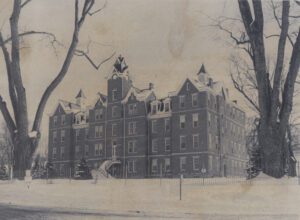
The surrounding 132 acres of land served as the Knox County Poor Farm (aka Knox County Infirmary and County Home) from 1842 to 1955. The farm was nearly self-sustaining. Able residents grew their own food, raised livestock, and did various chores as partial compensation for their care. In 1874, a fire in the original wood farmhouse resulted in one death. Public outrage and concerns for residents’ safety compelled the county commissioners to build a new “fireproof” poorhouse. The four-story brick building was constructed from 1875-1877. It is believed to be the last building designed by architect William Tinsley, utilizing a version of the Kirkbride Plan. This plan, conceived by Dr. Thomas Story Kirkbride, improved the layout of institutions and infirmaries for the well-being of their charges. (Continued on other side)
In recognition of its noteworthy representation of the history, culture, and architecture of the Western Reserve, Burton Village’s Historic District was placed on the National Register of Historic Places in 1974. The Historic District, an area of approximately 20 acres surrounding the Village Green and along streets at the north end of the Green, includes 15 buildings of historical significance built between 1815 and 1891. Preserved within the District are commercial and public buildings and private dwellings that reflect the cultural and architectural development of a village of the Western Reserve of Ohio during the 19th century. Buildings in the predominant architectural styles of the 19th century are all represented in the Historic District, including Western Reserve, Greek Revival, Second Empire, Italianate, and Queen Anne. [Continued on other side]
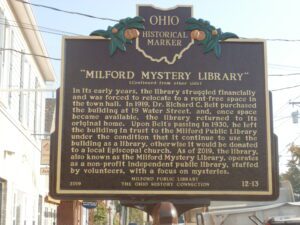
The Milford Public Library, Clermont County’s oldest continuously operating library, was founded in 1900 by a local civic organization, the Milford Village Improvement Society. It was preceded by a circulating library–one that charges patrons for renting books–that was chartered in 1822. At the time of the Milford Public Library’s founding, circulating libraries were in decline and public libraries were increasing in number as an inexpensive alternative. To obtain support for their proposed “reading room,” the Society’s Literary Committee travelled door-to-door, soliciting members and books. To become a member of the library, adults paid 25 cents and children paid 10 cents in annual dues. The library’s first–and current–home is the stone building at 19 Water Street. (Continued on other side)
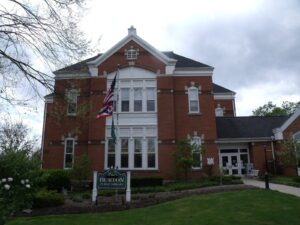
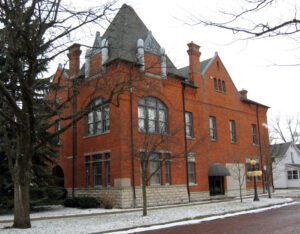
This Queen Anne style building with segmental-arched windows and steep hipped roof was Burton’s second high school. Completed in 1885 at a cost of $12,500, it is wood framed with a brick and stone exterior, modeled after an academy in River Falls, Wisconsin. Its basement and two upper floors contained 12,720 square feet of space, enough for all twelve grades. There were two separate entrances; girls entered on the left and boys on the right. Electricity was installed in 1921 by the superintendent and students. Classes met here until 1936. During its history, the building housed various organizations, including the Red Cross, Opportunity School of Geauga County (later Metzenbaum), Geauga County Historical Society, American Legion, and County Extension Office. In 1937, it became the home of the Burton Public Library and in 1983 was expanded with a north wing designed to be architecturally consistent with the original 1885 structure.
Butternut Ridge Road in front of the North Olmsted Library
North Olmsted
, OH
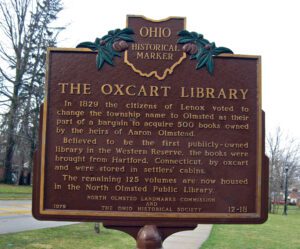
In 1829 the citizens of Lenox voted to change the township name to Olmsted as their part of a bargain to acquire 500 books owned by the heirs of Aaron Olmsted. Believed to be the first public library in the Western Reserve, the books were brought from Hartford, Connecticut, by oxcart and were stored in settlers’ cabins. The remaining 125 volumes are now housed in the North Olmsted Public Library.
Completed in 1892 at the height of the region’s oil boom, the Pemberville Town Hall followed a late-1800s municipal trend to house many civic functions under one roof. The fire station, jail, and council chambers occupied the ground level, while the entire second floor hosted a public auditorium, or “opera house,” that seated 250. The 1897 debut of The Mikado featured new electric lighting. The ornate Opera House was the center of Pemberville’s social activities for decades, hosting dances, plays, socials, graduation ceremonies, political meetings, lectures, and husking bees. Traveling companies performed concerts, vaudeville, minstrel, and medicine shows. Following World War II the Opera House fell into disuse. It was restored in 1999 to both its former grandeur and its place in Pemberville’s cultural life.
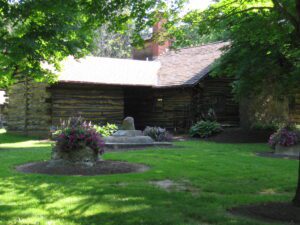
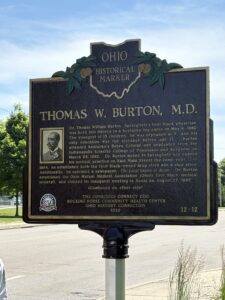
Dr. Thomas William Burton, Springfield’s first Black physician, was born into slavery in a Kentucky log cabin on May 4, 1860. The youngest of 15 children, he was orphaned at 9, and his only education was the alphabet before age 21. Burton attended Kentucky’s Berea College and graduated from the Indianapolis Eclectic College of Physicians and Surgeons on March 24, 1892. Dr. Burton moved to Springfield and opened his medical practice on East Main Street the same year. In 1894, he established both the first Black-owned drug store and a shoe store. Additionally, he operated a newspaper, The Loyal Legion of Honor. Dr. Burton established the Ohio Mutual Medical Association (Ohio’s first Black medical society), and chaired its inaugural meeting in Xenia on August 27, 1897. (Continued on other side)
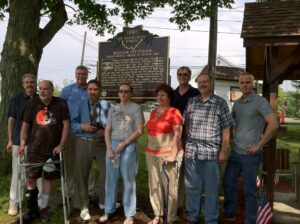
The General at Union Station in Chattanooga, Tennessee (circa 1907). Born in Knoxville in 1840 and reared at a farm in New Somerset, William Pittenger mustered into the 2nd Ohio Volunteer Infantry, under a 90-day enlistment, in 1861. He fought at the First Battle of Bull Run and was the war correspondent for the Steubenville Herald. After reenlisting, he participated in the ill-fated Andrews Raid of 1862. While attempting to disrupt enemy supply lines, the raiders stole the Confederate locomotive “The General.” After being chased north, they were captured. (Continued on other side)