

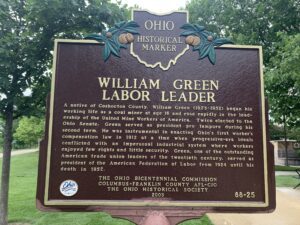
, OH
A native of Coshocton County, William Green (1870-1932) began his working life as a coal miner at age 16 and rose rapidly in the leadership of the United Mine Workers of America. Twice elected to the Ohio Senate, Green served as president pro tempore during his second term. He was instrumental in enacting Ohio’s first worker’s compensation law in 1912, at a time when progressive-era ideals conflicted with an impersonal industrial system where workers enjoyed few rights and little security. Green, one of the outstanding American trade union leaders of the twentieth century, served as president of the American Federation of Labor from 1924 until his death in 1952.
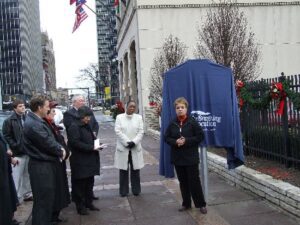
, OH
The Breathing Association was founded in 1906 as the Tuberculosis Society under the leadership of public health advocate Carrie Nelson Black. The society provided nutrition, medical care, and sanitorium services to people who could not afford proper medical care. A tuberculosis dispensary was operated at 40 South Third Street in Columbus for Ohioans needing consultation and treatment. Tuberculosis, known as the White Plague, killed one out of nine persons in Columbus during the early 1900s. An Open Air School was established on Neil Avenue in 1913 for children in homes where there were one or more cases of tuberculosis. In 1931, the Nightingale Cottage was opened on Brice Road as a tuberculosis preventorium for children. As tuberculosis became controllable, the agency became focused on emerging lung health issues. Today, The Breathing Association continues as a leading resource on lung health issues and preventing lung disease.
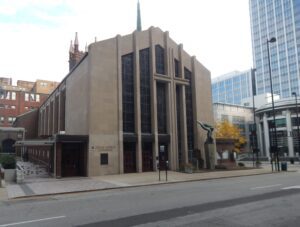
, OH
In 1817 twenty-two men, including future President William Henry Harrison, chartered Cincinnati’s first Episcopal parish, Christ Church. In 1835 members erected a Gothic Revival-style church on this site. The neighborhood evolved as the city grew with the influx of immigrants. Parish women raised funds to teach, feed, clothe, and shelter tenement families, and alleviate suffering during floods and disease outbreaks. In 1883 the women helped establish what became Cincinnati Children’s Hospital. In 1909 members opened the Late Gothic-style Parish House, a community center with kitchen, classrooms, library, auditorium, clinic, gymnasium, and bowling alley. By the parish’s centennial in 1917, music had expanded beyond worship to public concerts. In 1940 the annual Boar’s Head Festival of music and pageantry began. Since the 1960s, members have collaborated with local agencies to advocate for social and economic justice, a mission continuing into the 21st century. (Continued on other side)
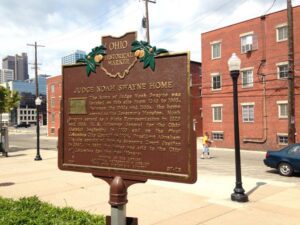
, OH
The first tax supported free public library in Columbus was formed in 1873 and housed in City Hall. In 1901, City Librarian John Pugh petitioned Andrew Carnegie for funding and was granted $200,000. In 1903, the Swayne home was razed and construction began. The library opened to the public on April 4, 1907. The library’s purpose is inscribed on the front of the building – Bibliotheca Fons Eruditionis: The library is a fountain of learning; Our Treasures Are Within; and Open To All.
, OH
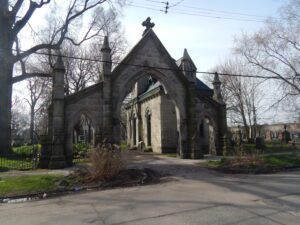
In January 1836, Barber and Lord sold a six-acre parcel for $160 that was to be used “forever as a public burying ground.” When Ohio City incorporated, the township cemetery became the city cemetery. Ohio City’s council established the cemetery’s rules and regulations, appointed a sexton, arranged for the ground to be platted, and purchased a hearse. After annexation by Cleveland, the cemetery became known as “the west side cemetery” and, later, the Monroe Street Cemetery. Under Cleveland’s charge, the cemetery was landscaped, protected by patrolmen, and fenced to keep out wandering hogs. Until the late 1890s, Monroe Street was the only public cemetery on Cleveland’s west side. Architect Joseph Ireland designed the cemetery’s Gothic Revival gateway arch (1874). Architect Walter Blythe designed the cemetery’s gatehouse, also in the Gothic Revival style (1876).
, OH
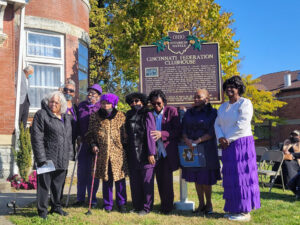
“Lifting As We Climb”: The Cincinnati Federation of Colored Women’s Clubs (CFCWC) was organized May 6, 1904, during a meeting called by Mary Fletcher Ross at the Allen Temple A.M.E. Church. Gathering together eight existing African-American women’s clubs, the CFCWC sought to unite in their work promoting “the betterment of the community.” At a time when both government and private philanthropies overlooked the needs of Black Americans, CFCWC members helped to organize the city’s first kindergartens for Black children, taught in Cincinnati African-American public schools –including the Walnut Hills Douglass and Stowe schools—and raised money for the Home of Aged Colored Women. Since 1904, the Cincinnati Federation of Colored Women’s Clubs has ensured the civic and constitutional rights of all African Americans while meeting the needs of their city.
, OH
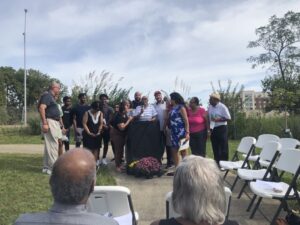
James W. Rankin served four consecutive terms (1971-1978) in the Ohio House of Representatives. Born and raised in Cincinnati, he graduated from Withrow High School and The Ohio State University’s School of Social Work. While working in Cincinnati’s Seven Hills neighborhood, he ran for office to “involve the disadvantaged in the governmental processes that affected their lives.” He won his first bid and served the next seven years as a state representative for the 69th House district, later the reapportioned 25th district. Representative Rankin fought passionately for civil and human rights in education and public policy. He served on the Reference, Human Resources, and Finance committees. When Rankin died of pneumonia, aged 52, the Cincinnati Enquirer proclaimed him a “Friend of the Poor.”
, OH
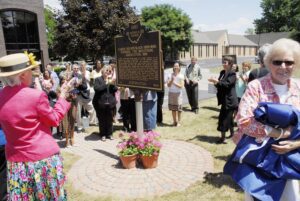
The Breathing Association was founded in 1906 as the Tuberculosis Society under the leadership of public health advocate Carrie Nelson Black. The society provided nutrition, medical care, and sanitorium services to people who could not afford proper medical care. A tuberculosis dispensary was operated at 40 South Third Street in Columbus for Ohioans needing consultation and treatment. Tuberculosis, known as the White Plague, killed one out of nine persons in Columbus during the early 1900s. An Open Air School was established on Neil Avenue in 1913 for children in homes where there were one or more cases of tuberculosis. In 1931, the Nightingale Cottage was opened on Brice Road as a tuberculosis preventorium for children. As tuberculosis became controllable, the agency became focused on emerging lung health issues. Today, The Breathing Association continues as a leading resource on lung health issues and preventing lung disease.