

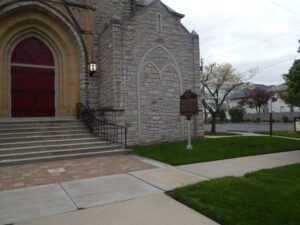
, OH
In 1886, thirty-six members from Toledo’s downtown Lutheran church, St. Paul’s, met to form a German-speaking Lutheran congregation for immigrants from Pommern, Mecklenburg and Hanover. Initially worshipping at St. Stephen’s at the corner of Harrison and Oliver Street, the congregation built a frame church on this site in 1887. That same year St. Lucas pioneered an early form of health insurance, The Mutual Sick Benefit Society, that later became a larger fraternal organization called The Mutual Sick Benefit Society for Ohio and Other States. In 1999, after joining a program called Reconciling in Christ, St. Lucas became the first Lutheran congregation in northern Ohio to publicaly welcome the LGBT communities. Named after Saint Luke, the patron saint of physicians, the church’s history is one of healing.
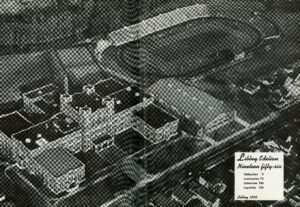
, OH
Edward Drummond Libbey High School . Edward Drummond Libbey High School – “the castle on the hill” – opened in 1923 to serve the growing number of students in Toledo Public Schools. The school offered a curriculum of manual and academic training, reflecting a progressive movement during the late 19th and early 20th centuries to democratize education. Libbey High School was named for Edward D. Libbey (1854-1925), a local businessman, civic leader, and philanthropist who founded the Libbey Glass Company and Toledo Museum of Art. Libbey’s successful business ventures earned Toledo the nickname “The Glass Capital of the World.” Much of his fortune was spent on providing cultural and educational institutions that still serve the public as of 2018. (Continued on other side)
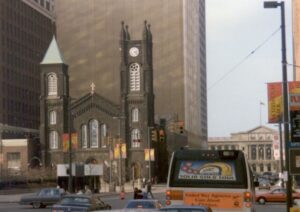
, OH
Religious worship began on this site in 1820 as a Plan of the Union Sunday School with ministers recruited by the Connecticut Home Missionary Society. Its first stone church, officially known as the First Presbyterian Church of Cleveland, was built and dedicated on February 26, 1834, but as the congregation grew, a second stone church was constructed and finished on August 12, 1855. Built of Berea Sandstone, it stands now as the oldest building on Public Square. Ravaged by fires in 1857 and 1884, the church was rebuilt according to the original plans, and the 1884 interior restored by East Coast architect, Charles W. Schweinfurth. From 1965 to 1983, the chapel served as the worship center for the Cleveland Chinese Christian Church.
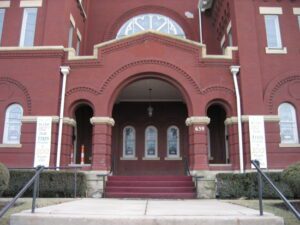
, OH
Organized in 1823 as Bethel African Methodist Episcopal Church, St. Paul A.M.E. Church is the oldest congregation of African descent in Columbus. The church, founded by Moses Freeman and 13 other members from the Town Street Church, was originally located on the east side of Lazelle Street. Several buildings were erected to meet the needs of the growing congregation. The present edifice, located at 639 E. Long Street, was completed in 1906. St. Paul has several outreach ministries, including The Prison Ministry, Alzheimer Ministry, Karen’s House, Community Development Corporation, Health Concerns Committee, St. Paul Tutorial and Enrichment Program (STEP), St. Paul Scholarship Program, St. Paul Drama Ministry, Jam’N Jefferson Park Festival, and Church Without Walls.
, OH
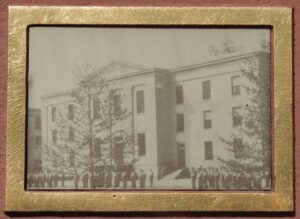
The first in a succession of schools that eventually gave College Hill its name was CARY’S ACADEMY FOR BOYS. Freeman Cary opened this school in his home on Hamilton Avenue in 1832. Success necessitated larger quarters and in 1833 PLEASANT HILL ACADEMY was built at the corner of Hamilton and Colerain (now Belmont) Avenues. Continuing growth and a distinguished faculty led to formation of a college. Money was raised by selling shares, mostly bought by local farmers. FARMERS COLLEGE OF HAMILTON COUNTY was chartered on February 23, 1846 and Cary Hall was built on this Belmont Avenue site in 1847. Future President of the United States, Benjamin Harrison, attended the college from 1848 to 1850. During the 1860s Cary Hall served as a station on the Underground Railroad. (Continued on other side)
, OH
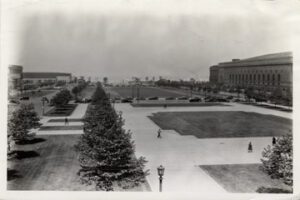
In August 1903, architects Daniel H. Burnham, John M. Carrere, and Arnold W. Brunner presented Mayor Tom L. Johnson and the City of Cleveland a plan that epitomized the City Beautiful Movement in America. The Group Plan envisioned a grand landscaped mall surrounded by public buildings in the Beaux-Arts style. The plan would create a monumental civic center, influence the design of buildings throughout the city, and lay the foundation for a city planning commission. The first of its kind in the nation, the Group Plan, as built, was the most completely realized of Burnham’s city planning efforts. In its green space and architecture, the Mall remains an enduring and vital element of Cleveland’s civic culture. (continued on other side)
, OH
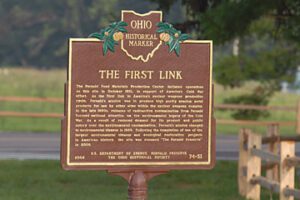
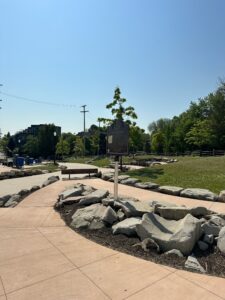
The Fernald Feed Materials Production Center initiated operations on this site in October 1951, in support of America’s Cold War effort. As the first link in America’s nuclear weapons production cycle, Fernald’s mission was to produce high purity uranium metal products for use by other sites within the nuclear weapons complex. In the late 1980s, releases of radioactive contamination from Fernald focused national attention on the environmental legacy of the Cold War. As a result of reduced demand for its product and public outcry over the environmental contamination, Fernald’s mission changed to environmental cleanup in 1989. Following the completion of one of the largest environmental cleanup and ecological restoration projects in American history, the site was renamed “The Fernald Preserve” in 2006.
, OH
Opened in July 1862, the 35 1/2-acre site here in Brooklyn Township’s University Heights served as the largest Civil War army camp of rendezvous, organization, and training in northeast Ohio. It was bordered by Hershel (now West 5th) and University (now West 7th) streets and Railway and Marquard avenues. A wartime high of 4,151 volunteers occupied the barracks here on December 5, 1862. Lieutenant William Dustin of the 19th Ohio Volunteer Artillery wrote, “It was a table land above the city and admirably suited to the use of a camp of instruction. It was as level as a floor and carpeted with grass. The capacious pine barracks held about 25 each of the battery’s men.” A total of 15,230 men trained here during the war–4.9 percent of the 310,646 enlistments in Ohio. More than 11,000 soldiers were discharged here at war’s end. It closed in August 1865. (continued on other side)