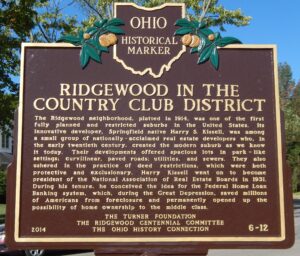
The Ridgewood neighborhood, platted in 1914, was one of the first fully planned and restricted suburbs in the United States. Its innovative developer, Springfield native Harry S. Kissell, was among a small group of nationally-acclaimed real estate developers who, in the early twentieth century, created the modern suburb as we know it today. Their developments offered spacious lots in park-like settings; curvilinear, paved roads; utilities, and sewers. They also ushered in the practice of deed restrictions, which were both protective and exclusionary. Harry Kissell went on to become president of the National Association of Real Estate Boards in 1931. During his tenure, he conceived the idea for the Federal Home Loan Banking system, which, during the Great Depression, saved millioins of Americans from foreclosure and permanently opened up the possibility of home ownership to the middle class.
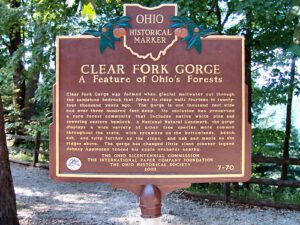
Clear Fork Gorge was formed when glacial meltwater cut through the sandstone bedrock that forms its steep walls fourteen to twenty-four thousand years ago. The gorge is one thousand feet wide and over three hundred feet deep. Its seclusion has preserved a rare forest community that includes native white pine and towering eastern hemlock. A National Natural Landmark, the gorge displays a wide variety of other tree species more common throughout the state, with sycamore on the bottomlands, beech, ash, and tulip farther up the slopes, and oak and maple on the ridges above. The gorge has changed little since pioneer legend Johnny Appleseed tended his apple orchards nearby.
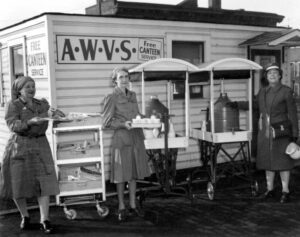
The Lima Chapter of the American Women’s Voluntary Services Organization established a community-based, free canteen during World War II for troops traveling on the Pennsylvania Railroad and adjacent Baltimore & Ohio-Nickel Plate Railroads. Meeting as many as forty trains a day, the ladies served 2.5 million troops between 1942-1945. Food, coffee, and other items were donated to the canteen from a twelve county area. The “AWVS” disbanded in 1945, but succeeding volunteers continued to provide service throughout the Korean Conflict and Viet Nam War. Lima’s “Servicemen’s Free Canteen” was the longest, continuously operated service canteen in the United States. An estimated four million soldiers, sailors, and marines were served between 1942-1970.
Born on September 28, 1769 in New Bedford, Massachusetts, Bathsheba Rouse is recognized as the first woman to teach in the Northwest Territory. Rouse arrived in the region along with other pioneers in 1788. The following year, the Belpre community employed Rouse to teach young children in the Farmers’ Castle near the Ohio River. Instruction in reading, writing, and sewing was reserved for the girls, while boys received lessons in reading, writing, and arithmetic. Rouse taught in Belpre for several terms before marrying Richard Greene and settling at nearby Marietta. Their descendants attained civic prominence in Washington County for generations. Bathsheba Rouse Greene died on February 27, 1843 at the age of seventy-three and is buried alongside her husband in Marietta’s Mound Cemetery.
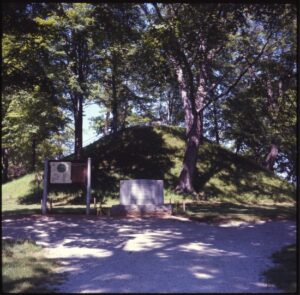
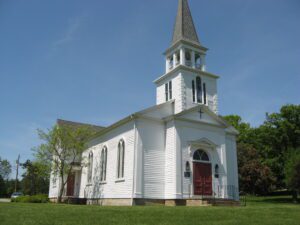
The first home of the oldest Episcopal parish in the Connecticut Western Reserve, the St. James Episcopal Church was built between 1827 and 1828. Philander Chase, first Bishop of the Diocese of Ohio, consecrated it in 1829. The belfry and steeple were added in 1881. It was moved to this site from its original Market Street location in 1972 after the parish built a new church. Renamed the St. James Meeting House, it is the anchor of a community of historic buildings that includes the Beardsley-Walter-Diehm House (circa 1828), the Oswald Detchon House (circa 1840), and the Schiller-Chuey Summer Kitchen. The oldest known structure in Boardman, the St. James Meeting House was added to the National Register of Historic Places in 1979.
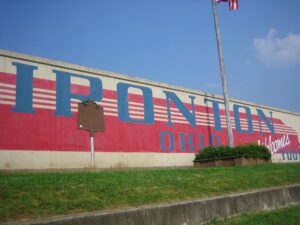
In 1849, the city of Ironton was founded by local ironmasters, railroaders, and financiers associated with the Ohio Iron and Coal Company. They saw the city as a manufacturing and shipping point for their products. As a young industrial city, Ironton prospered when river transportation facilitated the development and export of Lawrence County’s natural resources and manufactured items. The Iron Railroad Company was also established to transport pig iron and manufactured goods from nearby towns to Ironton, to awaiting steamboats on the Ohio River. Steamboats, in the form of towboats, packet boats, and showboats, traveled the river providing the city with goods, services, and entertainment. The Ironton wharf and boat landing once served the community as a gathering place to greet incoming passengers, receive mail, and hear the latest news.
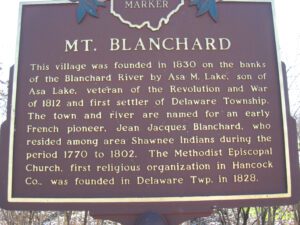
This village was founded in 1830 on the banks of the Blanchard River by Asa M. Lake, son of Asa Lake, veteran of the Revolution and War of 1812 and first settler of Delaware Township. The town and river are named for an early French pioneer, Jean Jacques Blanchard, who resided among area Shawnee Indians during the period 1770 to 1802. The Methodist Episcopal Church, first religious organization in Hancock Co., was founded in Delaware Twp. in 1828.
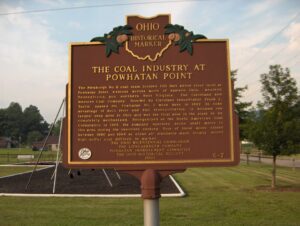
The Pittsburgh No. 8 coal seam, located 100 feet below river level at Powhatan Point, extends across much of eastern Ohio, western Pennsylvania, and northern West Virginia. The Cleveland and Western Coal Company, founded by Cleveland industrialist Frank E. Taplin, opened the Powhatan No. 1 mine here in 1922 to take advantage of both river and rail transportation. It became the largest deep mine in Ohio and was the first mine in the state to be completely mechanized. Reorganized as the North American Coal Corporation in 1925, the company operated seven shaft mines in this area during the twentieth century. Four of these mines closed between 1980 and 1984 as clean air standards made locally mined high-sulfur coal difficult to market.