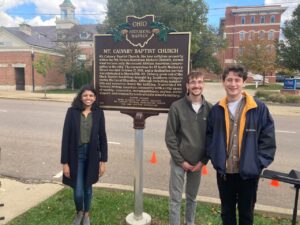
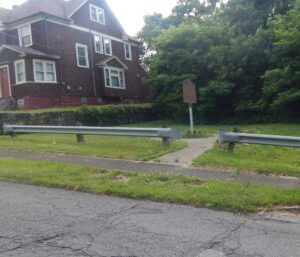
Mt. Calvary Baptist Church, the lone religious property within the Mt. Vernon Downtown Historic District, served what became only the second African American congregation in the city. The cornerstone for 13 South Mulberry Street was laid October 17, 1915, and a dedication service was celebrated in March 1916. Mt. Calvary grew out of the Black Baptist traditions brought by Southern refugees during the Great Migration. Although dwindling membership and resources closed the building, it provided Mt. Vernon’s African American community with a vital space of worship, communion, mutual assistance, asylum, social support, and community celebration for almost a century.
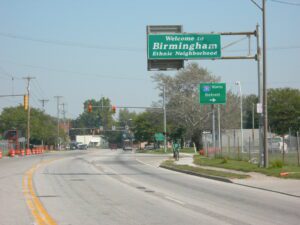
The Birmingham and Ironville neighborhoods were so named because of their early iron industries located along Front Street and the Maumee River. This became Toledo’s first area of heavy industrial development with iron manufacturing, coal shipping, oil refining, shipbuilding, and flour milling operations. In 1864 the Manhattan Iron Company built a charcoal blast furnace near the river’s mouth, securing fuel from nearby forests.
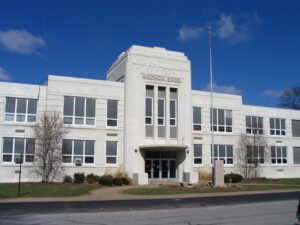
Ohio’s oldest continuing summer theatre, the Huron Playhouse has been housed at McCormick Middle School for its entire history. Dr. Frederick G. Walsh (1915-1999) of the Bowling Green State University (BGSU) Speech Department founded the theatre in 1949. Huron met Walsh’s expectations for an attractive site for the playhouse, and Huron Schools Superintendent R.L. McCormick (1904-1978) offered the use of this school. The curtain opened on the first Huron Playhouse production, Norman Krasna’s hit Broadway comedy John Loves Mary, on June 29, 1949. With persisting support from BGSU, actors and alumni, and the local community, the acclaimed Playhouse has provided theatrical experience for thousands of students and entertainment for generations of Huron residents.
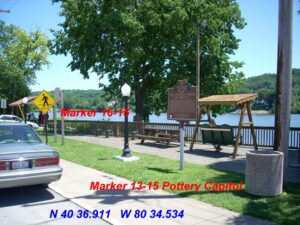
Fawcettstown, later to become East Liverpool, marked the first Ohio community to be encountered by early river travelers as they headed toward new challenges and new lives in the expanding nation. Indian canoes, flatboats, and steamboats carried increasing traffic, both passenger and freight, along these Ohio “Gateway” shores. Many of these early craft were built locally and local residents served as crewmen. Products from farms and ceramics from this city’s pioneer potteries were shipped from this site. The wharf area also served as a landing place for many of the early English potters who came here to ply their trades and, in the process, create a defining industry. The river continues to play an important role in industrial and recreational capacities.
Oscar D. Boggess (1832-1907) was born in Virginia, the son of a slave and her master. He and his family were granted freedom in the will of his father and master. The will was contested up to the United States Supreme Court, which upheld Boggess’ freedom. Boggess moved to Pennsylvania at age 20, and during the Civil War, joined the 43rd United States Colored Troops. He earned the Butler Medal of Honor for bravery at the Battle of the Crater near Petersburg, Virginia, in July 1864. Boggess moved to Youngstown after the war, and worked as a stonemason. He was a charter member of Tod Post 29, Grand Army of the Republic, in Youngstown, and a co-founder of the Oak Hill Avenue African Methodist Episcopal Church, the city’s first African American religious congregation. The Boggess home, formerly located near this site, hosted the church’s first meetings in 1870.
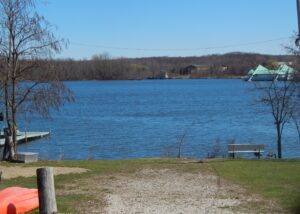
Geauga Lake, a scenic destination for visitors to northeast Ohio, was initially named “Giles Pond” after settler Sullivan Giles (1809-1880). In 1856, the predecessor of the Erie Railroad stopped at “Pond Station,” spurring the area’s growth. In the 1880s, locals established picnic grounds, a dance hall, and other facilities for those seeking a country getaway. Picnic Lake Park, later Geauga Lake Park, opened in 1887 and thereafter offered rides, a roller rink, photo gallery, billiard hall and bowling alley, among other attractions. In 1888, the Kent House hotel opened on the southeast side of the lake. In the century that followed, more attractions were added, including SeaWorld of Ohio, and the park expanded. In 2007, the melodic sounds of the carousel and the echoing screams from the “Big Dipper” roller coaster ceased when the park closed. (Continued on other side)
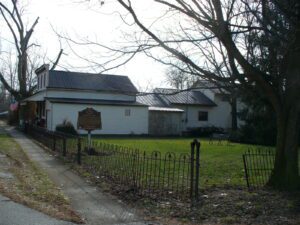
The foundation for the first Welsh settlement in Ohio was laid on June 29, 1801, when William and Morgan Gwilym purchased land in what is now Morgan Township at the Cincinnati Land Office. The Welsh, who settled in Pennsylvania beginning in the late eighteenth century, moved westward and settled here in 1802. This area was also the major terminus for the 1818 migration from Montgomeryshire and Cardiganshire in Wales. In 1803 a Congregational Church was organized and services were held in members’ homes or outdoors. A brick Meetinghouse, complete with a Welsh death door leading to the cemetery, was constructed in 1824. The building now serves as the Community House. The present brick church was built in 1854. For many years, the library, formed in 1852, was housed in the New London Special School District building that stood on this site. (Continued on other side)
The center of African-American culture in Akron during the mid-20th century, Howard Street was home to many of the city’s black-owned business and entertainment establishments, and provided an atmosphere in which minority-owned businesses could thrive. Attracted to the vitality of the neighborhood, entrepreneur George Mathews (1887-1982) established a barbershop here in 1920 and in 1925 opened the adjoining Mathews Hotel. The hotel quickly became the anchor of the Howard Street district. Mathews’ success allowed him to endow a scholarship fund at the University of Akron in 1964.