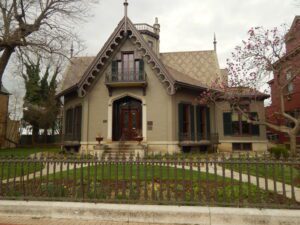
James Elrick, a local carpenter, built the Lane-Hooven House in 1863 for Clark Lane (1823-1907), a Hamilton industrialist and philanthropist. Lane, who first came to the area at age twenty-one as a blacksmith, resided in the house for more than eleven years. In 1866, Lane built the library, also originally an octagon, across the street. In 1868, he conveyed the library to the city. The C. Earl Hooven family resided in the house from 1895 to 1942. In 1943, Bertrand Kahn purchased the residence and presented it to the community for civic and charitable uses. It was donated as a memorial to his father, Lazard Kahn, a Hamilton industrialist and civic leader. The Lane-Hooven House was added to the National Register of Historic Places in 1973. (Continued on other side)
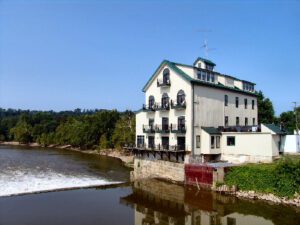
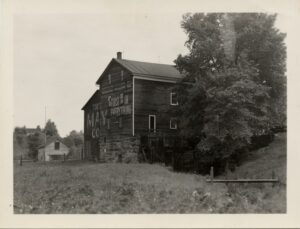
The Stockport Mill, the third on this site since 1842, was built in 1906 by the Dover brothers. Using a pair of 40-inch Leffel turbines, it harnessed water power for both milling and generating electricity for the town. Known for its Gold Bond, Seal of Ohio, and Pride of the Valley refined flours, the Stockport Milling Company shipped its products by steam packet boat and over the Ohio & Little Kanawha Railroad before the era of all-weather roads. The mill also functioned as a community hub where local farmers obtained supplies and shared news. It ceased operation as a feed mill in 1997.
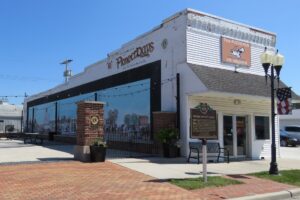
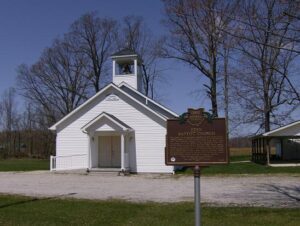
The Putnam County Pioneer Association was organized September 6, 1873, at a meeting in Kalida, Ohio. Its stated purpose was to “perpetuate the early history of our county.” Members gathered oral histories from early residents and published two volumes of Pioneer Reminiscences in 1878 and 1887. The all-day annual meeting, held every year in September, grew into a larger festival. In 1970, the Kalida Lions Club, with funds generated from the event, purchased the former Kalida Methodist Church at 201 E. Main Street and “sold” it for $10 to the Pioneer Association for use as a museum. The Pioneer Association adopted a revised constitution and changed its name to The Putnam County Historical Society in 1971. It continues to hold its annual meeting during the “Pioneer Days” weekend.
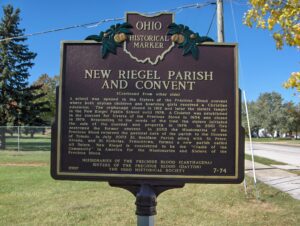
St. Boniface Catholic Church began in 1834 as a mission of several area churches and in 1836, the parish built its first church. In 1844 Bishop John Purcell commissioned Swiss born, Father Francis de Sales Brunner, a Missionary of the Precious Blood, to take pastoral charge of St. Boniface. Under the leadership of Father Brunner, the Missionaries of the Precious Blood, established in Italy in 1815, and the Sisters of the Precious Blood, founded in Switzerland in 1834, began ministry here in New Riegel (Wolfscreek) in 1844. Over two hundred acres of land were purchased for the priests, brothers, and sisters. The Missionaries brought spiritual support, farm labor, and education to the German immigrants of New Riegel. The sisters began their ministry of prayer in the convent, Mary at the Crib, on December 22, 1844. (Continued on other side)
Thirteen African American families migrated to Pebble Township in Pike County in the early 1820s from Virginia. Some of the families were former slaves while others were freeborn people of color. Their farm knowledge and skill helped to make them prosperous, angering some of their white neighbors who began a campaign of harassment. Ten of the original African American settlers eventually moved away, but despite the difficulties with the white population, other African Americans continued to arrive to the settlement. They founded a church, later known as the Eden Baptist Church, built a meeting hall, and organized a school. Several of the families were also involved in the activity of the Underground Railroad. The PP Settlement thrived until the 1950s when, for economic reasons, residents moved to other communities.
Fowlers Mill (originally Fowler’s Mills) developed around a group of mills built in the 1830s on the Chagrin River. Opportunities from these mills led to Fowlers Mill becoming the commercial center of Munson Township. From the 1830s into the twentieth century, the community expanded with construction of churches, a post office, township hall, stores, hotel, blacksmith shop, schools, and houses built in such styles as Federal, Greek Revival, Italianate, and Queen Anne. This type of community center was common in rural, nineteenth century America, but rarely survives with so much original fabric intact. On Mayfield Road, the Disciple Church was built in 1842. East of the church, the brick central school built in 1913 replaced earlier one-room schoolhouses. The gristmill is the only mill standing in Geauga County. The cemetery contains burials dating from the 1830s. The Fowler’s Mills Historic District was placed on the National Register of Historic Places in 2002.
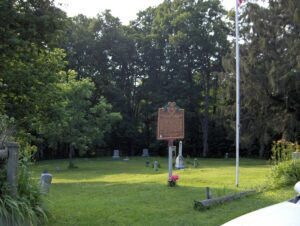
This cemetery stands as evidence of a once thriving African American farming community established in the 1820s. With the aid of community leader, Alexander “Sandy” Harper (c.1804-1889), Captina, originally called Guinea, became a stop on the Underground Railroad, a national network, shrouded in secrecy, of volunteers who directed slaves northward. Harper is buried in this cemetery, along with Benjamin Oliver McMichael (1865-1941), an educator who taught for twelve years in Captina/ Flatrock at a segregated schoolhouse. There are 113 known burials in the cemetery, including nine Civil War veterans. At this site in 1825, an African Methodist Episcopal Church was established to serve the community. Many of its members left Captina to work in cities, but the church continued services until 1962. The building then fell into disrepair and collapsed during a windstorm in 1978.
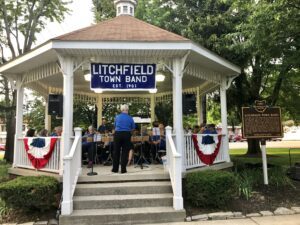
Around 1900, the newly formed Litchfield Cemetery and Park Association needed a band to lead processions to and from the town cemetery on Memorial Day. The Litchfield Town Band was born. Urial Crow served as its first director, so the group was sometimes known as “The Crow Band”. Although there were periods when the band was inactive, it has been a community institution for more than a century. The group plays a broad repertoire of standards and marches by John Philip Sousa at Memorial Day and other commemorations, ice cream socials, and various community events. Directors have included Urial Crow, Loren Hayes (c. 1915), Floyd Koons (mid-1920s), Raymond Bradley (1935-1939), Hal Leach (1939-1945), Kenneth Bradley (1946-2011) and Cynthia Bennett (since 2012).